Results 97 to 113 of 113
«« « 12345 » »»
-
Table. Walnut wood. 17th century. Table with a plain rectangular top and two drawers at the front, decorated with simple geometric shapes on their fronts, leaving a strip with tabs between them. The legs, joined at their lower rectangular joint by means of a plain stretcher, show an elaborate turned carving in discs, following the usual in the Baroque.
· Size: 64x97x74 cms.
ANTIQUES
Ref.: Z6778
-
Cornucopia. Gilded wood. 18th century. A rectangular cornucopia with a carved and gilded wooden frame decorated with a series of plain moldings and an elaborate finial at the top (arranged symmetrically, it features architectural and vegetal elements, volutes, etc.). While the plain moldings are a classic detail common in Neoclassicism, the lines, curves, and movement of the crest are characteristic of Rococo. The combination of both styles in the 18th century is common in Spanish furniture as well as in other schools. It requires restoration.
· Size: 33.5x4x57.5 LUZ 27x19 cms.
ANTIQUES
FURNITURE
Ref.: Z0311
-
Friar's chair. Walnut wood, textile. Spain, 17th century. A high-backed armchair of the type known as a "frailero" (friar's chair), featuring fabric upholstery with studs on the seat and back, low-profile stretchers connecting the front and rear legs, and smooth stretchers or side rails joining the two front and two rear legs, and simple armrests (curved, ending in scrolls). Originally of Italian origin, the frailero armchair became one of the most common pieces of Spanish furniture after its introduction in the 16th century, being characteristic of that century and the 17th, and experiencing a revival in the historicist movement of the 19th century. Because it was such a deeply rooted tradition in Spain, this type of chair continued to be produced throughout the years.
· Size: 74x67x128 cms.
ANTIQUES
FURNITURE
Ref.: Z0665
-
Friar's chair. Walnut wood, textile, metal. Spain, 16th century. It has defects. A high-backed armchair of the type known as a "frailero" (friar's chair), upholstered in fabric with studs on the seat and back, low-profile stretchers connecting the front and rear legs, and medium stretchers or side rails (the front ones featuring carved geometric motifs) connecting the two front and two rear legs, and simple armrests (curved, ending in scrolls; the front ones with grooves). Originally of Italian origin, the frailero chair became one of the most common pieces of Spanish furniture after its introduction in the 16th century, being characteristic of that century and the 17th, and experiencing a revival in the historicist movement of the 19th century. Because it was such a deeply rooted tradition in Spain, this type of chair was never discontinued.
· Size: 62,5x55x126 cms.
ANTIQUES
FURNITURE
Ref.: Z0667
-
Freestanding fitting room mirror in carved mahogany wood, 19th century. The rectangular mirror frame is decorated with scrolls and carved plant and floral motifs in the classical tradition, and rests on two curved legs with lines reminiscent of the characteristic movement of the Baroque and Rococo periods. This blend of styles was common in 19th-century furniture, as forms from past traditions were often chosen for contemporary creations.
· Size: 88x76x160 cms.
ANTIQUES
Ref.: Z2515
-
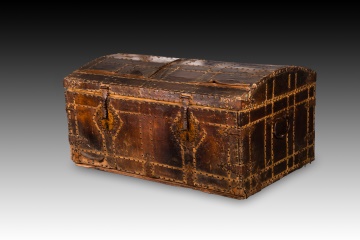
Chest. Wood, leather, iron. Spanish School, circa 1700. A rectangular wooden chest with a curved lid, covered in leather on the exterior, with fittings, handles, tacks, and two front closures. It has a front and top opening. Inside, there is a lower compartment accessible from the front, divided in two by a vertical wooden panel. The lid and part of the chest are lined with fabric. The back is not leathered. The round-headed nails are arranged in geometric patterns. The handles are decorated with discs. The fittings, also ornate, follow designs based on architectural motifs, which are also present on the lock shields on the front. Some of the metal elements still show traces of gilding. These types of trunks were known as "travel trunks" because they were typically used to store belongings on journeys, hence the leather covering and the apparent lack of decoration on the exterior. The two locks provided added security, as both keys had to be combined to open the trunk, and these keys were usually entrusted to two different people. Compare this to the 17th-century travel trunk from the Viceroyalty of Peru in the Museum of the Americas (Madrid), which features animal and plant motifs (embossed leather). Or compare it to the 17th-century chest of the Mayorazgo de la Cerda estate in the National Museum of Decorative Arts (Madrid).
· Size: 85x129x65 cms.
ANTIQUES
FURNITURE
Ref.: ZF1245
-
Desk. Rosewood. Possibly Northern Europe, mid-20th century. This wooden desk or writing table has four legs, a structure with two drawers, and a top with a raised edge at the back that extends along the sides to prevent items from falling. Stylistically, it resembles German and Scandinavian models from the mid-20th century or the 1960s and 70s.
· Size: 140x80x75 cms.
ANTIQUES
FURNITURE
Ref.: ZF0323
-
Drop-leaf table with turned legs. Walnut wood. Spanish school, 18th century. A round, folding table with two leaves that can be folded down, supported by two legs joined together on each side by lower stretchers. When folded, the table reveals a drawer with a wooden knob on each side and two legs on each side, joined in a rectangular shape by stretchers. The legs and vertical elements of the piece feature turned baluster-like elements and discs, a common feature in Spanish craftsmanship since the Baroque period.
· Size: 107x 37x76 cms / Abierta 107x103x76 cms.
ANTIQUES
FURNITURE
Ref.: ZF1173
-
Friar's chair. Walnut wood, leather. Spain, 16th century. A high-backed armchair of the type known as a "frailero" (friar's chair), featuring studded leather on the seat and upper back, very low stretchers connecting the front and rear legs, and medium stretchers or side rails (the front one carved with a relief of floral motifs flanking an empty heraldic shield in a roundel) connecting the two front and two rear legs, and simple armrests with fluted fronts reflecting architectural influences. Originally of Italian origin, the frailero armchair became one of the most common pieces of Spanish furniture after its introduction in the 16th century, characteristic of that century and the 17th, and experiencing a revival in the historicist movement of the 19th century. Because it was such a deeply rooted tradition in Spain, this type of chair continued to be produced throughout the centuries. It requires restoration.
· Size: 65,5x53x109 cms.
ANTIQUES
FURNITURE
Ref.: Z0706
-
Nightstand. Wood (mahogany and rosewood veneer), marble, bronze. 19th century. It has faults. Side table with four legs finished with metal fittings, a waist decorated with strips of lighter wood than the rest, highlighted with strips of gilded metal, and a circular top of light-colored stone with a cresting around the edge. It has two drawers with handles and two removable upholstered shelves. Stylistically, it is reminiscent of 19th-century French school models.
· Size: 65,5x65,5x75 cns,
ANTIQUES
FURNITURE
Ref.: ZF1467
-
Friar's chair. Wood, leather. Spain, 16th and 18th centuries. A high-backed armchair of the type known as a "frailero" (friar's chair), featuring studded leather on the seat and upper back, low-profile stretchers connecting the front and rear legs, and medium stretchers or side rails (the front one carved with an architectural relief) joining the two front and two rear legs, and simple armrests. In this particular case, it should be noted that the stretcher, based on its relief, dates from the 18th century. The frailero chair, originally of Italian origin, became one of the most common pieces of Spanish furniture after its introduction in the 16th century, being characteristic of that century and the 17th, and experiencing a revival in the historicist movement of the 19th century. Because it was such a deeply rooted tradition in Spain, this type of chair continued to be produced throughout the centuries.
· Size: 57,5x54x113 cms.
ANTIQUES
FURNITURE
Ref.: Z0672
-
Friar's chair. Leather, walnut wood. Spain, 16th century. A high-backed armchair of the type known as a "frailero" (friar's chair), featuring studded leather on the seat and upper back, low-profile stretchers connecting the front and rear legs, and medium stretchers or side rails (the front one carved and cut to create geometric patterns) joining the two front and two rear legs, and simple armrests with scroll finials. Originally of Italian origin, the frailero armchair became one of the most common pieces of Spanish furniture after its introduction in the 16th century, characteristic of that century and the 17th, and experiencing a revival in the historicist movement of the 19th century. Because it was such a deeply rooted tradition in Spain, this type of chair continued to be produced throughout the centuries.
· Size: 61x54x111 cms.
ANTIQUES
FURNITURE
Ref.: Z0673
-
Bench. Walnut wood. 18th century. A rectangular bench with a smooth molding around the edge and turned legs shaped like balusters, secured at the bottom by brackets with a cut-out profile. It displays classical influences, present alongside traditional elements of older Spanish furniture (format, construction, etc.).
· Size: 52x34,5x50 cms.
ANTIQUES
FURNITURE
Ref.: ZE331
-
Niche. Carved and polychromed wood. Possibly Spanish school, 18th century. A niche for a table, crafted from carved, polychrome, and gilded wood, features a front door with a key lock and gilded wooden elements, as well as a finial at the top. Two side openings allow a view of the interior. Vegetal motifs adorn the corners of these openings. Stylistically, subtle Rococo influences are evident alongside a strong Baroque tradition.
· Size: 55,5x38x74 cms, int: 42x30x65 cms.
ANTIQUES
FURNITURE
Ref.: ZF1363
-
Friar's chair. Leather, walnut wood. Spain, 16th century. It has faults. A high-backed armchair of the type known as a "frailero" (friar's chair), featuring studded leather on the upper part of the back (not present on the seat), low-profile stretchers connecting the front and rear legs, and medium stretchers or side rails (the front one carved and cut to create geometric patterns) joining the two front and two rear legs, and simple armrests with raised scroll finials. Originally of Italian origin, the frailero armchair became one of the most common pieces of Spanish furniture after its introduction in the 16th century, being characteristic of that century and the 17th, and experiencing a revival in the historicist movement of the 19th century. Because it was such a deeply rooted tradition in Spain, this type of chair continued to be produced throughout the centuries.
· Size: 68x53x102 cms.
ANTIQUES
FURNITURE
Ref.: Z0750
-
Miniature table. Wood, silver. Portugal, first half of the 20th century. It has faults. Miniature Portuguese-style table made of carved and turned wood that has legs with discs secured with chambranles in the lower area, waist with simulated drawers enhanced with silver applications in their color (without contrast marks) and a top table with wavy edges that rises thanks to hinges, giving way to an interior space that could have been intended to be used as a jewelry box (it has damaged upholstery).
· Size: 22,5x22,5x4 cms.
ANTIQUES
FURNITURE
Ref.: ZF1487
-
Miniature table. Wood, silver. Pinto & Carvalho, Portugal, first half of the 20th century. It has defects. Mark on the inside of the lid. Miniature Portuguese-style table made of carved and turned wood that has legs with discs secured with chambranles in the lower area, waist with simulated drawers enhanced with silver applications in their color (without contrast marks) and a top table with wavy edges that opens thanks to hinges, giving way to an interior space that could have been intended to be used as a jewelry box.
· Size: 25x16x14,5 cms.
ANTIQUES
FURNITURE
Ref.: ZF1488