-
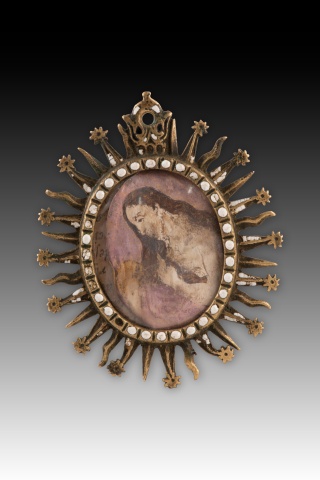
Devotional pendant. Bronze, enamel, glass, etc. Spanish school, 17th century. It has faults. A devotional pendant or confraternity insignia consisting of a frame with a ring at the top, a band with white enamel ovals, and a crest of alternating wavy and straight triangular rays topped with stars; and two sides. The front features a painted image (possibly Mary Magdalene in Penitence). The back has an openwork plaque with figurative enamel decoration (a monstrance with the Blessed Sacrament, a cross inside, and rays of light emanating outwards, flanked by two angels, all surrounded by further decorative elements). This devotional pendant (which sometimes functioned as a reliquary, allowing small items to be stored between the openwork plaque on the back and the image on the front) is considered by experts to be part of a group of medallions (oval, triangular, octagonal, etc.) made in Spanish workshops (Salamanca, Toledo, overseas, etc.) primarily between 1620 and 1640, but with a long-standing presence in Spanish tradition. Generally, the iconography they display shows a strong influence from the pronouncements of the Council of Trent.
· Size: 6,5x0.5x8 cms
ANTIQUES
MISCELLANEUS;JEWELRY
Ref.: ZF1558
-
Spouted jug-type cruet. Gilt bronze. Spanish school, 17th century. It has faults. Small jug made of gilt bronze, with a circular base, a body engraved with vegetal and architectural elements, a spout on one side, and a ribbed handle in the shape of a "C". Its characteristics are similar to those of silverwork from the Madrid school of the last third of the 17th century, although, being a highly prized and common type in Spain at the time, it is worth noting that these small jugs were also made in South America and Italy. Weight: 250 grams.
· Size: 7x11x10 cms.
ANTIQUES
MISCELLANEUS;OTHER OBJECTS
Ref.: ZF1563
-
Photograph and signature. Vaslav Niyinsky (kyiv, 1890-London, 1950), 1914. Vaslav Niyinsky (transliterated Vaslav Fomich Nizhinski) was a Polish-born Russian ballet dancer and choreographer considered one of the most gifted in history, particularly due to his encounter with Sergei Diaghilev, a member of the St. Petersburg elite and an important patron of the arts, who promoted Russian visual and musical art abroad, especially in Paris. During World War I, Nijinsky was placed under house arrest in Hungary because he was a Russian citizen. Diaghilev managed to get Nijinsky out of the country thanks to the intervention of King Alfonso XIII and his Office for Prisoners of War. The signature appears accompanied by a photograph of the type used as calling cards at the time (cabinet photograph), and is dated 1914.
· Size: 58x6,5x49 cms. int: 40,5x31 cms.
ANTIQUES
MISCELLANEUS;GRAPHIC WORK
Ref.: ZF1340B
-
Francisco de Goya y Lucientes (Fuendetodos, 1746 - Bordeaux, 1828) 'Bullfighting' National Library. Special facsimile edition produced to commemorate the establishment of the 'Spanish Bullfighting Museum, SA'. Directed and annotated by Antonio de Horna. Madrid, May 1970.
· Size: 45x32 cms
DECORATIVE ANTIQUES
Ref.: Z3879
-
Special Offer! - Off
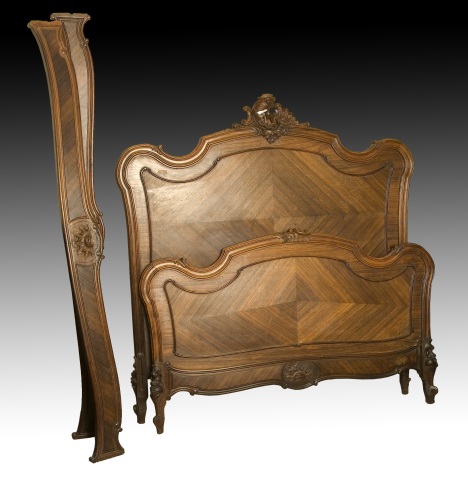
Louis XV style bed in rosewood, early 20th century. The headboard and footboard feature rocaille decoration at the top, along with curved lines, carved legs, and frieze decoration on the fronts. The side rails also display curved lines, as well as a carved rocaille element common to the rest of the bed. All these decorative elements belong to the Louis XVI style, used in 18th-century France, which corresponds to the Rococo period., detectedSourceLanguage: es
· Size: 146x190x155 cms. (Para colchon 130x190 cms.)
DECORATIVE ANTIQUES
Ref.: Z0384
-
"Architect's desk" table in mahogany wood, France, 19th century. The table, supported by four Solomon's legs with a central joint, features two drawers in the lower section, side shelves, and a sloping top. Inside, a large open space lies beneath nine compartments. This particular type of desk is characterized by its sloping top, designed to facilitate drafting, hence its name. The interior space is shaped this way to store various rulers and tools of different sizes typical of the profession. It requires restoration.
· Size: 100x60x105 cms.
DECORATIVE ANTIQUES
Ref.: Z0430
-
Desk. Carved wood. 19th century. A table with a straight rectangular top, raised on four vase-shaped legs with moldings, featuring two drawers on one side. The mixture of elements that can be linked to Neoclassicism (simplicity, moldings) and others that seem more Baroque from the 17th century (movement in the lines of the legs) is common in 19th-century furniture, which often drew inspiration from earlier styles.
· Size: 180x80x78 cms.
DECORATIVE ANTIQUES
Ref.: Z0435
-
Desk. Carved tropical wood, wood, mirror, metal, glass. 19th century. A tall, carved wooden cabinet with nine drawers at the front (with metal handles) and a lockable compartment above the top containing the writing surface; the upper section features two glass-fronted shelves flanking a rectangular mirror with architectural finials of classical influence. The absence of bronze fittings, the classical influence, and the clean lines are reminiscent of provincial pieces, distinct from, yet influenced by, the major architectural movements.
· Size: 135x56x120 cms.
DECORATIVE ANTIQUES
Ref.: Z0571
-
Cupboard. Carved and polychrome wood, metal. 20th century. Carved wooden cupboard with two lattice doors at the top (inside are two shelves creating three spaces) and two doors at the bottom (giving access to a space with a shelf), with a polychrome finish in shades of green, yellow, etc. Both the lines of the piece and its finish are reminiscent of works from the old Spanish school.
· Size: 106x42x206 cms.
DECORATIVE ANTIQUES
Ref.: Z0599
-
Pair of wrought iron hairpins. 17th century. A pair of wrought iron brackets of the type known as "fork brackets" due to their shape. These pieces were used in furniture to secure tables, both dining tables and those of writing desks or cabinets, making them a very common wrought iron item. The spirals and balustraded sections date both to the Baroque period.
· Size: 93x30 cms.
ANTIQUES
MISCELLANEUS;OTHER OBJECTS
Ref.: Z5447
-
Window frame. Carved stone. 20th century. A window frame carved from natural stone, decorated with scrolls and bands with knots reminiscent of ancient Celtic art, as well as a checkerboard pattern that can be linked to examples of Spanish Romanesque architecture, among other styles, and scrolls of classical influence. This type of piece was traditionally crafted to enhance openings in prominent residences.
· Size: 108x114 cms. int 51x100 cms.
DECORATIVE ANTIQUES
Ref.: Z5657
-
Pair of fireplace andirons. Iron. 19th century. A pair of iron fireplace andirons, each consisting of a horizontal piece to be placed under the firewood and a decorative front section (comprising a rectangular plate ending in two opposing volutes and a vertical piece resembling a column, topped with a flat disc). While elements such as the volutes appear in Romanesque ironwork, the lines of the andirons are more reminiscent of Neoclassical examples in some details.
· Size: 32x80x70 cms.
DECORATIVE ANTIQUES
Ref.: Z5802
-
Lamp. Bronze. 19th century. This lamp features a circular vase decorated with a series of classical moldings at the bottom and an oval shape from which a ring hangs. Another molding at the top joins three winged angel heads. From the back of these heads emerge three chains of polygonal links connected by a piece decorated with palms and scrolls, which terminates in a ring for hanging from the ceiling. Sometimes known as votive lamps due to their frequent presence in churches, these lamps were often considered noteworthy. Compare, for example, with the one in San Antonio de la Florida (Madrid) by Domingo Urquiza, dated 1799.
· Size: 48x48x95 cms.
DECORATIVE ANTIQUES
FURNITURE
Ref.: ZE324
-
Wall mirror. Modeled alabaster. 20th century, following Renaissance models. The rectangular mirror with a semicircular curve at the top is highlighted, following the same design principles, with a frame finished in marble dust. The chosen decorative elements are inspired by Renaissance works: volutes, metopes, scallop shells, pilasters, straight lines, etc.
· Size: 92x8x160 cms
DECORATIVE ANTIQUES
FURNITURE
Ref.: ZE416
-
Desk. Rosewood. Possibly Northern Europe, mid-20th century. This wooden desk or writing table has four legs, a structure with two drawers, and a top with a raised edge at the back that extends along the sides to prevent items from falling. Stylistically, it resembles German and Scandinavian models from the mid-20th century or the 1960s and 70s.
· Size: 140x80x75 cms.
ANTIQUES
FURNITURE
Ref.: ZF0323
-
Desk and chair set. Walnut wood. Circa 1900. It requires restoration. This furniture set comprises a desk with an armchair and high back, four armless high-back chairs, and a footstool, all crafted from carved walnut. The desk, featuring five drawers on one side, displays a series of carvings with plant and architectural motifs reminiscent of the Neo-Renaissance style. This same influence is evident in the carvings of the armchair, which also features animal protomes on the arms and studded leather upholstery. The chairs in this set, likewise, reflect the same style, with upholstery on the back and seat adorned with gilt studs. The footstool has a somewhat simpler decoration.
· Size: Mesa 135x74x83 cms. Sill¾n 63x48x147 cms silla 45x45x147 cms. Piecero 42x38x22 cms.
DECORATIVE ANTIQUES
FURNITURE
Ref.: ZF0650
-
Drop-leaf table with turned legs. Walnut wood. Spanish school, 18th century. A round, folding table with two leaves that can be folded down, supported by two legs joined together on each side by lower stretchers. When folded, the table reveals a drawer with a wooden knob on each side and two legs on each side, joined in a rectangular shape by stretchers. The legs and vertical elements of the piece feature turned baluster-like elements and discs, a common feature in Spanish craftsmanship since the Baroque period.
· Size: 107x 37x76 cms / Abierta 107x103x76 cms.
ANTIQUES
FURNITURE
Ref.: ZF1173
-
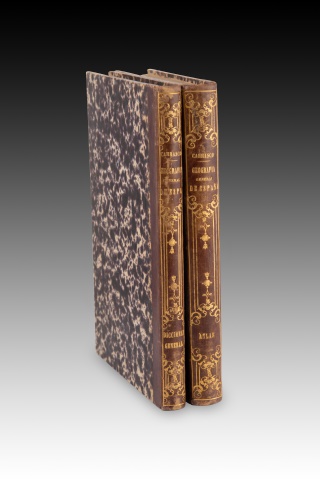
Two volumes: Geographical Atlas of Spain (…) and General Dictionary of all the peoples. Publishers Gaspar and Roig. Spain, Madrid, 1864 and 1862. Two similarly framed volumes, with leather spines and gilt details. A reference to each work (lower section) and the name Carrasco (upper section) are clearly visible. One of the volumes is the Geographical Atlas of Spain. Adjacent Islands and Spanish Overseas Possessions. It is indicated that it belongs to the “Collection of maps engraved on steel made by Don Martín Ferreiro”, and that it was published in Madrid by the Printing and Bookstore of Gaspar y Roig (the publishers), in 1864. It presents a series of maps, engraved on steel (see the touches of color), made by Martín Ferreiro y Peralta (1830-1896) and engraved by R. Alabern (indicated below the images). The other volume is the General Geography of Spain. General Dictionary of all the peoples, belonging to the so-called Illustrated Library of Gaspar y Roig. Published in Madrid, by the Printing and Bookstore of Gaspar y Roig (publishers), in 1862.
· Size: 18x5x27 cms.
ANTIQUES
MISCELLANEUS;OTHER OBJECTS
Ref.: ZF1298
-
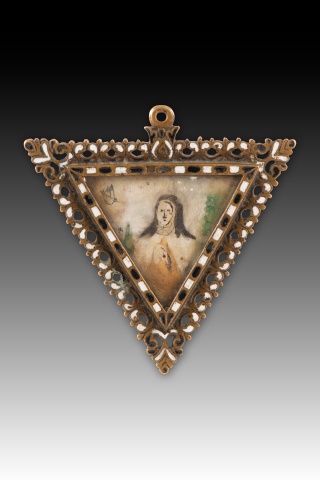
Devotional pendant, Saint Teresa of Ávila. Bronze, enamel, etc. Spanish School, 17th century. It has faults. A devotional medallion commonly known as a "steadfastness" or "steadfastness in the Faith" medal, or a "confraternity badge" due to its shape. It consists of a triangular frame with a ring for hanging and simple enameled elements (juxtaposed "C" shapes, bands, and vegetal motifs), and two fronts, leaving a small space in the center of each that was sometimes used to hold relics. On one side, the typical reverse of this type of piece is visible: the IHS with the second letter surmounted by a Latin cross and three nails, all surrounded by vegetal motifs and enameled in various colors. The front displays a painting of Saint Teresa of Ávila or of Jesus (founder of the Discalced Carmelite Order—a branch of the Order of Our Lady of Mount Carmel—canonized in 1622), based on the portrait painted by Friar Juan de la Miseria in 1576. This type of devotional medallion appears frequently in Barcelona apprenticeship examinations dated around 1620-1630, but examples have also been found in Toledo, Córdoba, Seville, and other cities, as well as in overseas productions. Experts generally mention a series of confraternity plaques or medallions (oval, rectangular, octagonal, or triangular) produced in Spanish workshops primarily between 1620 and 1640. Their iconography is generally heavily influenced by the teachings of the Council of Trent.
· Size: 8x0.5x8 cms
ANTIQUES
MISCELLANEUS;JEWELRY
Ref.: ZF1557
-
Bronze sculpture “Cupid”. Inspired by models by Auguste Louis Mathurin Moreau (1834-1917). Marble base. Lost-wax casting. The figure of the child is identified by its wings and the bow it displays. Cupid appears semi-nude, with his quiver at his feet and a tree stump behind him. The work is based on models created by a member of the renowned Moureau family. Mathurin first exhibited at the Paris Salon of 1848, and in 1897 he received a Medal of Honor. His work, rooted in that esteemed family style, exhibits a number of distinctive characteristics that are still present in this sculpture.
· Size: 28x28x66 cms
DECORATION
Ref.: V2524A
-
Louis XV style wooden desk with a rectangular tabletop featuring an elegant checkered pattern, a drawer, and cabriole legs with gilt bronze accents.
· Size: 75x45x75cm.
DECORATION
Ref.: D176
-
Bronze lamp with antique finish; four tulip-shaped shades and a ceiling light. From the piece that conceals the ceiling connection hang three cords, descending towards the body of the lamp, also made of bronze and decorated with plant motifs. From this area emerge four stems that terminate in white glass shades, the same material used for the circular shade that hangs from the bottom.
· Size: 70x70x95 cms.
DECORATION
Ref.: E508
-
Ceiling lamp. Antique-finish bronze and glass. A bulbous ceiling light fixture with flowers engraved in translucent glass is decorated with a striking garland featuring scrolls, plant motifs, and medallions with bows. From this garland extend three arms with architectural forms, terminating in interlacing patterns, which connect the lamp to the ceiling. Inspired by classic French designs.
· Size: 36x36x85 cms.
DECORATION
Ref.: E511
-
Iron base with antique finish for table. Rectangular base for low table made of iron with an antique finish that features flat openwork legs decorated with scrolls and plant elements of Neoclassical influence, similar to European examples of the 19th century, joined together by means of a simple chambranle and an upper frame, also reinforced in the central area.
· Size: 120x75x42cms.
DECORATION
Ref.: AMT35