-
Hand or table brazier. Bronze. Spanish school, 17th century. A small brazier for use on a desk or dais, with circular legs, a polygonal shape, curved lines, and vase-like finials, reminiscent of Renaissance-era designs in some details. It includes a flat, twisted-handle spoon (called a "badila" in the case of braziers). These were often called hand braziers, referring to their use for warming scribes' hands in cold weather, but they were also used to heat wax for sealing wax, for example. This type is common in the Spanish school of the 17th century (and later), characterized by its composition of horizontal polygonal pieces separated by balustraded or column-like elements. Weight: 1200 grams.
· Size: 24x24x12 cms.
ANTIQUES
MISCELLANEUS;OTHER OBJECTS
Ref.: ZF1520
-
Pair of candlesticks convertible into candelabras. Bronze. Spanish school, 17th century. A pair of candlesticks with triangular bases supported by scrolled legs and decorated with disc-shaped shafts, following models common in the 17th-century Spanish school. They include two pieces (each with two lights) that can be attached to each candlestick to create a three-light candelabrum, with curved arms decorated with vegetal and zoomorphic elements, reminiscent of medieval and Renaissance models.
· Size: 25x13x26 cms.
ANTIQUES
MISCELLANEUS;OTHER OBJECTS
Ref.: ZF1539
-
Chrism. Silver in its natural color. 16th century. Non-original lid. Silver chrismatory in its natural color, with a circular base decorated with an engraved composition of vegetal elements and a flat, circular body with two S-shaped handles adorned with vegetal motifs and a small neck at the top covered with a cap topped by a ring (which is not original to the piece). The body is engraved, on one side, with a cross on a pedestal and a shroud hanging from it, all within an engraved frame; on the other side, within a similar frame, appear the letters "ihs" (a Christogram of ancient origin, already used in Early Christian times, which gave rise to various etymologies and was adopted as a seal by Saint Ignatius of Loyola, founder of the Society of Jesus). Weight: 157 grams.
· Size: 6,5x 10x15 cms.
ANTIQUES
MISCELLANEUS;SILVER
Ref.: Z5977
-
Shepherd's box. Carved horn. 1811. With engraved date. A carved horn box with an oval base and a polygonal lid decorated on the exterior with a series of carvings. The lid features animals, scrolls, and simple geometric elements arranged flanking and facing a crowned heraldic shield. The base has a geometric composition with a rectangle in the center (where the date 1811, presumably the piece's creation, is engraved). The edges of the base are finished with fine, smooth moldings. The aforementioned shield, highly simplified, features five elements in the center and a border of towers or castles beneath a closed crown.
· Size: 8,5x5x3 cms.
ANTIQUES
MISCELLANEUS;OTHER OBJECTS
Ref.: ZF0658
-
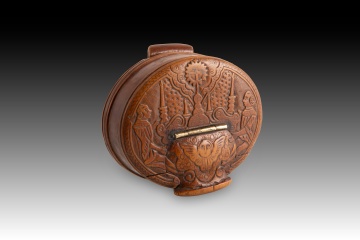
Tobacco box or snuff box. Carved wood, metal. Northern European school, 18th century. It has minor flaws. A small, carved wooden box with two hinged openings (one on each side). It is decorated with a series of figurative reliefs of religious themes. On one side, two male figures flank an altar with candles, upon which rests a cross with a burst of glory; the lid features a winged angel's head. The other side depicts a heart surmounted by a trilobed element surrounded by what appears to be a crown of thorns and flanked by two elements extending into the box. Inside the box is a crucifixion scene, with Jesus at the top, flanked by the two thieves, and elements of the Passion filling the rest of the space (the rooster of the denial, nails, pincers, the lance, a ladder, Veronica's veil, etc.). The wood is possibly boxwood. As for the decoration and morphology of the piece, it shows clear similarities to 18th-century works from Northern Europe, particularly those of the Flemish school. A very similar snuffbox (in shape and decoration) is known to exist in a private collection, considered to be a Dutch work from around 1700.
· Size: 7,3 x 8,7 x 3 cms.
ANTIQUES
MISCELLANEUS;OTHER OBJECTS
Ref.: ZF1509
-
Grille with two gates. Wrought iron. Spain, 17th century. A wrought iron window grille featuring two smooth, circular cross-section rails in the center, inserted between the vertical bars. These rails are decorated with small discs and balustrade-like shapes (adding a subtle sense of movement) between the two rails, with the two pieces facing each other to create harmony. The decorative details mentioned refer to Baroque works of this material from the 17th century: compare, for example, with the balconies of the Casa de Panadería in the Plaza Mayor of Madrid, or with Spanish pieces preserved in the Victoria and Albert Museum in London, a confessional grille in the Metropolitan Museum of New York dated 1629 (inv. 57.137.51) and another in the same museum made by the master Francisco González (inv. 56-234.12Ad).
· Size: 120x38x133 cms.
ANTIQUES
MISCELLANEUS;OTHER OBJECTS
Ref.: Z5602
-
Enameled porcelain and engraved glass box. 19th century. Oval box with an engraved glass base and a hinged lid, the latter crafted from a combination of enamel and metal. The lower section depicts a bucolic landscape with human figures and buildings, combining trees with lakes and dry land. The upper section follows the same theme: a couple in an idealized rural setting.
· Size: 7,5x6x4,5 cms.
ANTIQUES
MISCELLANEUS;OTHER OBJECTS
Ref.: Z6447
-
Toiletry case. 19th century. Tortoiseshell, metal, glass. Rectangular case with hinged lid made of tortoiseshell decorated with fine inlays of plant and floral elements on its sides, containing a toiletry set made up of several feminine grooming and personal use items (a small bottle of perfume, scissors, a thimble…), with a space designed for each of these utensils.
· Size: 6x3x8 cms.
ANTIQUES
MISCELLANEUS;OTHER OBJECTS
Ref.: Z6854
-
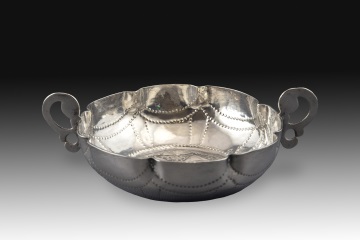
Wine tasting glass or shudder. Silver. 18th century. Without contrast marks. A vessel known as a wine glass or tembladera, with two closed, flat, S-shaped handles and a line of "bites" (scalloped shapes) highlighted by bands of dots that extend into the interior of the piece. The bottom has a star-shaped pattern (leaving some stripes smooth and with a glossy finish, forming a Maltese Cross, and combining the remaining areas with the same finish with others in diamond-shaped, pricked luster with dots). The bernegales and tembladeras de bocados were common pieces in 17th-century Spanish silverwork, generally becoming relegated to less important centers in the 18th century. Compare with pieces such as the silver bernegal from the last third of the 17th century in the Lázaro Galdiano Museum (perhaps of the Portuguese school; inventory 3916), or the one dated between 1640 and 1665 in the same museum (inventory 3910), or the one by José Jiménez de Illescas (inventory 3915, dated 1715-1725) in the same institution. Weight: 83 g.
· Size: 14,5x11x3 cms.
ANTIQUES
MISCELLANEUS;SILVER
Ref.: ZE192
-
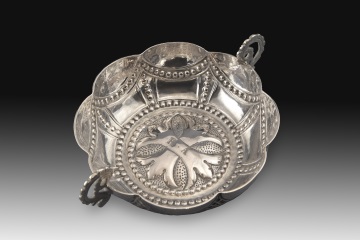
Wine tasting glass or shudder. Silver. 18th century. No contrast marks. With ownership initials. A vessel known as a wine glass or tasting glass, with two flat, curved handles decorated with simplified plant motifs, and a line of scalloped shapes along the rim, enhanced by bands of recessed dots that remain in relief on the interior of the piece, where they extend and frame the background decoration. In this area is a Greek cross with a fleur-de-lis or floriated design in a smooth, glossy finish, engraved with the letters "RA" (owner's initials), standing out against a background of dotted stippling. The bernegales and tembladeras de bocados were common pieces in 17th-century Spanish silverwork, generally becoming relegated to less important centers in the 18th century. Compare with pieces such as the silver bernegal from the last third of the 17th century in the Lázaro Galdiano Museum (perhaps of the Portuguese school; inventory 3916), or the one dated between 1640 and 1665 in the same museum (inventory 3910), or the one by José Jiménez de Illescas (inventory 3915, dated 1715-1725) in the same institution. Weight: 94 g.
· Size: 13,5x10,5x4,5 cms
ANTIQUES
MISCELLANEUS;SILVER
Ref.: ZE193
-
Wine tasting glass or shudder. Silver. 17th century. Without contrast marks. A vessel known as a wine glass or tasting glass, with two flat, closed "S"-shaped handles (decorated with simplified plant motifs) and a line of "bites" (scalloped shapes) highlighted with bands of dots. On the inside bottom, there is an eight-petaled flower engraved with a cross inside. The bernegales and tembladeras de bocados were common pieces in 17th-century Spanish silverwork, generally becoming relegated to less important centers in the 18th century. Compare with pieces such as the silver bernegal from the last third of the 17th century in the Lázaro Galdiano Museum (perhaps of the Portuguese school; inventory 3916), or the one dated between 1640 and 1665 in the same museum (inventory 3910), or the one by José Jiménez de Illescas (inventory 3915, dated 1715-1725) in the same institution. Weight: 96 g.
· Size: 15x10,5x4,5 cms.
ANTIQUES
MISCELLANEUS;SILVER
Ref.: ZE195
-
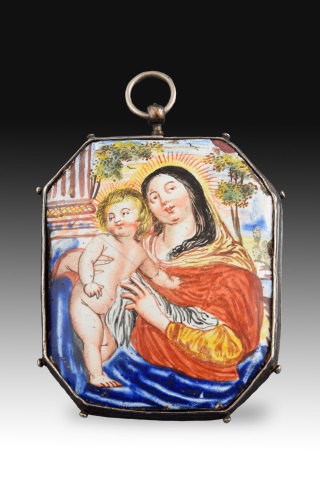
Reliquary pendant. Silver, enamel, textile. 17th century. A large, polygonal pendant with a silver frame decorated with small pearls of the same material at the corners of the edge, which has a ring at the top for hanging. One side features a textile background under a sheet of clear glass, likely intended to hold relics. The other side has a brightly colored enamel depicting the Virgin Mary in three-quarter view, holding the naked Christ Child in her arms, both figures silhouetted against a landscape background with classical architectural elements (a fluted column on a pedestal with moldings) and details of a natural landscape (thus linking the scene to the Rest on the Flight into Egypt; compare, for example, with works such as the Virgin and Child by Anton van Dyck in the Cerralbo Museum in Madrid, the oil painting in The Walters Art Museum, or the engraving by Paulus Pontius following models by Van Dyck – where the elements coincide in arrangement with those of the medallion). These types of jewelry have always been highly valued, both for the materials used in their creation and for their religious significance. Despite this (or perhaps because of it), few high-quality examples in good condition have survived, and they can only be found in important private collections and prominent museums such as the Valencia de Don Juan Foundation in Madrid, the National Museum of Decorative Arts in the same city, etc., or in historic religious centers like the Royal Convent of the Barefoot Nuns in Madrid.
· Size: 6,5x0.5x8 cms.
ANTIQUES
MISCELLANEUS;JEWELRY
Ref.: ZF0399
-
Mortar. Carved stone. 18th century. A mortar carved from a single piece of stone, featuring a circular base and four worn, cup-shaped handles or projections. These mortars were created for use in pharmacies (which could be located in a city, a religious institution, or a hospital) or in a kitchen (of a large residence or, again, a religious institution). Their specific purpose cannot be determined further due to the lack of decorative elements and the commonality of the model to which this piece belongs, a style with a long tradition in Europe. Similar examples are preserved, for instance, in the Museum of Hispanic Pharmacy at the Complutense University of Madrid, the Museum of the History of Pharmacy in Seville, the Pharmacy Museum in Krakow, and others.
· Size: 73x73x45 cms.
ANTIQUES
MISCELLANEUS;MORTARS
Ref.: Z1057
-
Alms plate. Nuremberg, 16th century. Alms plate made of gilded brass, decorated with a series of moldings and details both on the rim and towards the center. In this area is a figurative motif in slight relief (Adam and Eve flanking the tree around which the Serpent of Original Sin is coiled).
· Size: 38x38x5 cms.
ANTIQUES
MISCELLANEUS;OTHER OBJECTS
Ref.: Z5163
-
Pair of forked iron bail holders. 17th century. A pair of wrought iron brackets of the type known as "fork brackets" due to their shape. These pieces were used in furniture to secure tables, both dining tables and those of writing desks or cabinets, making them a very common wrought iron item. The spirals and balustraded sections date both to the Baroque period.
· Size: 22x6x78 cms
ANTIQUES
MISCELLANEUS;OTHER OBJECTS
Ref.: Z5019
-
Bernegal, 18th century. Silver, with marks. Weight: 55 g. Spanish Bernegal from the 18th century, marked Vidal, with a wide, low bowl, slightly rounded towards the base, following the typical style of this vessel in the Spanish Baroque period. Also characteristic of this style are the two vertical handles above the rim, in this case in the form of a mitered "S"-shaped bracket with a cut-out profile and small tendrils.
· Size: 4x10,5x7,2 cms.
ANTIQUES
MISCELLANEUS;SILVER
Ref.: Z5724
-
Shepherd's box. Carved horn, wood, metal. Spanish school, 1861. It presents inscriptions. An oval box made of carved horn in its natural color, with a wooden lid for reinforcement, decorated on the exterior with a series of engraved elements. An animal or monster appears on the base, while the lid features a monstrance or ostensorium with a cross in the center and a large pedestal with geometric elements, surrounded by angular shapes forming a frame. Beneath the horn hinge is the date of creation (1861), and between two bands of angular elements, an inscription (soy de francys / d inverted / un rhombo / poios), alluding to the owner (and possibly the craftsman) of the piece. This type of box, of folk tradition, was common in the past and was usually made by shepherds or cattle farmers themselves to store snuff or tobacco.
· Size: 7x4x4 cms.
ANTIQUES
MISCELLANEUS;OTHER OBJECTS
Ref.: ZE351A
-
Box. Wood, mother-of-pearl. 19th century. Rectangular box with a lid made of dark wood and decorated with lines and plant motifs, small furniture pieces, animals, etc., in marquetry mother-of-pearl appliqués, with engraved or inked details. These types of pieces were highly prized in Europe, originating from workshops in China or Vietnam.
· Size: 22,5x15x11 cms.
ANTIQUES
MISCELLANEUS;OTHER OBJECTS
Ref.: ZE358
-
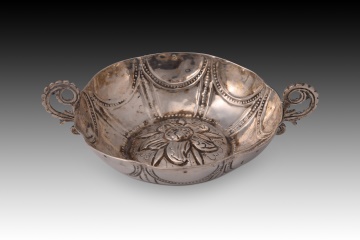
Wine tasting glass or shudder. Silver. 18th century. A vessel known as a wine glass or tembladera (due to its lack of a foot), made of silver in its natural color, with two flat, curved handles decorated with simplified vegetal motifs, and a line of scalloped shapes (lobed forms) around the rim, enhanced by bands of recessed dots that remain in relief on the interior of the piece, where they extend and frame the background decoration. A flower, highlighted with a line of dots, is located in this area. Bernegales and tembladeras with scalloped shapes were common pieces in 17th-century Spanish silverwork, generally becoming relegated to less important centers in the 18th century. Compare with pieces such as the silver bernegal from the last third of the 17th century in the Lázaro Galdiano Museum (perhaps of the Portuguese school; inventory 3916), or the one dated between 1640 and 1665 in the same museum (inventory 3910), or that of José Jiménez de Illescas (inventory 3915, dated 1715-1725) in the same institution. Weight: 79 grams.
· Size: 15x11x4 cms.
ANTIQUES
MISCELLANEUS;SILVER
Ref.: ZE366
-
Crucified Christ with base. Wood, mother-of-pearl. Jerusalem. 19th century A crucified Christ is depicted on a cross with a triangular base decorated with mother-of-pearl elements featuring engraved and tinted details, and darker wood combined to create floral, vegetal, and simple geometric motifs. The front is adorned with the IHS symbol surmounted by a cross above the three nails of Christ. The shape of this Latin cross and its decoration are reminiscent of examples created in the Holy Land during the 18th and 19th centuries as souvenirs for pilgrims, gifts for dignitaries, and so on.
· Size: 15x8x49 cms.
ANTIQUES
MISCELLANEUS;OTHER OBJECTS
Ref.: ZF1472
-
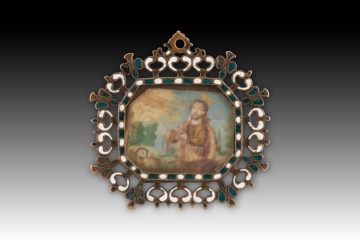
Devotional pendant or confraternity plaque. Bronze, enamel, etc. Spain, 17th century. It has faults. Devotional medallion consisting of a frame (with a ring at the top and decoration of alternating C's and enameled flowers, an interior line of enameled elements in the same colors (ovals and rectangles; this band does not appear on the back) and two fronts. On the front, protected by a sheet of glass, is a painting of, possibly, Saint John the Baptist accompanied by a lamb with a halo and set in a natural landscape (it should be noted that it also resembles works depicting Christ as the Good Shepherd). The back features a pierced plaque with the IHS, the second letter surmounted by a Latin cross and three nails, all surrounded by vegetal motifs, enameled in colors, and mounted on a textile. Experts mention a series of confraternity plaques or medallions (oval, rectangular, octagonal, or triangular) made in Spanish workshops between around 1620 and 1640, primarily in workshops in Toledo, Salamanca, Cordoba, Seville, etc., and also overseas. Their iconography is generally heavily influenced by the teachings of the Council of Trent.
· Size: 7x0.5x6,5 cms.
ANTIQUES
MISCELLANEUS;JEWELRY
Ref.: ZF1559
-
Case with field cutlery and knife. 19th century. A cylindrical case with a hinged closure containing various pieces of field cutlery, such as a spoon, a knife, a detachable fork, etc., secured in a rigid lining and stored inside a metal cup. This type of travel item was widely used during the 19th century.
· Size: 8x8x16 cms.
ANTIQUES
MISCELLANEUS;OTHER OBJECTS
Ref.: Z3806
-
Pair of frames. Wood. 20th century. Pair of carved wooden frames decorated on the front with a composition of moldings of different widths, all smooth, combining straight lines with curves.
· Size: 152x7x172 cms.
ANTIQUES
MISCELLANEUS;FRAMES
Ref.: Z3959
-
Special Offer! - Off
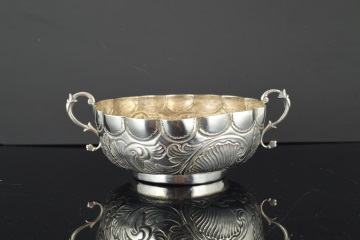
Silver Bernegal. Portugal, 19th century. With contrasting markings on the base. A Bernegal with a wavy rim, decorated with rocaille and vegetal motifs on the exterior, and two S-shaped handles. The hallmarks on the flower adorning the base of the vessel date and place its creation in 19th-century Portugal, a period when it was common to draw inspiration from past styles (Baroque, in this case). Weight: 170 g., detectedSourceLanguage: es
· Size: 18,5x15x7 cms.
ANTIQUES
MISCELLANEUS;SILVER
Ref.: Z4961