-
Special Offer! -25,00% Off
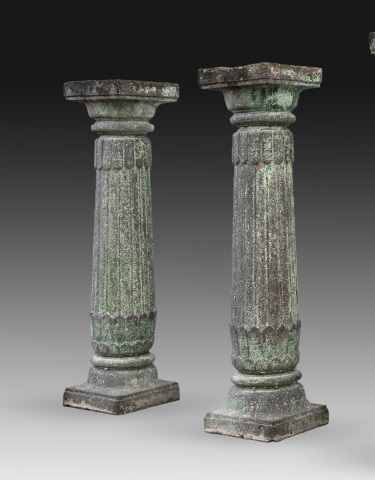
Columns. Carved stone. 19th-20th centuries. Symmetrical carved stone columns with bases and capitals (formed by various smooth moldings), fluted shafts, and decorated ends with shapes reminiscent of leaves, similar to certain elements of ancient Egyptian architecture. These types of elements were highly valued for prominent houses. 4 units available. , detectedSourceLanguage: es
· Size: 51x51x199 cms, / 46x46x188 cms.
DECORATIVE ANTIQUES
Ref.: AC051
-
Tuft. Metal. 19th century. A set of three metal pieces that, when joined, would form a crest. The scrolls, plant motifs, palms, lines, etc., link these pieces to 19th-century works with a clear Neoclassical influence, being similar to French works or those from schools with a strong French influence.
· Size: central 23x30 lateral: 40x23 cms
DECORATIVE ANTIQUES
Ref.: Z0165G
-
Tray with handle. Silver-plated metal. Circa 1900. With contrast markings. A lobed tray with three interior compartments and a pearl border. It features a handle that bisects its axis and is decorated with vegetal and architectural elements of clear classical influence. It has three leaf-shaped legs. The contrasting marks are located on the rim.
· Size: 34x34x15 cms
DECORATIVE ANTIQUES
MISCELLANEUS
Ref.: Z0165P
-
Bronze candlestick. 19th century. It is missing. Bronze candlestick with a curvilinear base and simple decoration, a balustraded shaft with moldings, a central disc with curved profiles, and a candle holder topped with waves, resembling a flower. Weight: 300 grams.
· Size: 11x11x20 cms.
DECORATIVE ANTIQUES
MISCELLANEUS
Ref.: Z0165X
-
Twelve handles. Cast iron. 20th century, inspired by antique models. Set of twelve handles composed of one part decorated with simplified plant elements, and another that hangs from the former by means of a ring and has a balustrade shape.
· Size: 3x2x10 cms.
DECORATIVE ANTIQUES
Ref.: Z0205B
-
Corner pieces for a chest. Wrought iron. 20th century, following Renaissance designs. Corner piece for the lower part of a chest, made of wrought iron and decorated at the ends with fleur-de-lis shapes with pointed tips and cut edges, following common designs in Renaissance work. Weight: 0.123 kg. Price per unit. Minimum order 4 units.
· Size: 15,5x9x6,5 cms.
DECORATIVE ANTIQUES
Ref.: Z0210C
-
Special Offer! -25,00% Off
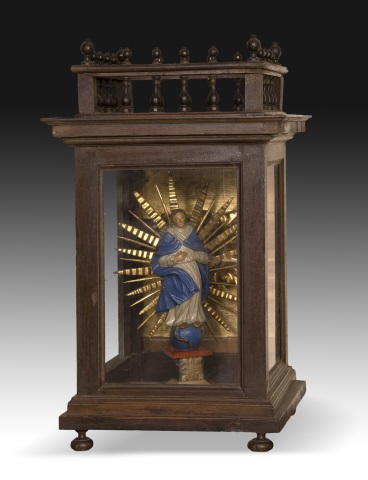
Chapel of the Immaculate Conception. Sculpture, carved wood, glass, metal. Second half of the 18th century. A carved wooden chapel with vase-shaped decoration at the top of the railing and balusters, reminiscent of the Baroque style, features three of its four sides in clear glass and is raised slightly on circular legs. Inside, a gilded background (on the fourth side of the chapel, highlighting a carved and polychrome vegetal composition) and a polychrome sculpture of the Immaculate Conception surrounded by alternating flat, undulating, pointed, and circular rays of light are visible. The sculpture stands on a pedestal and wears a white tunic and a blue mantle; Mary stands on the Orb of Creation, in which a serpent (associated with Sin) appears. The sculpture shows a clear influence of Spanish Baroque models, as well as certain details, such as the pose, that can be linked to Neoclassicism. This blending and the persistence of Baroque influence are common in 18th-century Spanish sculpture., detectedSourceLanguage: es
· Size: 38,5x38x65 cms virgen
DECORATIVE ANTIQUES
Ref.: Z0252
-
"
· Size: 8x8x37 cms.
DECORATIVE ANTIQUES
Ref.: Z0254
-
Special Offer! -25,00% Off
"
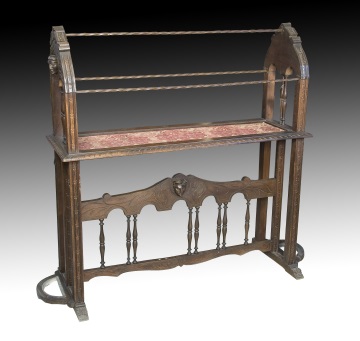
· Size: 100x40x75 cms.
DECORATIVE ANTIQUES
Ref.: Z0281
-
"
· Size: 75x22x67
DECORATIVE ANTIQUES
Ref.: Z0285
-
Art Nouveau style mantel clock. Tin alloy. A silver table clock consisting of an L-shaped base decorated with a lady holding aloft the dial, which features Arabic numerals for the hours and dots for the minutes, and a series of branches emerging from it. The prominence of nature and femininity, the curves of the figure and its pose, etc., are inspired by modernist examples from around 1900.
· Size: 8x7x15 cms.
DECORATIVE ANTIQUES
Ref.: Z0323
-
Candle. Silver-plated metal. 19th century. Table lamp with a circular base and a narrower, column-shaped stem. The circular body, decorated with fine moldings, features an upward-facing ornament (into which a handle is inserted) with gentle curves, a concave plaque decorated with engraved lines, and tongs hanging from a chain. As was typical of 19th-century art, it draws inspiration from past styles, adapting them to contemporary tastes.
· Size: 15x10x39 cms.
DECORATIVE ANTIQUES
Ref.: Z0324
-
Leontina, late 19th century. A watch chain consisting of six chains attached to a ring decorated with scrolls and small pendants, from which hang a series of objects and hooks for small items. The two longest chains end in an openwork plate with a ring for a watch. This type of "jewelry" was very common among the upper class, used to carry pocket watches, the keys necessary to operate them, and other small valuables.
· Size: 32 long. 34 cms. ancho
DECORATIVE ANTIQUES
Ref.: Z0334
-
Roman amulet “Fascinum”. Bronze. 1st-3rd centuries AD. c. Roman phallic amulet with a ring on one side for wearing it around the neck, as was customary. These pieces, personifying the "divine phallus" in the mythology of Ancient Rome and the god Fascinus, invoked his protection and defended against the evil eye, being omnipresent in Roman culture due to their apotropaic power (children wore them for protection, as did soldiers, etc.).
· Size: Long. 3 cms.
DECORATIVE ANTIQUES
Ref.: Z0345
-
Roman amulet “Fascinum”. Bronze. 1st-3rd centuries AD. c. An elongated Roman phallic amulet with a ring on one side for wearing it around the neck, as was customary. These pieces, personifying the "divine phallus" in the mythology of Ancient Rome and the god Fascinus, invoked his protection and defended against the evil eye, being ubiquitous in Roman culture due to their apotropaic power (children wore them for protection, as did soldiers, etc.).
· Size: Long 3,5 cms.
DECORATIVE ANTIQUES
Ref.: Z0346
-
Incense burner. Bronze. 19th century. A bronze censer with a circular base and a cup-shaped lid featuring elaborate lines and simple openwork elements, inspired by antique pieces. It includes metal chains that connect it to the standard ring-shaped holder. Certain lines and decorative motifs are reminiscent of some Spanish works from the 17th and 18th centuries.
· Size: 10x10x16 cms.
DECORATIVE ANTIQUES
Ref.: Z0351
-
Oak wood clothing press, Holland, 19th century. A clothes press with a lockable cabinet at the bottom, made of oak in Holland. As is typical of these utilitarian items, it is undecorated and was used for smoothing clothes. It is not common to find such objects because they were frequently discarded once better technologies became available. Oak was chosen for its hardness and durability.
· Size: 76x52x171 cms.
DECORATIVE ANTIQUES
Ref.: Z0368
-
Oak wood clothing press, Holland, 19th century. The press stands on four turned legs (three of them secured with a straight bracket), with a drawer underneath. Being a purely utilitarian piece of furniture, it has hardly any decorative elements. The oak wood used in its manufacture was chosen for its hardness and resistance, since these presses were used to smooth clothes as much as possible.
· Size: 72x55x167 cms.
DECORATIVE ANTIQUES
Ref.: Z0369
-
Writing desk. Bronze. 19th century. On a tray with curved edges, decorated with moldings and scallop shells, sit the four containers that make up the writing set. The sand tray, the feather duster, and the inkwell feature clean lines and smooth surfaces, combined with fine moldings resembling a cord; the oval box with a lid topped with a knob displays smooth moldings across its entire exterior surface. While certain details (particularly the tray) might recall some 18th-century Rococo works, the subdued movement of the tray, the decoration of the containers, the clean lines, and the lack of prominent decorative elements are more characteristic of 18th- and 19th-century Neoclassicism, as is the inspiration drawn from past styles and the combination of various trends in a single piece.
· Size: 25x18x11 cms.
DECORATIVE ANTIQUES
Ref.: Z0376
-
Sculpture in calamine. Signed “Aug. Moreau”. Following models by Auguste Moreau, France, 19th century. It is reminiscent of works such as the bronze sculpture "The Fountain" by Mathurin Moreau, as well as pieces by Hippolyte Moreau and Auguste Moreau (France, 1834–1917). Auguste began his training as a pupil of his older brother, Mathurin. He debuted at the Paris Salon of 1861, where he exhibited regularly until 1913. He was also a member of the Société des Artistes Français. His subjects—genre scenes, pastoral scenes, allegorical works—and his realistic and graceful style link him to other members of the Moreau dynasty, known for their small-scale bronze works that were widely reproduced and inspired many other masters, both during the artists' lifetimes and after their deaths.
· Size: 18x18x52 cms.
DECORATIVE ANTIQUES
Ref.: Z0388
-
Fitting mirror. Mahogany wood, glass. 19th century. An oval mirror with a frame formed by smooth moldings mounted on a carved mahogany structure, composed of turned rods with discs (the horizontal ones) and baluster-shaped forms (the two vertical ones), all four with square blocks interrupting their lines. Note the combination of details typical of 17th- and 18th-century furniture with others from 19th-century Neoclassicism. This combination of influences was common in the 19th century, within the framework of Historicism.
· Size: 58x3x100 cms.
DECORATIVE ANTIQUES
Ref.: Z0392
-
Panelled door. Walnut and pine wood. 17th century. A single-leaf wooden door, carved with traces of polychromy, decorated with a paneling that harmoniously combines rectangular and square shapes. Despite its lack of dynamism, this composition was common in the classicist style of the European Baroque.
· Size: 105x208 cms.
DECORATIVE ANTIQUES
Ref.: Z0403
-
Fifteen balusters. Bronze and wood. 18th century. Grouped in sets of seven, the bronze balusters are set between two straight painted wooden crossbars, thus highlighting the curved lines, discs, and other forms of the aforementioned elements. These types of pieces were very common in Neoclassicism (as well as in other periods) for decorating railings, staircases, and so on.
· Size: 200x5x54 cms.
DECORATIVE ANTIQUES
Ref.: Z0404
-
Panelled door with frame. Walnut and pine wood, wrought iron. 20th century. A single-leaf door with a wooden frame decorated with plain moldings, opening to the right. It features a decoration of square and rectangular panels with diamond shapes inside, combining dark and light wood, and a wrought iron doorknob (balauster handle, latch, and plate with cut-out profiles, combining curves and lines). Certain elements of the piece are reminiscent of 17th-century Baroque works.
· Size: 99x203 cms.
DECORATIVE ANTIQUES
Ref.: Z0406