-
Floor lamp. Glass, metal. Circa mid-20th century. This floor lamp, crafted from white glass and copper-finished metal, features a base composed of alternating glass clusters and small metal discs, culminating in two horizontal light sources and a metal cup. Its form and decoration are reminiscent of Murano glasswork from Italy dating back to the mid-20th century.
· Size: 55x55x171 cms s/pantalla: 35x35x170 cms
DECORATIVE ANTIQUES
FURNITURE
Ref.: ZF0908
-
Chippendale style side table. Mahogany wood. English school, 19th century. A round table with slightly cabriole legs, ending in ball-and-socket feet and decorated on top with finely carved vegetal motifs. This style, pioneered by Thomas Chippendale, was widely recognized and common in English school cabinetmaking during the 18th and 19th centuries.
· Size: 100x100x75 cms.
DECORATIVE ANTIQUES
FURNITURE
Ref.: ZF0890
-
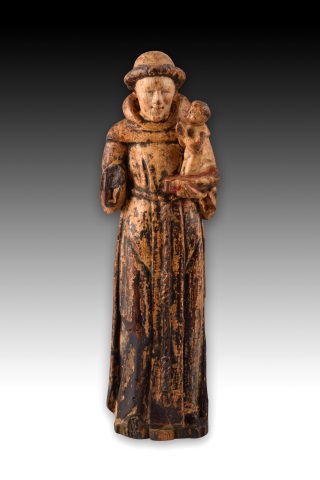
Saint Anthony with the Child Jesus. Wood. Mechelen School, 16th century. A carved wooden sculpture, worked, as was customary in that center, on the front because it was intended to be placed on an altar, depicting Saint Anthony of Padua with the Christ Child seated on a book, in one of the most common iconographies for this Franciscan saint. The influence of the Mechelen school is evident in the figures' features, the remnants of polychromy, and other aspects. The "poupées malinoises" or "Malines dolls" are small sculptures of saints made in the late 15th and early 16th centuries in the workshops of Mechelen (Flanders). They were known by these names because their faces resembled those of dolls or "poupins." They were sometimes also called "chop sculptures" because they were only finished on the front, being flat on the back, depending on the depth of the niche where they were to be placed. They were made for small domestic altarpieces—usually containing three statuettes or "dolls"—rectangular in shape, with painted wings or doors. Perhaps the best-known example is the altarpiece in the Mayer van den Bergh Museum in Antwerp.
· Size: 8,5x3,5x28,5 cms
ANTIQUES
FURNITURE
Ref.: ZF0907
-
Freestanding coat and umbrella stand, inspired by classic models. Made of aluminum.
· Size: 100x47x206
DECORATIVE ANTIQUES
FURNITURE
Ref.: ZF0717
-
Winged sewing table in rosewood, 19th century. A narrow side table with two drop leaves, supported by four cabriole legs decorated with carved floral garlands and metal casters. The front features two drawers and a pull-out shelf. The clean lines of the piece and its minimal decorative elements demonstrate the influence of classical art.
· Size: 65x40x81 cms. / 93x65x81 cms
ANTIQUES
FURNITURE
Ref.: Z0731
-
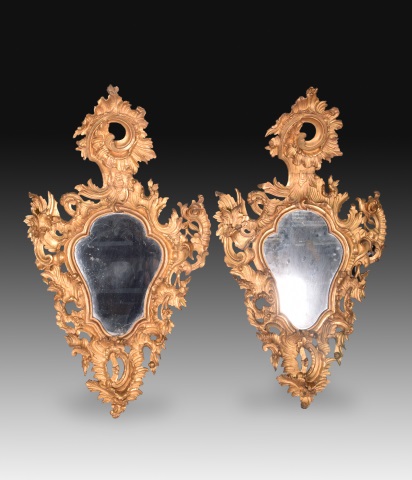
Pair of cornucopias. Carved and gilded wood. 18th century. Pair of carved and gilded wooden cornucopias decorated with a fine molding on the inside and an elaborate composition of plant elements with scallop-like shapes on the outside, leaving empty spaces and with a marked asymmetry in both, tempered by carving both examples with the same decoration. These types of mirrors were only made for grand houses, as their primary purpose was to reflect the light from candles and lamps in these luxurious interiors, thus showcasing the wealth of their owners. The method of manufacturing mirrors from sheets of glass was discovered in Venice in the 16th century and remained a secret for about a century, until the role of mercury in the process became known in London and Paris, allowing for the widespread use of these materials. However, the use of cornucopias did not become widespread in Europe until the Rococo period, and their use and creation have continued ever since. From the beginning, and with the intention of displaying the owner's wealth and aiding in illumination, it was customary to gild them after they were carved. The movement of the pieces inside, where the mirror would have been, provides an initial clue to their artistic style. As for their decoration, the vegetal elements, the volutes, the curved forms contrasting with counter-curves, and the scallop-shell details clearly indicate that both pieces belong to the Rococo period, distinguishing them from both the more Neoclassical-influenced 18th-century examples and those of the 19th century. The asymmetry in the decoration of each cornucopia points to the beginnings of this style, since, over time, the contrasts characteristic of this artistic style were softened, resulting in more symmetrical compositions.
· Size: 64x25x110 cms.
ANTIQUES
FURNITURE
Ref.: ZF0276
-
Lamp. Bronze, glass. Early 20th century.
A ceiling lamp composed of a central axis from which arms emerge, each ending in a colored glass shade resembling a flower and other decorative elements—a clear neoclassical touch—and topped with a partially openwork form. This type of lamp was common in important houses, more so in the private quarters of the owners than in the halls used for more formal celebrations and receptions.
"
· Size: 110x110x120 cms
DECORATIVE ANTIQUES
FURNITURE
Ref.: ZF0647
-
Pine chest, dated 1886. Palencia. Wrought iron fittings , detectedSourceLanguage: es
· Size: 154x54x54 cms.
DECORATIVE ANTIQUES
Ref.: Z0720
-
Extendable dining table. Mahogany wood. England, 19th century. Rectangular dining table made of mahogany with metal casters on the legs and a concentrated carved decoration on these supports, consisting of architectural and floral elements. The lines of the legs are reminiscent of English Victorian examples, but their decoration is not typical of this type of furniture. It has an extension leaf.
· Size: 140x115x74 cms. Extendida 115x185 cms.
ANTIQUES
FURNITURE
Ref.: ZE305
-
Wastepaper basket. Walnut wood, iron. Spain, 17th century. Rectangular structure for a wastepaper basket or writing desk, made of carved walnut wood, with a lid secured by two hooks and iron fittings (exterior knob, corner pieces, and interior hinges). Note the distribution of the interior compartments, of varying sizes to accommodate different items.
· Size: 154x53x60 cms.
DECORATIVE ANTIQUES
FURNITURE
Ref.: Z0719
-
Divan sofa. Mahogany wood, upholstered. 19th century. Mahogany divan with upholstered seat, S-shaped or half-lyre-shaped curved arms, and flat cabriole legs ending in scrolls. While the lines are reminiscent of French Empire-style pieces and other pieces from the first half of the 20th century, certain similarities can also be found with 19th-century Spanish Isabeline divans.
· Size: 62x200x90 cms.
DECORATIVE ANTIQUES
Ref.: Z3712
-
Miniature moon cabinet. Walnut wood. 19th century. Miniature wardrobe with one door (inside, two shelves and a drawer) and a drawer with two handles, featuring an exterior mirror and decoration based on architectural elements, plants, and moldings with a clear classical influence. The piece shares common elements with 19th-century Spanish Alfonsine wardrobes (columns on the front, mirror on the door, finials at the top, etc.).
· Size: 43x29x94 cms.
DECORATIVE ANTIQUES
Ref.: Z0596
-
Empire style fitting or psyche mirror. Mahogany wood. 19th century. A full-length tilting mirror situated between two columns and on two legs joined at their base by a turned crossbar, made of mahogany with gilt metal fittings. This type was commonly known as a psyche or psyché mirror and was very common in France. Compare this example with the one held in the Museum of Romanticism (Madrid).
· Size: 110x52x180 cms.
DECORATIVE ANTIQUES
Ref.: Z3063
-
English display cabinet. Mahogany wood. 19th century. A display cabinet with shelves and two glass doors decorated with geometric patterns, topped by a broken pediment with vegetal motifs, rests on a unit with two drawers at the front, four legs, and a chambranle or shelf at the bottom. Certain elements of the unit are reminiscent of the Chippendale style, and the beveled carving on the drawers and the top of the "table" is particularly noteworthy., detectedSourceLanguage: es
· Size: 77x43x195 cms.
ANTIQUES
Ref.: Z5022
-
Chest in walnut wood and wrought iron fittings, 17th century. Rectangular chest with base and lid featuring moldings, metal fittings, and corner pieces in wrought iron on a red fabric background, all made from stylized and simplified plant and architectural elements. Key lock on the front. Single-piece boards in excellent condition. The characteristic prototype of these pieces is followed in the Spanish examples for chests, which would have a civil or religious use, being used to store clothes, tableware, etc.
· Size: 75x190x80 cms.
ANTIQUES
Ref.: Z6357
-
Two chairs. Walnut wood. 17th century. Chairs made of carved walnut wood with openwork backs decorated with four crossbars, one with discs and the other with balustrade-like forms, both featuring moldings at the bottom, following common designs in 17th-century Spanish Baroque cabinetmaking. These types of pieces are not as commonly preserved as the most outstanding examples because they were used frequently and replaced as fashions changed.
· Size: 42x37x89 / 40x36x85 cms.
DECORATIVE ANTIQUES
Ref.: Z0291
-
"Architect's desk" table in mahogany wood, France, 19th century. The table, supported by four Solomon's legs with a central joint, features two drawers in the lower section, side shelves, and a sloping top. Inside, a large open space lies beneath nine compartments. This particular type of desk is characterized by its sloping top, designed to facilitate drafting, hence its name. The interior space is shaped this way to store various rulers and tools of different sizes typical of the profession. It requires restoration.
· Size: 100x60x105 cms.
DECORATIVE ANTIQUES
Ref.: Z0430
-
Wardrobe. Walnut wood. 19th century. A two-section wardrobe made of carved walnut wood in its natural color, featuring three lockable doors at the top, a central open space, and two drawers and two doors with metal handles at the bottom. The exterior displays a series of carvings (architectural elements, coats of arms, plant motifs, vases, bands, plain moldings, etc.) of classical influence, as well as elements reminiscent of traditional Spanish cabinetmaking ("parchment scrolls" on the upper doors, reminiscent of Gothic tradition, pearls, etc.). The 19th century was a time in European cabinetmaking when a range of influences and styles blended to create new pieces rooted in tradition. This example features Renaissance-inspired reliefs (vases, moldings, etc.) and other details of medieval influence (scrolls, etc.), along with a composition (door arrangement and central space) very typical of that century.
· Size: 60x160x275 cms.
ANTIQUES
FURNITURE
Ref.: ZE284
-
Desk and chair set. Walnut wood. Circa 1900. It requires restoration. This furniture set comprises a desk with an armchair and high back, four armless high-back chairs, and a footstool, all crafted from carved walnut. The desk, featuring five drawers on one side, displays a series of carvings with plant and architectural motifs reminiscent of the Neo-Renaissance style. This same influence is evident in the carvings of the armchair, which also features animal protomes on the arms and studded leather upholstery. The chairs in this set, likewise, reflect the same style, with upholstery on the back and seat adorned with gilt studs. The footstool has a somewhat simpler decoration.
· Size: Mesa 135x74x83 cms. Sill¾n 63x48x147 cms silla 45x45x147 cms. Piecero 42x38x22 cms.
DECORATIVE ANTIQUES
FURNITURE
Ref.: ZF0650
-
Swan, table base for glass. Marble and bronze. 20th century. A bronze table base in the shape of a swan taking flight from a water surface, set on an oval base of dark marble. The figure, in some details, is more reminiscent of 19th-century examples found, for instance, on French Empire-era clocks, than of more typical 20th-century works.
· Size: 97x110x71 cms
DECORATIVE ANTIQUES
FURNITURE
Ref.: ZF0657
-
“Dompedro” in mahogany wood. 19th-20th century. A polygonal-sectioned piece of furniture used to conceal the chamber pot under a lid and facilitated by a removable footrest. Very similar models were already in use in the 19th century, and this type of furniture was common in homes until the 19th century. Note its resemblance to examples preserved in the Museum of Romanticism in Madrid.
· Size: 45x45x46 cms.
DECORATIVE ANTIQUES
Ref.: Z5613
-
English-style display cabinet. Mahogany veneer, bronze, glass. 20th century. A display cabinet atop a chest of drawers, or a display cabinet with a lower section of drawers, clearly influenced by English Victorian designs. The upper section features double doors, glazing on three sides (with a quarried front section), and a molding trim with a carved central crest, as well as corner pilasters. This trim is repeated in the lower section with architectural elements that visually extend the piece, and the drawers (a total of four) are located at the front, fitted with circular knobs. It has faults.
· Size: 162x40x177 cms
DECORATIVE ANTIQUES
Ref.: Z6134
-
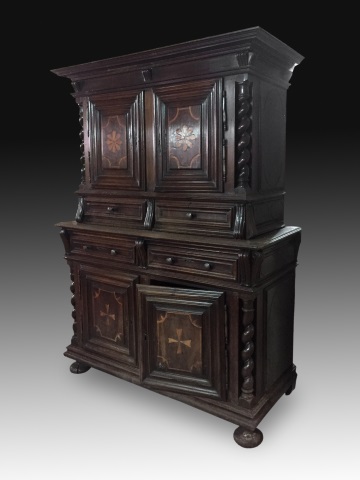
Two-door wardrobe. Walnut wood. Spain, 18th century. A two-section wardrobe made of carved walnut wood features doors (two pairs, top and bottom) and drawers (four, arranged in pairs towards the center) and is slightly raised on disc-shaped legs. The upper section is finished with a series of moldings of varying widths (the widest with small fluted brackets, elements also present flanking the drawers); the doors (with simple marquetry in lighter wood) and drawers are also highlighted by similar moldings; the corners of the door areas are accentuated by Solomonic columns with plain capitals; below, above the legs, another, finer molding frame completes the piece. The sides feature simple recessed carvings that differentiate the various sections mentioned. The careful consideration of the composition and its details (and therefore the quality) is evident in the wood joints, in the care with which the elements are used (the door hinges are left out to add more decoration), etc. The presence of Solomonic columns and the delicate use of fluted corbels placed opposite each other to add a sense of movement demonstrate the Baroque influence on the cabinet. The overall lines of the piece correspond to a common composition in Spain (compare with wastepaper baskets, the 18th-century sacristy cabinet of Burgos Cathedral, etc.), and the wood is also the most common type used in Spanish cabinetmaking. Compare this piece with the architrave in the Lázaro Galdiano Museum in Madrid (first half of the 17th century, note the corbels); the well-known paneled cabinets; pieces in the Louis XIII style (noting the usual differences); etc.
· Size: 161x75x218 cms.
ANTIQUES
FURNITURE
Ref.: ZF0485
-
Castilian-style chair. Carved walnut wood, leather, metal. 20th century. Several units available. A carved wooden chair decorated with simple geometric and architectural elements, featuring side moldings that are curved at the bottom and wider at the front (with framed bands, geometric details, and openwork heart-shaped motifs); the backrest and seat are upholstered in leather with metal studs. The piece is inspired by Castilian chairs of the type known as the "friar's chair" from the 17th century.
· Size: 50x40x101 cms.
DECORATIVE ANTIQUES
Ref.: Z1437