-
Special Offer! -20,00% Off
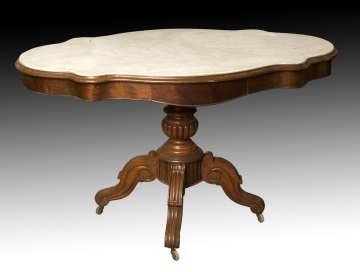
Coffee table. Mahogany wood, white marble. France, 19th century. Coffee table made of carved mahogany with a white marble top, cut into curved shapes. The piece is decorated with architectural elements of classical influence and features metal casters on the legs., detectedSourceLanguage: es
· Size: 130x78x75 cms.
DECORATIVE ANTIQUES
Ref.: Z4847
-
Octagonal side table. Rosewood wood. France, 19th century. Side table with a straight octagonal top, made of rosewood combined with another wood of a different tone to enhance the former. The four legs, turned with lines, are joined with a flat rhomboidal stretcher. The decoration has been reduced to highlight the quality of the wood and the clean lines of the piece, which is why there are no gilt bronze fittings, common in French furniture.
· Size: 75x75x70 cms.
DECORATIVE ANTIQUES
Ref.: Z4843
-
Castilian leather and walnut chair. Metal, walnut, leather. 20th century. 10 units available; price per unit. A Castilian-style chair with a leather back and seat attached to a carved walnut frame using metal studs. It features a carved stretcher at the front, with curves and a central circle, and two plain stretchers connecting the front and rear legs. Inspired by antique Castilian furniture, this style was common in traditional Spanish cabinetmaking.
· Size: 50x53x97 cms.
DECORATIVE ANTIQUES
Ref.: Z4845
-
Walnut wood dining table with wrought iron braces. 18th century. The dining table has a rectangular, smooth top supported by legs that, in a simplified form, follow the most common Baroque examples known as "lyre" legs, and are secured by straight wrought iron braces. The influence of 17th-century models is common in the following century, although curves are softened and straight lines are favored due to the influence of Neoclassicism.
· Size: 151x93x75 cms.
ANTIQUES
Ref.: Z3698
-
Desk. Mahogany wood. 19th century. A rectangular tabletop decorated with a band of vegetal motifs along the outer edge, its waistline enhanced with bands carved with egg-and-dart motifs and vegetal designs of classical influence, and legs decorated with an elegant cabriole shape and carved motifs (scrolls, bows, and simple vegetal themes extending along the waistline of the piece) topped with highly simplified claw-like shapes holding balls. This finial on the legs also appears in Chippendale examples and American works and, apparently, was a motif inspired by Far Eastern works, replacing the dragon's paw with the sphere with a lion's paw (thus demonstrating English supremacy) and becoming very popular in England during approximately the first half of the 18th century, before being revived later.
· Size: 94x70x76
DECORATIVE ANTIQUES
Ref.: Z3460
-
Pair of corbels in carved and gilded wood, Rococo, 18th century. A pair of corbels with a curved lower profile and polygonal section, decorated on their fronts with rocaille reliefs and engraved plant motifs and scales. The movement of their profiles and the decoration place the works within the Rococo period.
· Size: 94x43x119 cms.
ANTIQUES
Ref.: Z3412
-
Freestanding fitting room mirror in carved mahogany wood, 19th century. The rectangular mirror frame is decorated with scrolls and carved plant and floral motifs in the classical tradition, and rests on two curved legs with lines reminiscent of the characteristic movement of the Baroque and Rococo periods. This blend of styles was common in 19th-century furniture, as forms from past traditions were often chosen for contemporary creations.
· Size: 88x76x160 cms.
ANTIQUES
Ref.: Z2515
-
Corner unit. Carved mahogany wood. 20th century. A carved wooden corner unit with three shelves (creating four compartments) and a lockable door at the bottom. The decoration, featuring curves, architectural elements, and simple geometric motifs, is reminiscent of 19th and 20th-century Historicist styles.
· Size: 40x40x178 cms.
DECORATIVE ANTIQUES
Ref.: Z1229
-
Mahogany wood game table. 19th century. The upper tabletop is rectangular with curved profiles and rests on two baluster legs that terminate in two supports reminiscent of cabriole legs, decorated with moldings. Both are secured by a turned stretcher and feature metal pulleys. The lines recall Baroque examples, while the decorative simplicity evokes Neoclassical models, a common combination in 19th-century furniture.
· Size: 95,5x48x74 cms.
ANTIQUES
Ref.: Z3056
-
English “Davenport” desk in walnut wood, 19th century. A desk with four drawers on its side, a lockable inkwell on top, and a hinged top with a key lock. This style is known as the "Davenport" desk because a captain with that surname first ordered this piece of furniture from Gillows of Lancaster towards the end of the 18th century, after which these desks were produced with a remarkable variety of decorative elements. It requires restoration
· Size: 55,5x57x79 cms.
ANTIQUES
Ref.: Z3099
-
Special Offer! -20,00% Off
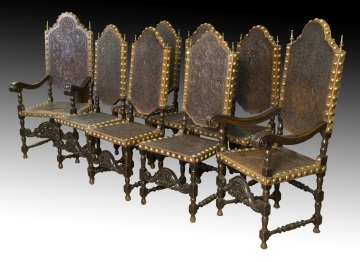
Chairs in walnut wood and embossed leather, 19th century. A set of six chairs and two matching armchairs, crafted from walnut with embossed leather seats and backs (some leather requires restoration). The structure is based on traditional Spanish armchair designs, incorporating decorative details from various artistic styles, such as the undulating arms (Rococo), carved and curved stretchers, and turned supports (Baroque). In the 19th century, it was common to create furniture by combining elements from different artistic traditions, using highly successful local designs as a base in Spain. Embossed leather on the seats and backs is another characteristic element of the Iberian Peninsula, widely used throughout the centuries., detectedSourceLanguage: es
· Size: 54x44x128 / 63x59x138 cms.
ANTIQUES
Ref.: Z0358
-
Isabeline three-piece suite in mahogany wood, 19th century. A three-piece suite with carved floral motifs, four cabriole legs, short curved and partially upholstered arms, and oval, single-person "à la reine" backs, linked by vegetal motifs to create continuity. The influences of contemporary French furniture are clear in all the Isabeline works, a style so named because it reached its peak during the reign of Isabella II (1830-1904).
· Size: Sofa: 185x110x60 cms. / 66x60x110 cms.
ANTIQUES
Ref.: Z0684
-
Wardrobe with gun rack. Cherry and oak wood. France, 18th century. A two-door cabinet with three drawers at the bottom, all lockable, and a side compartment for firearms. The lower front features gentle curves between two cabriole legs with carved details; the doors are decorated with Rococo-influenced moldings, and there is also a molding at the top. This piece clearly demonstrates the influence of Provençal and Louis XV styles.
· Size: 173x68x220 cms.
ANTIQUES
Ref.: Z0609
-
Door. Carved and molded tropical wood. Northern India, 19th century. The double door and jambs with lintel are made of carved wood, decorated with simple architectural, geometric, and vegetal elements in low relief. The Latin cross that dominates the center of the lintel is particularly noteworthy, as is the delicate carving of some of the aforementioned decorative elements.
· Size: 130x38x228 con marco
DECORATIVE ANTIQUES
FURNITURE
Ref.: Z0755
-
Sideboard. Walnut wood, metal. France, 19th century. A carved walnut sideboard with two upper doors decorated with reliefs (diamonds, triangular panels, symmetrical plant motifs, etc.), a central section with two turned vase-shaped pieces flanked by discs, and a lower section with two doors (columns on either side, geometric and plant motifs in low relief) positioned beneath two small drawers flanking a lockable compartment. The metal fittings feature plant and architectural elements reminiscent of classical architecture. This type of furniture was common throughout 19th-century Europe, blending Neoclassical details with Baroque and Renaissance influences.
· Size: 140x60x237 cms.
DECORATIVE ANTIQUES
Ref.: Z0536
-
Sideboard. Carved oak, metal, glass. 19th century. A carved oak sideboard composed of two sections: the upper section features a display cabinet with shelves and simple decoration with columns and a prominent molding reminiscent of certain Neoclassical examples; the middle section presents a space flanked by columns with vase-shaped shafts and a small shelf at the back; the lower section has two drawers and two doors, decorated with carvings reminiscent of certain Renaissance works. This mixture of styles was common in 19th-century furniture.
· Size: 147x61x246 cms.
DECORATIVE ANTIQUES
Ref.: Z0585
-
Special Offer! -20,00% Off
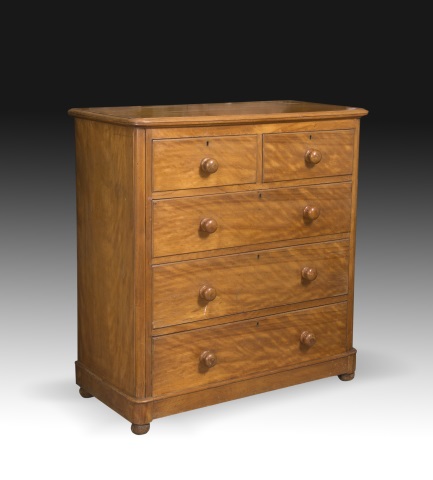
Chest of drawers. Lemonwood. 19th century. A lemonwood chest of drawers with a straight, rectangular top and five drawers at the front (two narrow and three long), decorated with simple flat moldings and spherical legs. This decorative simplicity, which highlights the quality and grain of the lemonwood finish, is reminiscent of English examples., detectedSourceLanguage: es
· Size: 103x49x106 cms.
ANTIQUES
Ref.: Z0312
-
Desk. Carved tropical wood, wood, mirror, metal, glass. 19th century. A tall, carved wooden cabinet with nine drawers at the front (with metal handles) and a lockable compartment above the top containing the writing surface; the upper section features two glass-fronted shelves flanking a rectangular mirror with architectural finials of classical influence. The absence of bronze fittings, the classical influence, and the clean lines are reminiscent of provincial pieces, distinct from, yet influenced by, the major architectural movements.
· Size: 135x56x120 cms.
DECORATIVE ANTIQUES
Ref.: Z0571
-
Sideboard. Mahogany, wood, metal. England, circa 1900. A rectangular chest of drawers with pilastered legs and four drawers at the front, flanking a central space topped by a piece with a semicircular arch at the bottom. In this area, the drawers, legs, and central space display simple linear marquetry decoration. The simplicity of the lines, the material, and the forms of the piece are reminiscent of English designs.
· Size: 52x106,5x85
DECORATIVE ANTIQUES
Ref.: Z0541
-
Bed and bedside table set in rosewood and bronze. France. 19th century
· Size: 123x201x136 cms.
DECORATIVE ANTIQUES
Ref.: Z0692
-
Pair of dais chair frames. Carved wood. Spain, circa 1900. Pair of carved wooden chair frames decorated with baluster-shaped turns on part of the backrests (which have two smooth crossbars leaving the rest openwork), legs and stretchers, thus taking inspiration from old models common in traditional furniture and following a common trend at the time.
· Size: 42x35x66 cms.
DECORATIVE ANTIQUES
Ref.: Z0465
-
Chapel. Mahogany wood. 18th century. Broken glass. A private chapel made of mahogany, with a space protected by a sheet of clear glass (locked) to house a sculpture. The decoration and lines of the piece (straight moldings, columns with entasis and simple capitals, recessed central section, etc.) reflect classicist influences, a common inspiration in 18th-century art.
· Size: 77x37x103 cms. int: 62x21x95 cms.
DECORATIVE ANTIQUES
FURNITURE
Ref.: Z0449
-
Special Offer! -20,00% Off
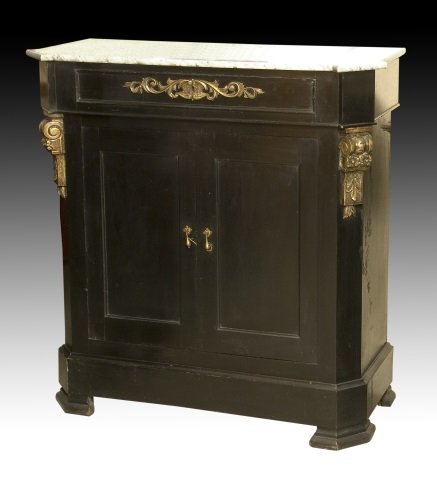
Entredos. Ebonized wood, bronze, marble. France, 19th century. A narrow chest of drawers known as an "entredós," crafted from ebonized wood with bronze appliqués on the chamfered sides and the front, which features a light marble top. The neoclassical influence is evident in both the clean lines and the metalwork (vegetal elements, scrolls, architectural motifs, etc., all of classical influence)., detectedSourceLanguage: es
· Size: 101x40x108 cms.
DECORATIVE ANTIQUES
Ref.: Z0450
-
Small chest. Walnut wood, iron. 17th century. Rectangular chest or casket with a flat lid and an iron lock shield on the front (highlighting the key lock), decorated with simplified plant motifs. The lid features smooth moldings around the edge, which would also be present on the lower section, as was common in these pieces during the 17th century.
· Size: 72x41x44 cms.
DECORATIVE ANTIQUES
Ref.: Z0511