-
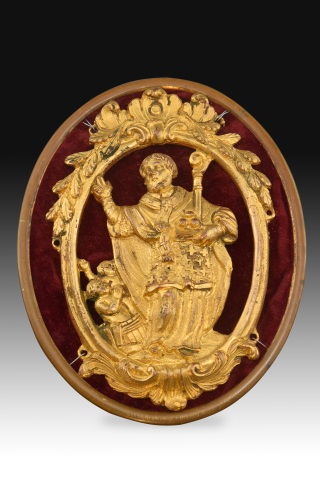
Devotional medal of Saint Nicholas on a stand. Gilt bronze, textile, metal. 18th century. A gilded bronze devotional medal mounted on a wire support with an oval frame adorned with a crest featuring symmetrical vegetal motifs and another finial below, also composed of vegetal elements and volutes. Within this plain frame is the figure of a saint. Standing, holding a staff in one hand and raising the other in a gesture of blessing, is a male figure dressed in liturgical vestments, accompanied by small figures praying, positioned within a barrel or bucket. Saint Nicholas of Myra or Bari was a bishop who died around the middle of the 4th century AD. One of his best-known miracles was the resurrection of three children (depicted in this work) who had been sacrificed by an innkeeper to feed his customers. Although he was bishop of the city of Myra, he is shown here in liturgical vestments but without the customary mitre. The three spheres above the book are believed to allude to the miracle in which the saint helped the father of three girls to gather a dowry for them (as they are three golden spheres).
· Size: 9x11,5x1 cms.
ANTIQUES
SCULPTURE
Ref.: ZF0460
-
Pitcher and glass. Glass. Royal Glass Factory of La Granja de San Ildefonso, Segovia, Spain, 18th century. A pitcher or vase with a lid and a small spout, made of clear, carved, and engraved glass, decorated with plant motifs and architectural elements of classical influence. These were produced at the Royal Glass Factory of La Granja de San Ildefonso, founded in 1727 by Buenaventura Sit, initially as a furnace for flat glass to supply the nearby Royal Palace. Shortly thereafter, they diversified their production, becoming one of the leading glassmaking centers in Spain.
· Size: Jarra 10x10x33 cms. Vaso 13x13x15 cms
ANTIQUES
MISCELLANEUS;OTHER OBJECTS
Ref.: ZF0878
-
Serving cutlery in a case. Silver, silver gilt, textile, etc. Puiforcat, France, circa 1900. With contrast markings. A pair of serving utensils with silver handles in their natural color and gilt-plated parts, decorated with engraved and embossed elements in the Neoclassical tradition, and openwork areas with vegetal motifs. Émile Puiforcat, upon taking over his uncle's company, registered the hallmark that the firm still uses today (a knife flanked by the letters E and P). The rectangular case, with front clasps, features a strip referencing a Brussels jewelry and goldsmith shop called De Coster Paternoster (located at 128 Rue Royale), which sold distinguished pieces such as diamond earrings, cufflinks, etc. Weight: 296 grams.
· Size: 5x1,5x32 cms
ANTIQUES
MISCELLANEUS;SILVER
Ref.: ZF1309
-
Niche. Carved and polychromed wood. Possibly Spanish school, 18th century. A niche for a table, crafted from carved, polychrome, and gilded wood, features a front door with a key lock and gilded wooden elements, as well as a finial at the top. Two side openings allow a view of the interior. Vegetal motifs adorn the corners of these openings. Stylistically, subtle Rococo influences are evident alongside a strong Baroque tradition.
· Size: 55,5x38x74 cms, int: 42x30x65 cms.
ANTIQUES
FURNITURE
Ref.: ZF1363
-
Espetera. Wrought iron. 19th century. Wrought iron decoration following designs common in certain regions of Spain in the past. The piece features a section decorated with wrought iron forming simplified vegetal scrolls and two birds perched at the top for wall mounting. Several hooks hang from this section; three of these are vertical elements ending in tridents and decorated in the same style as the wall-mounted section, but without animals. Compare it to the one preserved in the National Costume Museum in Madrid (originally from Santa María de Riaza) or those in the Palace of the Countess of Lebrija in Seville.
· Size: 71x8x114 cms.
DECORATIVE ANTIQUES
WROUGHT IRON;MISCELLANEUS
Ref.: ZF1525
-
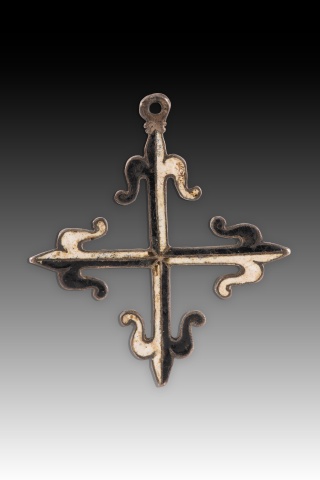
Cross of the Order of Preachers or habit of Saint Dominic. Gilt bronze, enamel. 17th century. A habit or badge with the fleur-de-lis cross of the Order of Preachers, also known as the Order of Saint Dominic or Dominicans, made of gilt bronze and decorated with black and white enamels on the front (the back is plain, with the metal visible). This emblem was commonly used by members (relatives) of the Tribunal of the Holy Office of the Inquisition, as Pope Gregory IX entrusted this order with the persecution of heretics in the bull "Ille humani generis". The Order of Preachers—Latin: Ordo Praedicatorum, abbreviated OP—also known as the Dominican Order or the Order of Saint Dominic, was founded by Saint Dominic and approved by Pope Honorius III in 1216. Its members, when they do, wear a white habit with a scapular and a rosary of twenty mysteries (formerly fifteen) attached to the waist, and a black cape, worn in the choir. Until the 20th century, the tonsure was common. This type of habit or badge is believed to derive from sewn examples and appears frequently in 17th-century portraits, although, as it is a medal used practically from that time onward, it is difficult to date and relatively abundant.
· Size: 6x0.2x6.5 cms.
ANTIQUES
MISCELLANEUS;JEWELRY
Ref.: ZF1553
-
View of Palencia, Monzón Gate. Oil on canvas. Spanish School (A. Rodríguez), 19th century. It shows damage. A landscape depicting a town or city wall in the foreground and a tower with a belfry in the background on the right, accompanied by houses, etc. This type of scene and its execution (brushstrokes, colors, fondness for ruins, etc.) were common in 19th-century European schools, in line with a series of principles and tastes that arose, in large part, thanks to Romantic painting. The image shows the Monzón Gate of the Palencia city walls, with the city's cathedral in the background, in a manner very similar to how it could be seen in 19th-century paintings and engravings such as a lithograph from volume 9 of the series "Recuerdos y bellezas de España" (Lithograph "Puerta de Monzón (Palencia)". Drawn from life by FX Parcerisa; lithographed by S. Isla. Lithographed by J. Donon, [1861]).
· Size: 62x4x45 cms.
DECORATIVE ANTIQUES
PAINTINGS
Ref.: Z5820A24
-
Side table. Marquetry, wood, metal Side table with a chambranle-style top at the bottom, slightly cabriole-shaped legs, three drawers at the front (highlighted with floral marquetry) and a pull-out shelf, and a drawer on the sides. The marquetry decoration is also found on the sides and the top. Note the neoclassical influence in both the form and the decoration.
· Size: 59x44x77 cms.
DECORATION
Ref.: E536
-
Ceiling lamp with bunches of grapes. Metal, glass. Inspired by classic designs. Ceiling lamp with three arms decorated with roses and leaves that end in a central panel crowned by a structure with stems and flowers. From this panel extend three arms that curve and end in three tulip-shaped shades. Both the central panel and the shades feature beadwork on the exterior, which in the case of the shades recreates bunches of grapes., detectedSourceLanguage: es
· Size: 53x53x72 cms.
DECORATION
Ref.: E83
-
Ceiling lamp with bunches of grapes. Metal, glass. Inspired by classic designs. Ceiling lamp with three arms decorated with roses and leaves that end in a central panel crowned by a structure with stems and flowers. From this panel extend three arms that curve and end in three tulip-shaped shades. Both the central panel and the shades feature beadwork on the exterior, which in the case of the shades recreates bunches of grapes.
· Size: 53x53x72 cms.
DECORATION
Ref.: E83A
-
"
· Size: 41x42x135 cms.
DECORATION
Ref.: JB015
-
19th century Chinese console. Painted wood. A traditional Chinese-style console table with a projecting rectangular top supported by brackets carved in the shape of cloud-like scrolls, inspired by architectural motifs. It stands on four simple legs, and beneath the top are two tiers of drawers: three below and two larger ones above, with plain fronts and shelves highlighted by moldings. Below the drawers is a decorative skirt with side scrolls similar to the brackets.
· Size: 101x48x85 cms.
DECORATION
Ref.: XZ014
-
Oriental figure with movement in glazed porcelain. Inspired by 18th-century Meissen models. The sculpture is dressed in the manner understood in 18th-century Europe as Chinese attire. The movement of the head and hands, as well as the decorative motifs and forms, are inspired by very similar works produced at the Meissen porcelain factory in Germany in the 18th century.
· Size: 45x37x44 cms.
DECORATION
Ref.: S4732B
-
Oriental figure with movement in glazed porcelain. Inspired by 18th-century Meissen models. The sculpture is dressed in the manner understood in 18th-century Europe as Chinese attire. The movement of the head and hands, as well as the decorative motifs and forms, are inspired by very similar works produced at the Meissen porcelain factory in Germany in the 18th century.
· Size: 45x37x44 cms.
DECORATION
Ref.: S4732C
-
Pair of wall sconces with three lights. Gold-plated metal. Pair of wall sconces with holders for three candles each, made of gilded metal and decorated with architectural and plant elements inspired by 19th-century Neoclassicism.
· Size: 32x22x52 cms.
DECORATION
AUXILIARY LIGHTING
Ref.: E279
-
Blacksmith's anvil. Wrought iron. Possibly Spain, 17th century. Wrought iron anvil used for a forge, dating from the 18th century, with the shape and wear typical of this type of antique utilitarian piece. Weight: 18 kg.
· Size: 30x10x35 cms.
DECORATIVE ANTIQUES
WROUGHT IRON;MISCELLANEUS
Ref.: Z3634
-
Rectangular table with curved sides. The table stands on four smooth, stipe-shaped legs secured by a low panel that serves as a frame; the waist section features a drawer and gilt metal decorations in the form of ribbon garlands, and follows the lines of the upper tabletop, which is rectangular with circular shorter sides. This latter area is decorated with geometric marquetry.
· Size: 54x31x72 cms.
DECORATION
Ref.: D057
-
Oval table with floral marquetry. The legs, shaped like pilasters, feature gilded metal cubes at the bottom. The table's waist is decorated with a wooden band that contrasts with the legs and the two darker strips flanking it. The tabletop is highlighted with Italian-inspired marquetry: a central motif of objects surrounded by flowers and ribbons within an oval, framed by a floral band.
· Size: 75x54x74 cms.
DECORATION
Ref.: E542
-
Square table with parquet shelf. The four cabriole legs feature a square shelf at their base with curved lines and a parquet marquetry decoration that is repeated at the waist. Gilt metal appliqués are placed on the legs and the front of the table, combining floral and architectural motifs. The green marble top follows the lines of the piece, adding movement without detracting from the marquetry work.
· Size: 54x54x73 cms.
DECORATION
Ref.: E547
-
Pair of figures in glazed porcelain. “The Courtship”. Inspired by models from the Manufacture Nationale de Sèvres (France). Each figure stands on its own base: the young lady carries a basket of flowers, and the gentleman plays a lute. They are dressed in highly idealized peasant clothing, as if intended for the aristocracy. The subject matter, the high quality of the enameling, and the figures' garments show the influence of works from the Manufacture Nationale de Sèvres (France).
· Size: Alt. 34 cms.
DECORATION
Ref.: S4631
-
Writing desk. Bronze. 19th century. On a tray with curved edges, decorated with moldings and scallop shells, sit the four containers that make up the writing set. The sand tray, the feather duster, and the inkwell feature clean lines and smooth surfaces, combined with fine moldings resembling a cord; the oval box with a lid topped with a knob displays smooth moldings across its entire exterior surface. While certain details (particularly the tray) might recall some 18th-century Rococo works, the subdued movement of the tray, the decoration of the containers, the clean lines, and the lack of prominent decorative elements are more characteristic of 18th- and 19th-century Neoclassicism, as is the inspiration drawn from past styles and the combination of various trends in a single piece.
· Size: 25x18x11 cms.
DECORATIVE ANTIQUES
Ref.: Z0376
-
Mirror. Carved and polychromed wood. Spanish school, 20th century, following antique models. Rectangular wall mirror made of wood and decorated with a relief of plant motifs on the front, with a small crest at the top. Stylistically, it is inspired by typical models from the Spanish school of the 18th century.
· Size: 45x5x61 cms.INT 31x43,5 cms.
DECORATIVE ANTIQUES
FURNITURE
Ref.: Z0522
-
Axeman. Wrought iron. Spain, 14th-15th century Candlestick or torch holder for a wax candle made of wrought iron, featuring three flat legs, a vertical axis consisting of a rectangular part with engraved geometric motifs and a longer part with differently arranged corners and a couple of elements in the same material, and a finial of three flat rods ending in a circle. Weight: 7 kg.
· Size: 36x36x164,5 cms.
DECORATIVE ANTIQUES
WROUGHT IRON;MISCELLANEUS
Ref.: Z0742
-
Figures with soldier. Oil on canvas. 20th century. In this oil painting, a series of figures of humble means and all ages are positioned to the right, and a soldier on horseback has his back to the viewer (a detail which, along with his posture, precludes any possibility of a heroic tone in the work). In the background, ruins with rocks occupy most of the canvas, leaving an opening to the horizon and the light of dawn to the left. The influence of Old Flemish models is clear in the painting, both in the figures themselves and in the composition and the ruins.
· Size: 101x81 cms
DECORATIVE ANTIQUES
Ref.: Z4862