-
English “Davenport” desk in walnut wood, 19th century. A desk with four drawers on its side, a lockable inkwell on top, and a hinged top with a key lock. This style is known as the "Davenport" desk because a captain with that surname first ordered this piece of furniture from Gillows of Lancaster towards the end of the 18th century, after which these desks were produced with a remarkable variety of decorative elements. It requires restoration
· Size: 55,5x57x79 cms.
ANTIQUES
Ref.: Z3099
-
Dog-shaped knocker. Wrought iron. Spanish school, 15th century. A wrought iron door knocker with a star-shaped striking piece featuring engraved decoration and a zoomorphic end (a typology common in the Spanish Gothic period, known as "dog-shaped"). These types of pieces were common in important residences, and similar examples are preserved in institutions such as the Provincial Ethnographic Museum of León or on house doors, such as in Valdespino de Somoza.
· Size: 15x5x21 cms.
ANTIQUES
MISCELLANEUS;OTHER OBJECTS
Ref.: Z3687
-
Bedroom decoration. Carved and polychrome wood. Italian school, 19th century. Architectural decoration made of carved and polychromed wood, consisting of a central arcade with a mixtilinear profile and two lateral trilobed arcades flanked by two small benches below. The decoration, featuring vegetal scrolls, diamonds, rhombuses, capitals, etc., is inspired by Italian Renaissance models, incorporating variations common in 19th-century historicist interpretations.
· Size: 252x16x291 cms.
DECORATIVE ANTIQUES
Ref.: Z3854
-
Table leg of contemporary design. Carved and polychromed wood. Table base inspired by 19th-century French neoclassical models featuring a bust of a semi-nude child holding a cushion on his head, with the lower half of his body transformed into a pillar decorated with plant and architectural elements reminiscent of the Rococo style.
· Size: Alt. 65 cms.
DECORATION
Ref.: Z4709
-
Sideboard. Carved walnut wood in its natural color. 19th century. A double-section sideboard with a decorated front, crafted from carved walnut. The lower section features decorative elements on both doors, accentuated by columns on either side; a similar composition is found in the upper section, though the decorative motif on the doors differs. The center is left empty, adorned with various wooden elements. Both the form and decoration of the piece are reminiscent of antique Spanish furniture, with a classicist influence.
· Size: 140x60x237 cms.
ANTIQUES
Ref.: Z4912
-
Special Offer! - Off
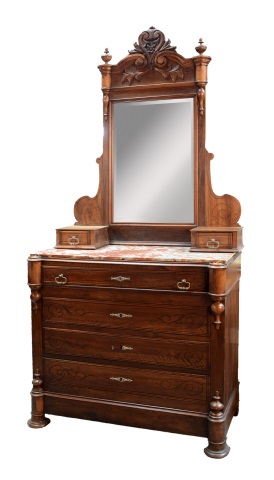
Dressing table with mirror. Wood, glass, metal, stone. 19th century. A chest of drawers with four drawers at the front and a stone top featuring a front panel with two additional drawers, a mirror, and a series of architectural and floral carvings reminiscent of the Elizabethan period. The carvings, centered on the sides of the lower section and on the crest and sides of the mirror, show Neoclassical influences., detectedSourceLanguage: es
· Size: 53x110x100 cms ALT ESPEJO 133 cms.
DECORATIVE ANTIQUES
Ref.: Z4913
-
Mirror of Ferdinand VII. Carved and gilded wood, glass. Circa early 19th century. Rectangular mirror made of carved wood in its natural color, combined with decorations of strong classical influence of carved and gilded wood, reminiscent of bronze appliques that were common in French furniture, which inspired this piece.
· Size: 102x6x197 cms
ANTIQUES
Ref.: Z5300
-
Folding mahogany side table in the George II style, USA (America), circa 1860. A tripod with animal claws gripping a ball serves as the base for the furniture's foot, adorned with a small fluted column and a bulbous plant. The folding mechanism is located above this foot, and the top surface is round with a curved profile flanked by straight sections. American furniture owes much to English design, as this example demonstrates: it follows the so-called George II style, named after the monarch during whose reign it was created (he was born in 1683 and died in 1760), and is based on models taken from Renaissance Roman architecture.
· Size: 78x78x72 cms.
ANTIQUES
Ref.: Z5502
-
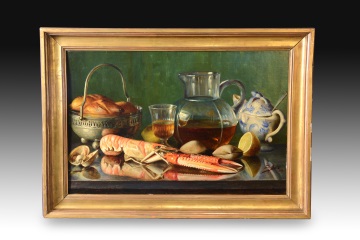
Asterio Mañanós Martínez began his painting studies at the Municipal Drawing School of Palencia with Justo María de Velasco and, from 1877, at the San Fernando School of Fine Arts in Madrid, in the classes of Casto Plasencia and Casado del Alisal. He also frequently visited the Prado Museum, making copies of Velázquez's works. From 1881, he participated in the National Fine Arts Exhibitions. He divided his time between Madrid and Palencia, where he was commissioned to design the curtains and stage curtains for the Teatro de Recreo Palentino. In 1885, he received a grant from the Provincial Council of Palencia to further his artistic training at the Royal Academy of Spain in Rome, which lasted a year. Back in his hometown, he decorated the Teatro de la Peña Palentina with Sabino Ojero. He also opened a drawing academy, named "Casado del Alisal" in honor of his teacher, in collaboration with Isidro Mallol. In 1889, he moved to Paris for a year to study the realist style of Léon Bonnat. Upon returning to Spain, he established his studio in Madrid, where he painted Doña Sancha Before the Corpse of Her Husband and the portrait of Tomás Bretón. From 1908, the Senate's Governing Commission appointed him curator of the Upper House's artworks. The large parliamentary paintings depicting Senate sessions and chambers are a product of this experience. One of his last canvases was an allegory of the Second Republic, now part of the Senate's collection. The place and circumstances of his death are unknown, but it is documented that he was alive in 1935.
· Size: int. 60x40 cms.
ANTIQUES
Ref.: Z6229
-
Frame. Carved and gilded wood. 18th century. A rectangular frame made of carved and gilded wood, combining a thin, smooth band on the inside with another carved band and a third, on the outside, in which smooth areas are combined with delicate vegetal details (these in the same finish as the rest of the molding, highlighted against a striped background). Currently, the value and appreciation of frames are on the rise due to their demand by important museums and institutions, who seek to restore artworks to their original frames. This explains why similar examples can be found in some of Vermeer's paintings, for instance, or in the Metropolitan Museum of Art in New York, the Louvre Museum, the British Museum, and the Victoria & Albert Museum in London, among others.
· Size: 75x6x58 cms. / 50x38 cms.
ANTIQUES
MISCELLANEUS;FRAMES
Ref.: ZE225
-
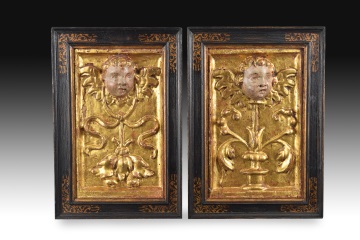
Pair of reliefs; grotesques or candelabra. Carved, polychrome and gilded wood. 16th century. A pair of reliefs made of hand-carved, gilded, and polychromed wood, each depicting a winged cherub's head (or putti) positioned on a vertical element that serves as the axis of symmetry for the relief's composition. The remaining motifs include scrolled leaves, floral and vegetal details, interlacing patterns, and moldings, all clearly influenced by classical art. The background is devoid of any decorative elements, either carved or painted, thus allowing the aforementioned elements to take center stage. These types of compositions were very common during the Renaissance throughout Europe, as the "fashion" for grotesques spread from Italy. Compare, for example, with the frieze depicted in an image from Diego de Sagredo's work entitled "Medidas del Romano" (1526, Toledo); details from the Chapel of Santa Librada in Sigüenza Cathedral by Francisco de Baeza (circa 1520); others from the façade of the Escuelas Mayores of the University of Salamanca; the main altarpiece of the Collegiate Church of Torrijos (Toledo), commissioned in 1558 from Juan Correa de Vivar; etc. It should be noted that these decorative motifs would have a long tradition in Spanish art. It is quite possible that the present relief plaque was created to form part of an altar in a church even though it is not decorated with a religious theme (note that the theme of the “winged heads”, often called “putti”, also comes from Italy and is found in both civil and religious works).
· Size: 14x5x22 cms.
ANTIQUES
SCULPTURE
Ref.: ZE238
-
Reliefs with angels' heads. Polychrome and gilded wood. Spanish school, 16th century. Pair of rectangular panels with a hanging ring on the back, featuring two deep figurative reliefs on the front. Against a gold background are depicted two winged children's heads, one looking to each side. Note the gilded details on the feathers, arranged in a somewhat heraldic style, and the painterly treatment of the hair. This type of relief was very common in the Spanish school from the Renaissance onward for decorating altarpieces, altars, etc. Weight: 600 grams.
· Size: 32x6x11 cms
ANTIQUES
SCULPTURE
Ref.: ZE371
-
Naveta. Silver in its natural color. Salamanca, Spain, 1824-1850. With contrasting marks and text. Silver boat in its natural color with a circular, stepped foot decorated with finished moldings, a curved or shaped foot with lines, and an elongated top part, with a lid on one side and a protrusion on the other side of the piece (note the damage here). The hallmarks on the upper edge (beneath the hinged lid) and on the foot place the manufacture of this vessel in Salamanca, during the years of the renowned assayer known as Bernabé Hidalgo (apparently documented in 1840, considered by some to have been active in the 18th and 19th centuries; there is evidence of a Bernabé Sahagún Hidalgo practicing as an assayer in Salamanca between 1824 and 1850). The other hallmark could not be identified. Note also the inscription “Billaberde” on the foot of the piece. Weight: 454 grams.
· Size: 16x10x18 cms.
ANTIQUES
MISCELLANEUS;SILVER
Ref.: ZE438
-
Fire truck or motorized sprayer. EC Flader of Jöhstadt, Germany, circa 1920. A motorized sprayer designed to be pulled by horses, manufactured by EC Flader of Jöhstadt (name partially visible on the rectangular label on the front of the unit), with a folding compartment and space for machinery in the rear, powered by two spoked wheels and equipped with a vertical bar for securing it to the ground when in use. This type of machinery was used by firefighters, typically in cities, and this particular example is known to have been used, for instance, in 1925 in Wellsdorf.
· Size: 130x230x145 cms.
DECORATIVE ANTIQUES
MISCELLANEUS
Ref.: Z1009A
-
Fire truck or motorized sprayer. EC Flader of Jöhstadt, Germany, circa 1920. A motorized sprayer designed to be pulled by horses, manufactured by EC Flader of Jöhstadt, with a folding compartment and space for machinery in the rear. It is powered by two spoked wheels and has a vertical bar for securing it to the ground when in use. This type of equipment was typically used by firefighters in cities, and the example shown, if accurate, is known to have been used in 1925 in Wellsdorf.
· Size: 340x142x125 cms.
DECORATIVE ANTIQUES
MISCELLANEUS
Ref.: Z1009C
-
Fire engine or irrigation pump. Renault, 20th century. Trailer or cart with motor and two hose heads, hose and other parts and mechanisms that would have been used for watering, spreading water, etc. The brand can be seen on the plate located at the front of the machine.
· Size: 260x130x135 cms.
DECORATIVE ANTIQUES
MISCELLANEUS
Ref.: Z1009D
-
Ceiling lamp. Bronze, glass, metal. 19th century. A ceiling lamp or chandelier with a gilded bronze structure, featuring architectural and classical influences, consisting of a series of openwork arms formed by two metal lines, creating pronounced curves reminiscent of 18th-century French Rococo works. These arms terminate in the traditional saucers and holders for the candle and to catch any dripping wax. As is typical, it has been adapted for electrical use, with the wiring routed externally since the arms lack the internal space for it.
· Size: 65x65x87 cms.
ANTIQUES
FURNITURE
Ref.: ZF0282
-
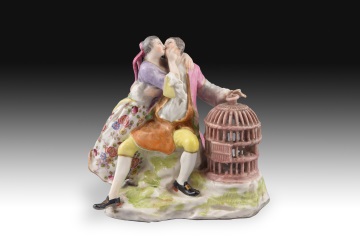
Courtiers and Cage. Glazed porcelain. Model: Johann Joachim. Circa 1800 Enameled porcelain figure with a base resembling rocks and a couple of lovers dressed in the style of the 18th century, with the boy extending his left hand towards a large birdcage. The piece is very similar to figures titled “Lovers with a Cage” made by Du Paquier (who opened a porcelain factory in Vienna in 1719) in 1737, examples of which are preserved in collections such as the Metropolitan Museum of Art in New York and the Indianapolis Museum of Art. Du Paquier, in turn, drew his inspiration from works produced in Meissen by Johan Joachim Kaendler around 1736-1740 (varying in details such as the substitution of the table found in the German pieces with the cage found in the Viennese ones in some examples, or in colors, for instance). If the present work is compared with Du Paquier's works, notable similarities can be seen in poses, elements, etc., but also important differences (coloring, details, base of the figure, etc.).
· Size: 14x12x13 cms.
ANTIQUES
MISCELLANEUS;CERAMIC
Ref.: ZF0445
-
Historical Compendium of the Arquebusiers of Madrid… Soler, Isidro (fl. Ca. 1795). Madrid, 1795. Original, leather binding. 86 pages. Perfect condition. “Historical Compendium of the Arquebusiers of Madrid from their origin to the present time, with two plates on which are engraved the marks and countermarks they used in their works,” by Isidro Soler, arquebusier of Our Lord the King. Pantaleón Aznar Printing House, 1795, Madrid. 86 p., 2 leaves of engraving. Full leather binding with gilt spines and decorated raised bands; gilt edges, back edges and corners; cover with embossed and gilt borders framing a royal superlibris with the Order of the Golden Fleece and a closed crown.
· Size: 15,5x1,5x20,5 cms.
ANTIQUES
MISCELLANEUS;OTHER OBJECTS
Ref.: ZF0568
-
Frame. Gilded and polychrome wood. 17th century. It shows loss in the lower left area. The frame, crafted from carved, gilded, and polychromed wood in certain areas, features a decoration based on bands (alternating plain with others adorned with vegetal and architectural elements) and a raised section at the top with vegetal and architectural motifs. In this area and below, polychromy is combined with gilding. Note the similarity between the decoration and lines of this piece and certain Spanish Baroque altarpieces of the 17th century.
· Size: 105x16,5x101,5 / int 81x57 cms.
ANTIQUES
MISCELLANEUS;FRAMES
Ref.: ZF0631
-
Ceiling lamp. Glass, bronze. Early 20th century. It has faults. Ceiling lamp adapted for electric use with the structure made of bronze and decorated with transparent and colored glass applications, combining simple beads (faceted polygonal beads, teardrops…) with more elaborate ones (balustraded finials, bowl-shaped ornaments, mixed profile beads, etc.), following common models in 19th-century French school works.
· Size: 82x82x102 cms.
DECORATIVE ANTIQUES
FURNITURE
Ref.: ZF0707
-
Floor lamp. Glass, metal. Circa mid-20th century. This floor lamp, crafted from white glass and copper-finished metal, features a base composed of alternating glass clusters and small metal discs, culminating in two horizontal light sources and a metal cup. Its form and decoration are reminiscent of Murano glasswork from Italy dating back to the mid-20th century.
· Size: 55x55x171 cms s/pantalla: 35x35x170 cms
DECORATIVE ANTIQUES
FURNITURE
Ref.: ZF0908
-
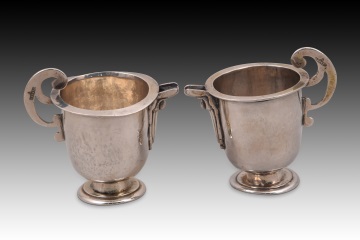
Pair of spouted jugs. Silver. BENITO GÓMEZ, Antonio (1775-1835). Segovia, Spain, 1801-1835. With contrast markings. Pair of spouted jugs with a circular base with moldings, a low conical foot and a tubular body ending in a hemisphere at the bottom and with a flat molding at the top; the handle, in a double C shape, has a simple volute or branch that rests towards the mouth of the piece; the spout shows a simple decoration. Typologically, this pair is linked to a type of spouted jug that, with variations, was common in Spanish domestic silverware from the first half of the 17th century until the beginning of the 18th century, and was also found after that date. As is typical, the secular model was quickly adopted by religious silverware, especially for use in liturgical cruets. Antonio Benito Gómez (1775-1835) was a silversmith who worked in Segovia from at least 1801 until his death, also serving as a silversmith's marker between 1824 and 1828, and again between 1831 and 1835. The son of silversmith Juan de la Cruz Benito, several of his works have been preserved: a baptismal shell and veil for the Church of Vera Cruz in Zamarramala, a holy water sprinkler located in the Church of Our Lady of Sorrows in La Granja de San Ildefonso (Segovia), and others. Stylistically, most of his known work is clearly Rococo in style, although some Neoclassical pieces stand out.
· Size: 8,5x5,5x8 cms.
ANTIQUES
MISCELLANEUS;SILVER
Ref.: ZF0984
-
Uniform of Honor, Order of Malta. Spain, possibly from the early 20th century. A blue jacket or coat and trousers, the former bearing a label from the tailor shop Félix del Hierro, which was located on Barquillo Street in Madrid, Spain, and had another branch on Almirante Street in the same city. It is known to have been active until at least 1946. The Sovereign Military Hospitaller Order of Saint John of Jerusalem, of Rhodes and of Malta (SMOM), known simply as the Order of Malta or Knights Hospitaller, was recognized by Pope Paschal II in 1113. After having provisional headquarters in Messina, Catania, and Ferrara, the Order finally settled in Rome in 1834. During the 20th century, the Order refocused on its mission of providing hospital care.
· Size: 50x5x90 cms.
ANTIQUES
MISCELLANEUS;OTHER OBJECTS
Ref.: ZF1448