-
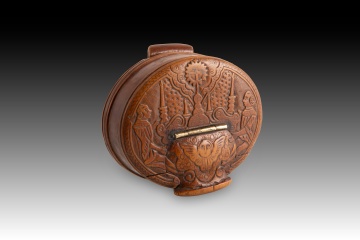
Tobacco box or snuff box. Carved wood, metal. Northern European school, 18th century. It has minor flaws. A small, carved wooden box with two hinged openings (one on each side). It is decorated with a series of figurative reliefs of religious themes. On one side, two male figures flank an altar with candles, upon which rests a cross with a burst of glory; the lid features a winged angel's head. The other side depicts a heart surmounted by a trilobed element surrounded by what appears to be a crown of thorns and flanked by two elements extending into the box. Inside the box is a crucifixion scene, with Jesus at the top, flanked by the two thieves, and elements of the Passion filling the rest of the space (the rooster of the denial, nails, pincers, the lance, a ladder, Veronica's veil, etc.). The wood is possibly boxwood. As for the decoration and morphology of the piece, it shows clear similarities to 18th-century works from Northern Europe, particularly those of the Flemish school. A very similar snuffbox (in shape and decoration) is known to exist in a private collection, considered to be a Dutch work from around 1700.
· Size: 7,3 x 8,7 x 3 cms.
ANTIQUES
MISCELLANEUS;OTHER OBJECTS
Ref.: ZF1509
-
Trumeau mirror. Synthetic material imitating gilded wood, glass. Mirror decorated with interlacing patterns and plant motifs, divided between an oval and a rectangular area. It shows a clear influence of 19th-century French Neoclassical models.
· Size: 110x6x235 cms.
DECORATION
Ref.: E550
-
Allegory of Music. Oil on framed porcelain. 20th century. The scene is set in a natural environment with a forest and classical ruins, showing a series of figures dancing, sitting, playing musical instruments, etc. Note the three young women dancing and the child on a panther, reminiscent of works inspired by European Neoclassicism of the 18th and 19th centuries and, in particular, paintings related to the god Bacchus or Dionysus.
· Size: 73x3x53 cms. int: 60x40 cms
DECORATION
Ref.: SA022
-
Wide cup on a green marble pedestal. A vase-like form rises from a low column with a smooth, cylindrical shaft and base, supporting a wide cup with an outward-curving rim. Besides its material, the work is notable for its elegance and clean lines, and for its connection to models inherited from 19th-century Neoclassicism.
· Size: 80x80x106 cms.
DECORATION
Ref.: M0131A
-
Desk with marquetry decoration and one drawer. The four pilastered legs feature marquetry and line work that accentuate the forms. The waist of the piece follows the shape of the top panel and has a drawer at the front. This drawer is decorated with marquetry featuring plant motifs with outlined outlines arranged in rectangles framed by metal cords. The top panel displays prominent marquetry scrolls with lines and frieze bands, combining woods of different tones.
· Size: 97x48x80 cms.
DECORATION
Ref.: D159
-
Oriental sideboard. Carved and polychrome wood. 19th-20th centuries. A four-legged table with a rectangular top that projects slightly from the body of the piece and a front carved in a subtle relief, clearly distinguishing each of its five drawers. The decorative motifs, color scheme, and overall appearance (with areas that seem lacquered) follow ancient Chinese examples, but it is also possible to observe particular differences from what was typical of 19th-century Chinese furniture in the West (proportions, combination of decorative techniques).
· Size: 91x45x89 cms.
DECORATION
Ref.: XM076
-
Oriental sideboard. Carved and polychrome wood. 19th-20th centuries. A rectangular, straight-topped cabinet decorated on the sides with geometric elements and on the front with elaborate carvings of plant motifs highlighting the ovals in its five drawers, which feature floral compositions and figurative scenes against a black background. Both its form and decoration clearly demonstrate the piece's connection to antique Chinese furniture.
· Size: 87x45x89 cms
DECORATION
Ref.: XM087
-
Special Offer! - Off
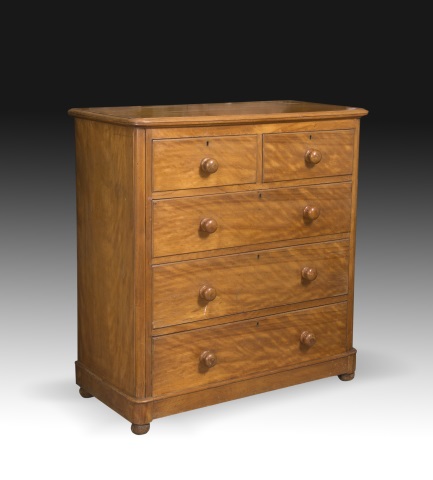
Chest of drawers. Lemonwood. 19th century. A lemonwood chest of drawers with a straight, rectangular top and five drawers at the front (two narrow and three long), decorated with simple flat moldings and spherical legs. This decorative simplicity, which highlights the quality and grain of the lemonwood finish, is reminiscent of English examples., detectedSourceLanguage: es
· Size: 103x49x106 cms.
ANTIQUES
Ref.: Z0312
-
Walnut wood wing table with claw legs, 19th century. The rectangular table, supported by four eagle-like legs grasping balls, features a drawer and two folding tabletops (from which this type of table derives its name). The piece's decorative simplicity stems from its design as a primarily functional piece of furniture, although it displays the characteristic use of decorative elements from various traditions, a common feature in 19th-century art. The legs are very common in 18th-century English examples ("claw and ball" with cabriole legs), and the wood used is the most typical for Spanish furniture.
· Size: abierta 138,5x 117 x 78 cerrada 57x117x78 cms.
DECORATIVE ANTIQUES
Ref.: Z0485
-
Parapet. Wrought iron. Castilian school, 16th century Parapet made of wrought iron decorated with a series of vertical balustraded shapes enhanced with curves topped with simple floral elements, and a spherical finial at one end.
· Size: 180x45x85 cms.
DECORATIVE ANTIQUES
WROUGHT IRON;MISCELLANEUS
Ref.: Z1048
-
Still. Copper, iron handles. 19th century. A still with a bell-shaped copper body, a cap on top with the usual fitting for these objects, and a simple support for placing the apparatus over the fire. It has four iron handles for moving it. Used to perform the distillation process.
· Size: 80x80x125 cms.
DECORATIVE ANTIQUES
Ref.: Z3694
-
Barber's chair. Iron, porcelain, etc. Triumph, Spain, circa early 20th century. 1 unit available. Iron barber chair with a highly ornate footrest featuring plant motifs and the name of the patent holder, with a cane seat and backrest and a red fabric headrest, matching the area next to the footrest. It is very likely an example of the Gran Lujo Nº1 model, which was manufactured in Spain under a foreign patent in 1910, and is one of the most highly regarded in Spain.
· Size: 79x110x120 cms.
DECORATIVE ANTIQUES
MISCELLANEUS
Ref.: Z3939
-
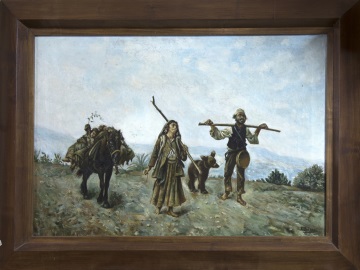
“Gypsies”. Oil on canvas. Signed “A. Briones”. 20th century. Oil on canvas depicting a barely sketched natural landscape in the background, giving prominence to the figures advancing in the foreground. The man on the right carries a staff over his shoulder and several other items, and is accompanied by a bear cub. In the center, a woman walks with a walking stick over her shoulder, leading a horse laden with more objects and some children. The painting depicts a Gypsy family on their way to a performance involving a bear cub. Between the 15th and 18th centuries, artistic representations of Gypsies were stereotypical and scarce, with only a few engravings, tapestries, and paintings such as David Teniers III's "Landscape with Gypsies" in the Prado Museum (inv. Poo1818). The 19th century saw the flourishing of Gypsy motifs in the visual arts, driven by the interest of foreign artists drawn to the "exotic" nature of these people. These artists depicted what they considered their most folkloric features, with Fortuny and Sorolla being particularly noteworthy. This work aims to highlight the unique characteristics of the Roma people, but without dwelling solely on stereotypes, clearly depicting the hardships of their lives and the loneliness that accompanied them. Technically, its connection to innovative contributions to French painting from the late 19th century onward is evident. Thematically, it is reminiscent of works of social realism (a painting movement that emerged in France around the mid-19th century).
· Size: 97x64 cms. 86x117 cms.
DECORATIVE ANTIQUES
Ref.: Z4081
-
Chest. Walnut wood, iron. Burgos, 17th century. A rectangular chest with a flat lid, made of carved walnut wood, with corner pieces and a lock on the front for securing it with a key. The lower part features a carved decoration with simple geometric elements, and simple lines adorn the outer edge of the lid. This type of furniture was very common in Spain, frequently used to store valuable items such as clothing, tableware, and so on.
· Size: 169x52x73 cms.
ANTIQUES
Ref.: Z4841
-
Grille with two gates. Wrought iron. Spain, 17th century. A wrought iron window grille featuring two smooth, circular cross-section rails in the center, inserted between the vertical bars. These rails are decorated with small discs and balustrade-like shapes (adding a subtle sense of movement) between the two rails, with the two pieces facing each other to create harmony. The decorative details mentioned refer to Baroque works of this material from the 17th century: compare, for example, with the balconies of the Casa de Panadería in the Plaza Mayor of Madrid, or with Spanish pieces preserved in the Victoria and Albert Museum in London, a confessional grille in the Metropolitan Museum of New York dated 1629 (inv. 57.137.51) and another in the same museum made by the master Francisco González (inv. 56-234.12Ad).
· Size: 120x38x133 cms.
ANTIQUES
MISCELLANEUS;OTHER OBJECTS
Ref.: Z5602
-
Display case. Walnut wood. 19th century. A tall display cabinet made of carved walnut wood with interior shelves and a glass door secured with a key, decorated with carvings of architectural elements clearly influenced by classical architecture. These details show a certain French influence, common in 19th-century European furniture.
· Size: 38x70x166 cms.
DECORATIVE ANTIQUES
Ref.: Z5731
-
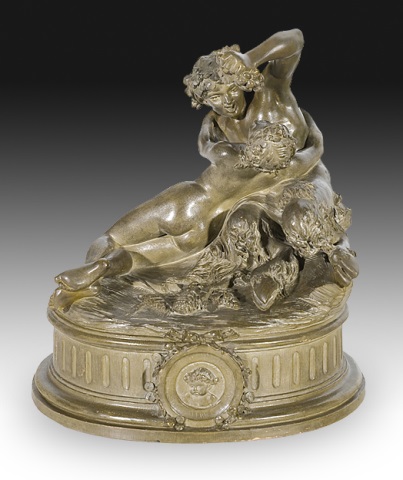
“Satyr”. Patinated terracotta. Following models by Claude Michel Clodion (France, 1738-1814). Late 19th-early 20th century. A patinated terracotta sculpture consisting of an oval base decorated with simple architectural elements of classical influence and a tondo with a bust adorned with a garland, and two figures. These figures, reclining at the top, are a satyr (with his characteristic goat-like legs) holding a bunch of grapes, and a young nymph embracing him as she tries to reach the fruit. Compare this sculpture (though not so much the base) with the one entitled “Nymph and Satyr” in the Calouste Gulbenkian Museum in Lisbon, Portugal, attributed to the sculptor Claude Michel, noting the similarities and differences. Pieces similar to this work, also known as “Satyr Feeding a Nymph with Grapes,” are held in several private collections. Claude Michel “Clodion” (1730–1814) was a French sculptor who trained with Lambert Sigisbert Adam and Jean-Baptiste Pigalle. He received numerous awards (Prix de Rome in 1762, etc.) and maintained a prominent workshop in Paris from 1771. While he also produced large-scale works, he is best known for his small-format sculptures in bronze (or other materials such as calamine or terracotta). These works had a significant influence both during his lifetime and long after his death, inspiring countless other works.
· Size: 38x31x40 cms.
ANTIQUES
Ref.: Z5882
-
CASWELL, William Frederick (United Kingdom, act. 1870 – 1914). "Landscape". Watercolor on paper. Signed with initials in the lower right corner. . In this work, Caswell offers us an evocative landscape with romantic roots, typical of English landscape painting of the time, worked with a light and translucent chromatism that gives a special luminosity to the scene, enhancing at the same time its mysterious atmosphere. William F. Caswell, a British painter active between 1870 and 1914, worked in landscape and portraiture using oil and watercolor, and also produced series of prints such as "Le Barnabooth et autres bêtes modernes." He was a member of the Royal Birmingham Society of Artists, where he exhibited his works regularly.
· Size: 78x103 int 49x71 cms
ANTIQUES
Ref.: Z6194
-
Enameled porcelain and engraved glass box. 19th century. Oval box with an engraved glass base and a hinged lid, the latter crafted from a combination of enamel and metal. The lower section depicts a bucolic landscape with human figures and buildings, combining trees with lakes and dry land. The upper section follows the same theme: a couple in an idealized rural setting.
· Size: 7,5x6x4,5 cms.
ANTIQUES
MISCELLANEUS;OTHER OBJECTS
Ref.: Z6447
-
Table. Walnut wood. 17th century. Table with a plain rectangular top and two drawers at the front, decorated with simple geometric shapes on their fronts, leaving a strip with tabs between them. The legs, joined at their lower rectangular joint by means of a plain stretcher, show an elaborate turned carving in discs, following the usual in the Baroque.
· Size: 64x97x74 cms.
ANTIQUES
Ref.: Z6778
-
Toiletry case. 19th century. Tortoiseshell, metal, glass. Rectangular case with hinged lid made of tortoiseshell decorated with fine inlays of plant and floral elements on its sides, containing a toiletry set made up of several feminine grooming and personal use items (a small bottle of perfume, scissors, a thimble…), with a space designed for each of these utensils.
· Size: 6x3x8 cms.
ANTIQUES
MISCELLANEUS;OTHER OBJECTS
Ref.: Z6854
-
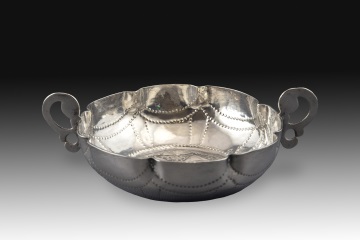
Wine tasting glass or shudder. Silver. 18th century. Without contrast marks. A vessel known as a wine glass or tembladera, with two closed, flat, S-shaped handles and a line of "bites" (scalloped shapes) highlighted by bands of dots that extend into the interior of the piece. The bottom has a star-shaped pattern (leaving some stripes smooth and with a glossy finish, forming a Maltese Cross, and combining the remaining areas with the same finish with others in diamond-shaped, pricked luster with dots). The bernegales and tembladeras de bocados were common pieces in 17th-century Spanish silverwork, generally becoming relegated to less important centers in the 18th century. Compare with pieces such as the silver bernegal from the last third of the 17th century in the Lázaro Galdiano Museum (perhaps of the Portuguese school; inventory 3916), or the one dated between 1640 and 1665 in the same museum (inventory 3910), or the one by José Jiménez de Illescas (inventory 3915, dated 1715-1725) in the same institution. Weight: 83 g.
· Size: 14,5x11x3 cms.
ANTIQUES
MISCELLANEUS;SILVER
Ref.: ZE192
-
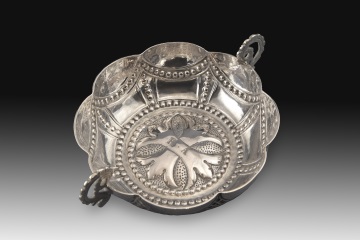
Wine tasting glass or shudder. Silver. 18th century. No contrast marks. With ownership initials. A vessel known as a wine glass or tasting glass, with two flat, curved handles decorated with simplified plant motifs, and a line of scalloped shapes along the rim, enhanced by bands of recessed dots that remain in relief on the interior of the piece, where they extend and frame the background decoration. In this area is a Greek cross with a fleur-de-lis or floriated design in a smooth, glossy finish, engraved with the letters "RA" (owner's initials), standing out against a background of dotted stippling. The bernegales and tembladeras de bocados were common pieces in 17th-century Spanish silverwork, generally becoming relegated to less important centers in the 18th century. Compare with pieces such as the silver bernegal from the last third of the 17th century in the Lázaro Galdiano Museum (perhaps of the Portuguese school; inventory 3916), or the one dated between 1640 and 1665 in the same museum (inventory 3910), or the one by José Jiménez de Illescas (inventory 3915, dated 1715-1725) in the same institution. Weight: 94 g.
· Size: 13,5x10,5x4,5 cms
ANTIQUES
MISCELLANEUS;SILVER
Ref.: ZE193
-
Wine tasting glass or shudder. Silver. 17th century. Without contrast marks. A vessel known as a wine glass or tasting glass, with two flat, closed "S"-shaped handles (decorated with simplified plant motifs) and a line of "bites" (scalloped shapes) highlighted with bands of dots. On the inside bottom, there is an eight-petaled flower engraved with a cross inside. The bernegales and tembladeras de bocados were common pieces in 17th-century Spanish silverwork, generally becoming relegated to less important centers in the 18th century. Compare with pieces such as the silver bernegal from the last third of the 17th century in the Lázaro Galdiano Museum (perhaps of the Portuguese school; inventory 3916), or the one dated between 1640 and 1665 in the same museum (inventory 3910), or the one by José Jiménez de Illescas (inventory 3915, dated 1715-1725) in the same institution. Weight: 96 g.
· Size: 15x10,5x4,5 cms.
ANTIQUES
MISCELLANEUS;SILVER
Ref.: ZE195