-
Sold
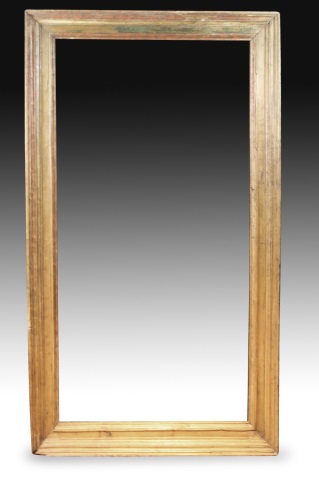
Frame. Carved wood. 17th century. It has faults. Rectangular frame made of carved wood that still retains some of its original polychromy. As was common in several European schools since the Renaissance (particularly the Italian, but also the Spanish, for example), it is decorated with a series of smooth moldings of varying widths, arranged to leave a plain band., detectedSourceLanguage: es
· Size: Ext 175x95 cm Int: 1.55x74 cms.
ANTIQUES
MISCELLANEUS;FRAMES
Ref.: Z6224
-
Carmelite parapets. Iron. Spain, 19th century. Parapets or fragments of low railings made of iron and decorated with a series of geometric elements surrounding two shields, which feature a crown as a finial and a composition with three stars and a cross above a moment. This heraldry links the present piece to the Order of the Brothers of the Blessed Virgin Mary of Mount Carmel, also known as the Carmelite Order, founded around the 12th century.
· Size: 100x5x100 cms.
DECORATIVE ANTIQUES
WROUGHT IRON;MISCELLANEUS
Ref.: ZE362
-
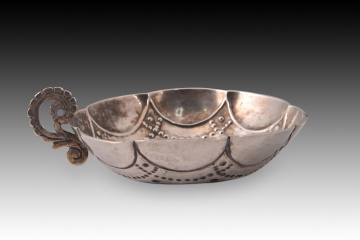
Wine-tasting glass or wine cup. Silver. 18th century. One handle is missing. A vessel known as a wine glass or tembladera (due to its lack of a foot), made of silver in its natural color, with a flat, curved, S-shaped handle decorated with simplified vegetal motifs, and a line of scalloped shapes around the rim, highlighted by a plain band. The interior features strings of pearls and dots, and a cross at the bottom. Bernegales and tembladeras with scalloped shapes were common pieces in 17th-century Spanish silverwork, but were generally relegated to less prominent centers in the 18th century. Compare with pieces such as the silver bernegal from the last third of the 17th century in the Lázaro Galdiano Museum (perhaps of the Portuguese school; inventory 3916), or the one dated between 1640 and 1665 in the same museum (inventory 3910), or that of José Jiménez de Illescas (inventory 3915, dated 1715-1725) in the same institution. Weight: 101 grams.
· Size: 12x10x4 cms.
ANTIQUES
MISCELLANEUS;SILVER
Ref.: ZE367
-
Mirror. Molded and polychromed alabaster. 20th century. Wall mirror made of molded alabaster with polychrome decoration, featuring a frame of classically influenced architectural elements and a series of figurative elements in the same style (two semi-nude female figures, possibly allegorical, a child's head with two pairs of wings, two putti with garlands below). Weight: 36 kg.
· Size: 120x9x122 cms
DECORATIVE ANTIQUES
FURNITURE
Ref.: ZE402
-
Wall mirror. Molded alabaster. 20th century, following Renaissance models. Rectangular wall mirror with a frame made of molded alabaster, polychromed and decorated with a series of elements strongly inspired by classical art (candelabra on the sides, a scallop-shaped crest, flanking architectural motifs, grotesques with children and fruit, etc.). Stylistically, the piece is inspired by Renaissance models, with a certain resemblance to details found in pieces from the Spanish school. Weight: 35 kg.
· Size: 99,5x10x157 cms
DECORATIVE ANTIQUES
FURNITURE
Ref.: ZE409
-
Silver spice rack. Stefano Olivero, Italy. Possibly 19th century. Silver spice rack raised on simple legs, located at the chamfered ends of the piece, decorated on the exterior with garlands and other architectural elements of classical influence in slight relief. Weight: 198 grams.
· Size: 5,5 x 8,5 x 6,5 cm
ANTIQUES
MISCELLANEUS;SILVER
Ref.: ZF0006
-
Freestanding coat and umbrella stand, inspired by classic models. Made of aluminum.
· Size: 100x47x206
DECORATIVE ANTIQUES
FURNITURE
Ref.: ZF0717
-
Bronze bell. India, 20th century. This bronze bell has a tall, oval-shaped body at its base, almost rectangular in height, and an elaborate upper section with smooth areas and figures made of the same material. In addition, it is decorated with fine reliefs of geometric and floral motifs concentrated in specific areas throughout the piece.
· Size: 47x47x100 cms
DECORATIVE ANTIQUES
MISCELLANEUS
Ref.: ZF0859
-
Table clock. Bronze. 1990s, following designs by August Moreau. In working order. Table clock with a raised base and gilt bronze legs, following 19th-century designs, and a white dial with Roman numerals for the hours. It is topped with a bronze child figure based on a design by Auguste Moreau (1834-1917), a French sculptor known especially for his delicate and naturalistic works within the Art Nouveau movement, of which he was a leading figure. He created busts, figures, and small sculptures, and his designs were subsequently adopted by many other bronze sculptors due to the artist's success and the quality of his pieces. Weight: 22 kg.
· Size: 35X22,5X64 cms
ANTIQUES
MISCELLANEUS;CLOCKS
Ref.: ZF1410
-
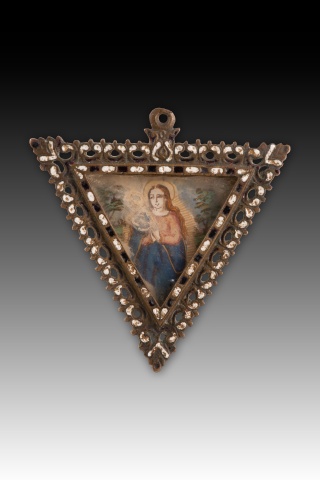
Devotional or steadfast medallion. Bronze, enamel, glass, etc. Spanish school, 17th century. It has faults. A devotional medallion commonly known as a "steadfastness" or "steadfastness in faith" medal, or a "confraternity badge" due to its shape. It consists of a triangular frame with a ring for hanging and simple enameled elements (juxtaposed "C" shapes, bands, and vegetal motifs), and two fronts, leaving a small space in the center of each, sometimes used to hold relics. On one side, the typical reverse of this type of piece is visible: the IHS with the second letter surmounted by a Latin cross and resting on three nails, all surrounded by vegetal motifs and enameled in various colors. The front displays a three-quarter view of the Virgin Mary (most likely an Immaculate Conception, following the usual iconography) against a natural landscape. This type of devotional medallion appears frequently in Barcelona apprenticeship examinations dated around 1620-1630, but examples have also been found in Toledo, Córdoba, Seville, and other cities. Experts generally mention a series of confraternity plaques or medallions (oval, rectangular, octagonal, or triangular) produced in Spanish workshops primarily between 1620 and 1640. Their iconography is generally heavily influenced by the teachings of the Council of Trent, and they also proliferated overseas.
· Size: 8x0.5x8 cms.
ANTIQUES
MISCELLANEUS;JEWELRY
Ref.: ZF1548
-
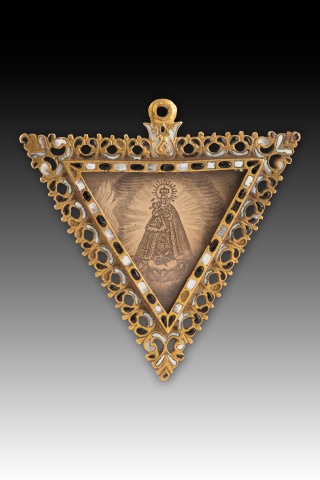
Devotional or steadfast medallion. Bronze, enamel, glass, etc. Spanish school, 17th century. It has faults. A devotional medallion commonly known as a "steadfastness" or "steadfastness in faith" medal, or a "confraternity badge" due to its shape. It consists of a triangular frame with a ring for hanging and simple enameled elements (juxtaposed "C" shapes, bands, and vegetal motifs), and two fronts, leaving a small space in the center of each, sometimes used to hold relics. On one side, the typical reverse of this type of piece is visible: the IHS with the second letter surmounted by a Latin cross and three nails, all surrounded by vegetal motifs and enameled in various colors. The front shows what appears to be an engraving of the Virgin Mary with the Child Jesus in her arms. Note the presence of gilding. This type of devotional medallion appears frequently in Barcelona apprenticeship examinations dated around 1620-1630, but examples have also been found in Toledo, Córdoba, Seville, and other cities. Experts generally mention a series of confraternity plaques or medallions (oval, rectangular, octagonal, or triangular) produced in Spanish workshops primarily between 1620 and 1640. Their iconography is generally heavily influenced by the teachings of the Council of Trent, and they also proliferated overseas.
· Size: 8x0.5x8 cms.
ANTIQUES
MISCELLANEUS;JEWELRY
Ref.: ZF1549
-
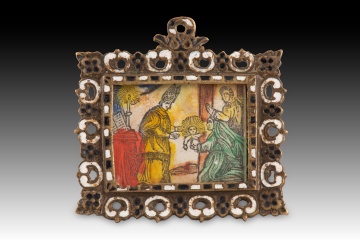
Devotional pendant or confraternity plaque. Bronze, enamel, etc. Spain, 17th century. It has faults. Devotional medallion consisting of a frame (with a ring at the top and decoration of alternating C's and flowers in black and white enamel, and an inner line of enamel bands of the same color) and two fronts. The front, protected by a glass plate, features a hand-painted engraving of the Presentation of the Child Jesus in the Temple. The back has an openwork plaque with two figures (likely angels) flanking a chalice from which a Sacred Host protrudes, along with a Cross, all surrounded by vegetal elements in white, black, and blue enamel. Experts mention a series of confraternity plaques or medallions (oval, rectangular, octagonal, or triangular) made in Spanish workshops between around 1620 and 1640, primarily in workshops in Toledo, Salamanca, Cordoba, Seville, etc., and also overseas. Their iconography is generally heavily influenced by the teachings of the Council of Trent.
· Size: 6,5x0.5x6,5 cms.
ANTIQUES
MISCELLANEUS;JEWELRY
Ref.: ZF1550
-
Devotional pendant or confraternity plaque. Bronze, enamel, etc. Spain, 17th century. It has faults. Devotional medallion consisting of a frame (with a ring at the top and decoration of alternating C's and flowers in colored enamel, an inner line of white enamel stripes in two corners and black in the rest) and two fronts. The painted scene that is usually present on the front is missing. The back features an openwork plaque with two palms flanking a chalice from which a Sacred Host with a Cross protrudes, all surrounded by vegetal elements in colored enamels. Experts mention a series of confraternity plaques or medallions (oval, rectangular, octagonal, or triangular) made in Spanish workshops between around 1620 and 1640, primarily in workshops in Toledo, Salamanca, Cordoba, Seville, etc., and also overseas. Their iconography is generally heavily influenced by the teachings of the Council of Trent.
· Size: 6.5x0.5x6.5 cms.
ANTIQUES
MISCELLANEUS;JEWELRY
Ref.: ZF1551
-
Pax bearer. Bronze. 16th century. A bronze pax with an asymmetrical S-shaped handle on the back, featuring a low-relief decoration on the front framed by an architectural composition adorned with classical elements (a scallop shell finial, vegetal motifs in the upper section, columns with decorated shafts, architrave, and a base with semicircular arches). A heraldic shield is located in the center of the lower section. Beneath a winged angel's head is the central theme of the pax: Lamentation over the Dead Christ, with the cross in the background, Mary with Christ, flanked by two figures. The heraldic shield is very similar to that of the House of Mendoza used by Íñigo López de Mendoza y de la Vega, 1st Marquis of Santillana, and progenitor and head of the Ducal House of Infantado (which also presents it).
· Size: 7,5x4x12 cms.
ANTIQUES
MISCELLANEUS;OTHER OBJECTS
Ref.: ZF0541A
-
Chest of drawers. Carved and polychrome wood, metal. A chest of drawers with four slightly cabriole-shaped legs and curved fronts, decorated with polychrome roses and plant motifs, a top following the contours of the piece, and two drawers. The design is inspired by 19th-century French furniture.
· Size: 110x47x82 cms.
DECORATION
Ref.: E430
-
· Size: 37x124x90 cms.
DECORATION
Ref.: AJ527
-
Dining table. Tropical wood. Inspired by classic designs. Dining table with a rectangular tabletop slightly protruding from the waist (which features a carved decoration of geometric elements) and supported by four cabriole legs, carved at the knees with plant motifs of classical influence, decoration which can also be seen in a more simplified form at the bottom of the legs.
· Size: 84x180x75 cms
DECORATION
Ref.: JD002
-
Bronze lamp base, “Lady with vase of roses”. The figure stands on a stepped circular pedestal topped by an Ionic column. The young woman is depicted placing a vase of roses on the column, which is surmounted by a translucent glass torch that conceals the light source.
· Size: 30x30x80 cms.
DECORATION
Ref.: V3029
-
Collection of eighteen handles. Wrought iron. 17th century. A set of 18 wrought iron handles of varying sizes, dimensions, and decoration, some retaining the piece that anchors to the door and others not. Note that, in general, they conform to the baluster style common at the time, except for a few that feature details inspired by older pieces.
· Size: Mayor 15x3x3 cms Menor 10x2x2 cms.
DECORATIVE ANTIQUES
WROUGHT IRON;MISCELLANEUS
Ref.: Z0007
-
Two chairs. Walnut wood. 17th century. Chairs made of carved walnut wood with openwork backs decorated with four crossbars, one with discs and the other with balustrade-like forms, both featuring moldings at the bottom, following common designs in 17th-century Spanish Baroque cabinetmaking. These types of pieces are not as commonly preserved as the most outstanding examples because they were used frequently and replaced as fashions changed.
· Size: 42x37x89 / 40x36x85 cms.
DECORATIVE ANTIQUES
Ref.: Z0291
-
Special Offer! - Off
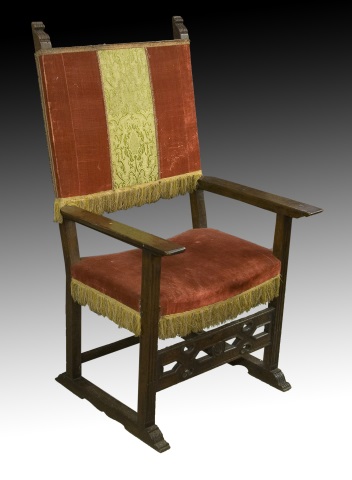
Friar's chair. Walnut wood, textile. Spain, 17th century. Armchair with arms and a high back, of the type known as a "frailero" (friar's chair), upholstered in red and yellow fabric, with fringe on the seat and the lower part of the back. The carved decoration of vegetal motifs and fluting is concentrated on the backrest finials and the front of the piece; the openwork stretcher between the front legs displays simple geometric shapes and curved details surrounding a carved mask. Originally of Italian origin, the frailero armchair became one of the most common pieces of Spanish furniture after its introduction in the 16th century, being characteristic of that century and the 17th, and experiencing a revival in the historicist movement of the 19th century., detectedSourceLanguage: es
· Size: 72x61x130
DECORATIVE ANTIQUES
Ref.: Z0381
-
Cupboard with marbled finish. Carved wood, metal. 20th century. A carved wooden cupboard with three shelves at the bottom and two doors at the top, which provide access to two additional compartments. It has been painted with a marbled finish, reminiscent of veined wood. Both its decoration and lines evoke antique Spanish school pieces.
· Size: 125x35x200 cms.
DECORATIVE ANTIQUES
Ref.: Z0594
-
Miniature moon cabinet. Walnut wood. 19th century. Miniature wardrobe with one door (inside, two shelves and a drawer) and a drawer with two handles, featuring an exterior mirror and decoration based on architectural elements, plants, and moldings with a clear classical influence. The piece shares common elements with 19th-century Spanish Alfonsine wardrobes (columns on the front, mirror on the door, finials at the top, etc.).
· Size: 43x29x94 cms.
DECORATIVE ANTIQUES
Ref.: Z0596
-
Isabeline sofa. Mahogany wood, textile. Spain, 19th century. A sofa or three-piece suite made of carved mahogany, upholstered inside and out in yellow or gold-toned fabric, with plush button tufting on the inside of the backrest. The legs, with their slightly curved shape, and the base feature simple decoration of carved geometric elements, while the high backrests are adorned with more elaborate vegetal crests. This type of furniture, with its strong French influence, was common during the Elizabethan period, a style so named because it reached its peak during the reign of Isabella II (1830-1904).
· Size: 200x65x100 cms.
DECORATIVE ANTIQUES
FURNITURE
Ref.: Z0604