-
Spice rack. Silver. DE CASTRO, Damián. SÁNCHEZ SOTO, Juan. Spain, Córdoba, second half of the 18th century. With contrast markings. Silver spice rack in its natural color with a truncated conical body, a sinuous lower rim resting on scroll-shaped feet with vegetal motifs, a semi-spherical, undivided bowl, a domed hinged lid, and decoration with high-relief vegetal elements. The lid features a rose surrounded by a line of dots creating waves. Hallmarks place the piece in Córdoba, as verified by Damián de Castro, and indicate it was made by Juan Sánchez Soto (likely the son, brother of Cristóbal), in the second half of the 18th century. Typologically, it belongs to a somewhat unique tradition or style, common in Córdoba and Madrid but also found in Girona, Antequera, and other locations. Weight: 87 grams.
· Size: 7,5x6x5 cms
ANTIQUES
MISCELLANEUS;SILVER
Ref.: ZF0982
-
Spice rack. Silver. DE LUQUE Y LEYVA, Juan. Córdoba, 18th century. With contrast markings. Silver spice rack in its natural color with a truncated conical body, a sinuous lower rim resting on volute feet with scallop and floral motifs, a semi-spherical bowl, a domed hinged lid, and decorated with high-relief vegetal elements. The hallmarks identify it as an 18th-century Cordoban work by Juan de Luque y Leyva or Leiva (1721-1779/80), who was the city's official assayer between 1772 and 1779/80. Typologically, it belongs to a somewhat peculiar tradition or model, common in Cordoba and Madrid but also found in Girona, Antequera, and other locations. Weight: 68 grams.
· Size: 7x7x4,5 cms
ANTIQUES
MISCELLANEUS;SILVER
Ref.: ZF0983
-
Niche. Carved and polychromed wood. 16th century. Wall niche with a rectangular front opening topped by a gilded, shell-shaped motif with two polychrome angel heads at the corners, and a dark polychrome space with gilded classical elements (candelabra with grotesques, interlacing patterns, scrolls, etc.). The base has a polygonal finish on the front, with a red edge, like the rest of the piece. This type of pedestal was very common in private oratories in both secular (houses, etc.) and religious (convents, chapels, etc.) settings to display and enhance small-format sculptures. Weight: 850 grams.
· Size: 18x9x47 cms.
ANTIQUES
SCULPTURE
Ref.: ZF1204
-
Pair of framed engravings, Wedding and Baptism. ALPHONSE LAMOTTE (1844-1914). A pair of framed engravings depicting, respectively, a wedding and a christening, featuring upper-class figures judging by their clothing and settings. As indicated in the title section, they were published in Paris by Alphonse Delarue, based on works by Alphonse Lamotte and Emile Bayard (1837–1891).
· Size: 120x3.5x103 cms
DECORATIVE ANTIQUES
PAINTINGS
Ref.: ZF1247
-
Officer's dress sword, ceremonial saber or officer's sword. Solingen, Germany, first quarter of the 19th century. Signed sheet. It features a hilt with decorative elements of strong classical influence in relief and a pommel with a lion's head on a curve. Note the grips, with two bands decorated with vegetal motifs. The front of the grip has scrolls, palms, and vegetal elements framing a figurative theme, also classical (possibly a river allegory). The straight blade has the first third decorated with a bluing and gold engravings (the word "Solingen" is clearly legible on the ricasso), the second third follows the fuller ending in a point, and the final part displays the two edges typical of these pieces.
· Size: 11x5x97 cms.
DECORATIVE ANTIQUES
MISCELLANEUS
Ref.: ZF1297
-
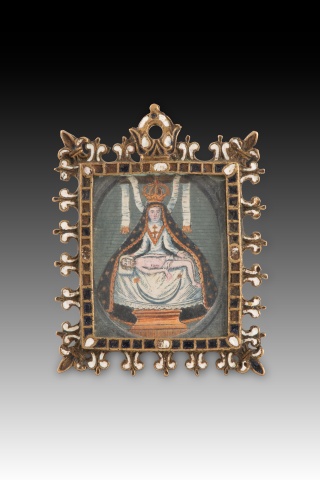
Devotional pendant or confraternity plaque. Bronze, enamel, etc. Spain, 17th century. It has faults. Devotional medallion consisting of a frame (with a ring at the top and decoration of vegetal elements with fleurs-de-lis in the corners, a band of rectangles with ovals in the centers of the sides and teardrop shapes in the corners facing inwards, on the front; only the cresting is visible on the back) and two front panels. The front panel features what is likely a painted engraving of a Pietà (possibly Our Lady of Sorrows of Granada). The back panel has lost the openwork plaque that this type of pendant usually has. Experts mention a series of confraternity plaques or medallions (oval, rectangular, octagonal, or triangular) made in Spanish workshops between around 1620 and 1640, primarily in workshops in Toledo, Salamanca, Cordoba, Seville, etc., and also overseas. Their iconography is generally heavily influenced by the teachings of the Council of Trent.
· Size: 5.5x0.5x7 cms.
ANTIQUES
MISCELLANEUS;JEWELRY
Ref.: ZF1552
-
Silver tray in its natural color. Possibly Spain, 20th century. It shows damage. Rectangular silver tray with wavy edges and a center and background decorated with a repoussé floral motif arranged around a central, projecting rectangle. Stylistically, it is inspired by antique Spanish silverware. Weight: 340 grams.
· Size: 23x2.5x34.5 cms
DECORATIVE ANTIQUES
MISCELLANEUS
Ref.: ZF1146A
-
Pair of wall sconces. Gold-plated metal, glass. A pair of wall sconces with a rectangular base decorated with shell-shaped elements, plant motifs, and architectural details, from which a scroll molding rises, serving as the base for the torch in which the light is located. Both the form and decoration reflect a strong influence of 19th-century Neoclassical models.
· Size: 16x23x47 cms.
DECORATION
AUXILIARY LIGHTING
Ref.: E65
-
Pair of wall sconces. Gold-plated metal. A pair of wall sconces, each with a holder for three candles, made of gilded metal and decorated with architectural and floral elements, topped with feathers. The influence of 19th-century neoclassical designs is evident in both the lines of the pieces and their decoration.
· Size: 30x18x68 cms.
DECORATION
AUXILIARY LIGHTING
Ref.: E84
-
Pair of wall sconces. Bronze Pair of three-light wall sconces (candles) each decorated with plant and architectural elements of strong classicist influence and which can be related to French examples of the 19th century.
· Size: 62x28x30 cms.
DECORATION
AUXILIARY LIGHTING
Ref.: E502
-
Ceiling lamp (oil lamp) boat, shade D. 40 cms. A kerosene lamp adapted as a decorative light fixture features boats among the delicate plant elements that form the arms connecting the base (green, with flowers) to the white shade, adorned with chains and ribbons. From these arms extend double chains with decorated links that secure the lower part to the ceiling.
· Size: 54x54x157 cms.
DECORATION
Ref.: L231E
-
Pair of wall sconces. Bronze. Pair of wall sconces with two lights each decorated with figurative, plant and architectural elements inspired by certain Rococo souvenir works of the 19th century. Weight: 13.5 kg
· Size: 33x23x40 cms.
DECORATION
AUXILIARY LIGHTING
Ref.: E503
-
Pair of wall lights. Bronze. Silver finish. Pair of wall sconces with two lights each, decorated with figurative, plant and architectural elements inspired by certain Rococo souvenir works from the 19th century. Weight: 13.5 kg
· Size: 33x23x40 cms.
DECORATION
AUXILIARY LIGHTING
Ref.: E503A
-
Bronze sculpture, “Cabrial Horse”. Lost-wax casting. On a rectangular base resembling earth stands the figure of a horse, positioned with both forelegs raised and only partially harnessed. This type of sculpture was very common in the 19th century, especially in England, and it is these models that serve as inspiration for this work.
· Size: 44x21x54 cms.
DECORATION
Ref.: V4080
-
Louis XVI style sofa. Carved beech wood, textile. 20th century. Two-seater sofa with arms and backrest (to be upholstered) with wood carving decoration inspired by 19th century French examples (dice with flowers, garlands, plant elements, cresting...).
· Size: 120x70x112 cms.
DECORATION
Ref.: E194
-
Oriental sideboard. Carved wood, metal. 20th century. Rectangular sideboard with a plain top and a visual division at the front into two levels: three drawers on the upper level, decorated with carvings of facing dragons; four drawers on each side of two central doors (a total of eleven drawers and two doors), with the fronts highlighted by simple lines. This door provides access to two shelves. The influence of ancient Chinese examples is clear both in the decoration and in the arrangement of the furniture's elements.
· Size: 141x45x100 cms.
DECORATION
Ref.: XM091
-
Bronze, “Two young people caressing each other”. Lost-wax casting. The two figures stand on a round base. The girl holds the boy's head in both hands, while he embraces her with one arm, carrying a basket in his left. A tree stump places the scene within an idealized natural setting. This work is based on models created by Auguste Moreau (1834-1917), son of Jean-Baptiste Moreau, known for his meticulous style and his affiliation with Art Nouveau.
· Size: 23x23x43 cms.
DECORATION
Ref.: V4025
-
Pair of candlesticks. Bronze. 18th century. Pair of candlesticks made of bronze, which still maintain a strong influence of Spanish Baroque models, especially in the turned axis, with prominent bases and spherical legs reminiscent of wild beast claws topped by vegetal elements of classicist influence. One of the candlesticks has been restored. Weight per unit: 1.8 kg
· Size: 13x13x37 cms.
DECORATIVE ANTIQUES
Ref.: Z0409
-
Wall clock. Metal, wood. United States of America, patented 1874. American wall clock with a wooden and metal case, 8-day/30-hour model, featuring a white dial with Roman numerals for the hours and lines for the minutes, and a landscape with colonial-style architecture set against a natural backdrop. Along with the usual influence or echoes of English designs, several details specific to the continent and region can be seen.
· Size: 38x10x63 cms.
DECORATIVE ANTIQUES
Ref.: Z0611
-
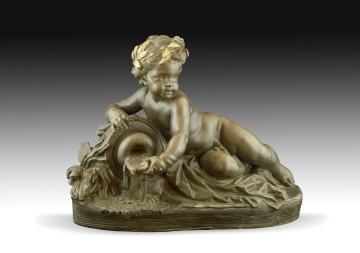
The Fountain. Polychrome terracotta. 20th century, following models by CARRIER-BELLEUSE, Albert-Ernest (Aisne, 1824-Sèvres, 1887). The figure depicts a reclining, almost entirely nude child, his head adorned with a crown of golden leaves. He is shown holding a shell (with touches of gold), drawing water from a pitcher beside him, thus recalling the allegories of rivers or their sources in Ancient Rome. This work should be compared with Albert-Ernest Carrier-Belleuse's "La Source," housed, for example, in the Art Institute of Chicago or the Portland Museum of Art (of which several variations exist, differing in the figures and materials used). Albert-Ernest Carrier-Belleuse was a French sculptor and draftsman trained by David d'Angers and at the École des Beaux-Arts in Paris. He achieved international recognition after participating in the Salon des Artistes Français in 1861 (winning the Third Medal), and went on to create notable works such as several busts of Napoleon III, the fireplace in the grand hall of the Paris Opera, and others. His work is held in prominent private collections and institutions such as the Musée d'Orsay in Paris and the Prado Museum in Madrid; in addition, his terracotta sculptures and monuments (such as the one of Bernardo O'Higgins in Santiago, Chile) should be mentioned. It is also worth highlighting the publication in 1884 of L\\'application de la figure humaine à la decoration et à l\\'ornementation industrielles, an important collection of decorative arts of the time, and in 1876 he was appointed art director of the Manufacture Nationale de Sèvres.
· Size: 50x25x40 cms
DECORATIVE ANTIQUES
Ref.: Z0628
-
Desk. Mahogany wood. 19th century. A rectangular tabletop decorated with a band of vegetal motifs along the outer edge, its waistline enhanced with bands carved with egg-and-dart motifs and vegetal designs of classical influence, and legs decorated with an elegant cabriole shape and carved motifs (scrolls, bows, and simple vegetal themes extending along the waistline of the piece) topped with highly simplified claw-like shapes holding balls. This finial on the legs also appears in Chippendale examples and American works and, apparently, was a motif inspired by Far Eastern works, replacing the dragon's paw with the sphere with a lion's paw (thus demonstrating English supremacy) and becoming very popular in England during approximately the first half of the 18th century, before being revived later.
· Size: 94x70x76
DECORATIVE ANTIQUES
Ref.: Z3460
-
Boy. Carved and polychromed wood. 17th century. A polychrome wood carving depicts a semi-nude child, partially covered by a flowing cloth, standing in a pronounced contrapposto pose. This movement is softened by the position of the hands and the expression on the face, with the head inclined. It is possible that this is a sculpture of the Christ Child, given its resemblance to Baroque sculptural groups or painted scenes featuring several figures (more like the Christ Child with Saint John the Baptist than the Holy Family).
· Size: 18x11x33 cms.
DECORATIVE ANTIQUES
Ref.: Z3498
-
Walnut wood chest of drawers with marble top. 19th century. A rectangular chest of drawers on four legs with chamfered corners, divided into two sections by a thin molding: the upper section features a single drawer highlighted with molding, and the lower section has three drawers, all with two handles and a key lock. The lines of the piece are reminiscent of English "chests of drawers," chests of drawers that emerged around the 17th century and influenced some important European manufacturing centers. In the 19th century, it was very common to choose styles and examples from the past to create works more in keeping with the times.
· Size: 56x125x94,5 cms.
DECORATIVE ANTIQUES
Ref.: Z5816
-
Wall mirror. Marble dust. 20th century. Wall mirror with a frame made of polychrome marble dust, featuring a decoration resembling carvings of plants and fruits, with a crest at the top. The piece is inspired by antique European styles.
· Size: 81x10x114 cms
DECORATIVE ANTIQUES
FURNITURE
Ref.: ZE403