-
Pair of miniature medallions, Ferdinand II of Portugal and Isabella II of Portugal. Cardboard, metal, glass. 19th century. A pair of miniatures on cardboard depicting the busts of a man and a woman within medallions, which are in turn placed in a frame with two points for hanging, on a textile upholstery matching that found in the miniatures. Ferdinand II of Portugal (Vienna, 29 October 1816-Lisbon, 15 December 1885) was king “iure uxoris” of Portugal by marriage to Queen Maria II (1819-1853), from the birth of their son in 1837 until his death in 1853. The miniature of the queen is reminiscent of one in the Royal Collection Trust in England, signed and dated 1852, by Sir William Ross.
· Size: 23,5x2x18 cms. Miniatura: 6x1x8 cms
DECORATIVE ANTIQUES
PAINTINGS
Ref.: ZF1157A
-
Interior. Oil on canvas. Signed and with an illegible inscription. COLLADO, Pedro (Valladolid, 1874-1954). A mentor to artists like Félix Cano Valentín, Pedro Collado's work is primarily held in private collections in Spain and Latin America. Stylistically, his work can be linked to the humble interior scenes typical of the painter's era, but it differs from many of these in its masterful use of light, composition, and other aspects.
· Size: 55x4x68 cms.
DECORATIVE ANTIQUES
Ref.: Z5820A18
-
“Still Life with Sea Bream”, Valladolid, 1943. Oil on canvas. Signed and dated in the lower right corner; titled, with author and location on the back. VIVERO, Asterio (Valladolid, 1899-1975). Still life on a flat background featuring a sea bream, accompanied by lemons, a glass, a tray, and other elements. Asterio Vivero Soba was a Spanish painter, a disciple of Luciano Sánchez Santarén and teacher of his son Luis Vivero Salgado, a member of the Royal Academy of Fine Arts of the Immaculate Conception in Valladolid.
· Size: 50x4x42 cms.
DECORATIVE ANTIQUES
Ref.: Z5820A32
-
Advertising poster, Magin Rubio Factory. Paper or cardboard. Spain, possibly around 1900. The Magin Rubio Chocolate and Shortbread Factory was located in a modernist mansion built by Eduardo Sánchez Eznarriaga in the early 20th century to house both the production facilities and the residence of the company's founder, Magín Rubio González. Today, it houses the Astorga Chocolate Museum.
· Size: 22,5x0,1x34,5 cms
ANTIQUES
MISCELLANEUS;GRAPHIC WORK
Ref.: ZF135437
-
Modernist tray. Metal. A tray consisting of a base with three openings, crafted to resemble a leaf. Its upward-curving petiole supports a female figure in a tunic billowing in the breeze. The delicate details, the inspiration drawn from nature, the curves, the prominence of the female figure, etc., are characteristic of Modernism.
· Size: 26x31x19 cms.
DECORATION
Ref.: E487
-
Centerpiece. Enameled porcelain. A centerpiece made of glazed porcelain, consisting of a base with flowers and three semi-nude young women holding a flower-like form. This piece is inspired by works from some of Europe's leading porcelain factories, such as Meissen, Capodimonte, and El Buen Retiro.
· Size: Alt. 46 cms.
DECORATION
Ref.: HA029
-
Mirror frame, Empire style. Wood, metal. 20th century. Rectangular frame made of wood and decorated with gilt metal appliqués of busts, plant motifs, animals, etc., following classical models. Both in form and material, as well as in decorative elements, a clear inspiration from 19th-century French school models is evident.
· Size: 118x5x96 cms.
DECORATION
Ref.: E341A
-
Bookcase. Tropical wood, metal. 20th century. This rectangular wooden bookcase features three shelves, creating four accessible spaces from the front, and two drawers with metal handles at the bottom. It follows a vintage style in both its decoration and the materials used.
· Size: 98x34x180 cms
DECORATION
Ref.: JA062
-
Chest of drawers with two drawers and marquetry decoration. The piece of furniture rests on four cabriole legs with gilt metal finials. The waist is decorated with several panels of floral marquetry (one on each side and three horizontally arranged on the front). The two drawers interrupt this decoration when opened. The top panel features a basket of flowers inlaid with very light wood on a plaque, which is cut to follow the lines of the chest of drawers.
· Size: 56x32x78 cms.
DECORATION
Ref.: E499
-
Oriental chair. Carved and lacquered wood. 19th century. High-backed chair with arms made of lacquered wood decorated with carvings inspired by traditional Chinese design. Note the lacquered compositions on the stretchers at the front, the shape of the legs, arms, and backrest, the geometric decorations, and the figurative compositions on the backrest, highlighted in simple frames. This type of furniture was very popular in Europe due to its exotic colors and decorations. 4 units available.
· Size: 57x46x104
DECORATION
Ref.: XF425
-
Cup in carved white marble. Inspired by classical designs. The cup, with its wide, concave mouth, features carved decoration based on classically inspired architectural motifs: egg-and-dart reliefs, beveled rectangles, and lines at the base. This type of design was widely used in the main gardens of the Renaissance period.
· Size: 52x52x52 cms.
DECORATION
Ref.: Z1685
-
Cylindrical bronze base. With a smooth shaft, it features only a base with a molding at the bottom and two straight ones at the top. The piece stands out for its purity of line, and the lack of decorative elements will further emphasize the object placed on the pedestal. Weight: 21 kg.
· Size: 30x30x73 cms.
DECORATION
Ref.: V3066
-
Oriental console table. Polychrome wood, metal. Circa early 20th century. Console with a rectangular, finished top, decorative geometric and floral motifs on the sides and bottom, and two small doors on the front. The shape, color, and decorative elements of the piece are all inspired by antique Chinese designs.
· Size: 113x57x41 cms.
DECORATION
Ref.: XG009
-
“Christ the Savior”. Oil on canvas. Spanish School, 17th century. Damage Oil on canvas with the three-quarter image of bearded Christ, blessing with one hand and holding the Orb of Creation crowned by a cross in the other, in an iconography known as Christ the Savior of the World and already used by masters such as Pedro Berruguete, Leonardo da Vinci, El Greco, etc., both in Europe and in South America.
· Size: 53x2x67 cms. int: 45x59
DECORATIVE ANTIQUES
PAINTINGS
Ref.: Z0264
-
Fireplace screen. Mahogany, silk, metal. Possibly English, 19th century. A fireplace screen featuring a base with three legs and a balustraded design, and a frame crafted from carved mahogany. The piece includes three rectangular panels upholstered in red silk, which are extendable and retractable to cover or protect more or less of the area from the heat of the fireplace.
· Size: 56x30x101 cerrado
DECORATIVE ANTIQUES
Ref.: Z0728
-
Pair of guarantors. Iron. 20th century, following antique models. Pair of iron table braces of Castilian type with a slightly curved shape, balustraded profile and discs as decoration, following models common in the Spanish school of cabinetmaking of the 17th century.
· Size: Long. 93 cms.
DECORATIVE ANTIQUES
WROUGHT IRON;MISCELLANEUS
Ref.: Z4885
-
Tabletop. Marbles. A round tabletop made of marbles in different shades, forming a symmetrical geometric composition with a touch of classical influence. The decoration shows a certain 19th-century influence, while the material is reminiscent of older Italian pietra dura.
· Size: 100x100x2 cms
DECORATION
Ref.: M0114
-
Tabletop. Marble. Following antique designs. A circular marble tabletop with inlays of other colored marbles features a geometric design resembling a compass rose, with an eight-pointed star framing a smaller one. The technique is very similar to marquetry, but uses marbles and hard stones (over 7 on the Mohs scale) to create these designs. Desks, tabletops, and other objects were made using this "hard stone work" technique. Lapis lazuli was commonly used with a Belgian marble base, often accompanied by jade, chalcedony, and other stones. The high cost of the materials and skilled labor made these works of art so expensive that they were only purchased by the leading houses and courts of the time, and are therefore now found only in prominent private collections and major museums.
· Size: 100x100x2,5 cms
DECORATION
Ref.: M0115
-
Small glazed porcelain figurine. “Couple of nobles with a small dog.” Inspired by models from the Manufacture Nationale de Sèvres. The young lady is seated on a large sofa, and the gentleman stands behind her, his hand resting on the back. A small dog adds a touch of liveliness, resting its front paws on her knees. The couple is dressed in the aristocratic fashion of the late 18th century. The work is inspired by designs from the Manufacture Nationale de Sèvres (France).
· Size: 34x34x38 cms.
DECORATION
Ref.: S4436
-
Low oriental table. Carved wood, metal. 19th-20th centuries. This low table, crafted from carved wood, features a simple geometric openwork design at the corners of the legs. It also has a drawer on each of its four sides, located along one edge. Both the metal fittings and the aforementioned decoration, as well as the shape of the legs, show Chinese influence.
· Size: 80x80x60 cms.
DECORATION
Ref.: XM013
-
Oriental side table. Carved wood, metal. 20th century. Side table made of carved wood, with a rectangular top decorated with two raised sections on its shorter sides and a drawer at the front. Both its shape and decoration (simple, present on the sides in the form of bands) show a clear influence of Chinese designs.
· Size: 97x46x93 cms.
DECORATION
Ref.: XM015
-
Special Offer! - Off
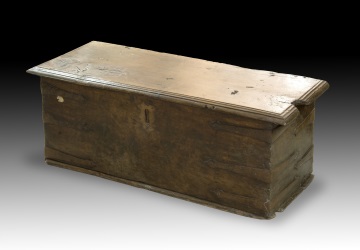
Chest. Walnut wood, iron. Spain, 17th century. It has flaws. It requires restoration. Rectangular chest with a flat, projecting lid, made of carved walnut and secured with iron pieces at the corners (these topped with a pointed shape cut into the metal). Despite having only a simple molding on the lid and the aforementioned elements as its sole decorations, these same details link it to pieces made during the Spanish Baroque period., detectedSourceLanguage: es
· Size: 105x40x39 cms.
DECORATIVE ANTIQUES
Ref.: Z0203
-
19th century Pinewood
· Size: 186x45x105 cms.
DECORATIVE ANTIQUES
Ref.: Z0734
-
Friar's chair. Leather, walnut wood. Spain, 16th century. It has faults. A high-backed armchair of the type known as a "frailero" (friar's chair), featuring studded leather on the upper part of the back (not present on the seat), low-profile stretchers connecting the front and rear legs, and medium stretchers or side rails (the front one carved and cut to create geometric patterns) joining the two front and two rear legs, and simple armrests with raised scroll finials. Originally of Italian origin, the frailero armchair became one of the most common pieces of Spanish furniture after its introduction in the 16th century, being characteristic of that century and the 17th, and experiencing a revival in the historicist movement of the 19th century. Because it was such a deeply rooted tradition in Spain, this type of chair continued to be produced throughout the centuries.
· Size: 68x53x102 cms.
ANTIQUES
FURNITURE
Ref.: Z0750