-
Isabeline-style chairs in walnut wood. Spain, 19th century. Composed of a three-seater sofa, two armchairs and a wingback chair. The wingback chair features a high upholstered back, in subtle contrast to the armchairs (formed from juxtaposed ovals), which also display curves. In all cases, simplicity and cabriole legs are prominent features. The lines of the furniture and the small decorative details place its creation within the style known as Isabeline, as it flourished during the reign of Isabella II.
· Size: Tresillo: 156x60x93 cms.
DECORATIVE ANTIQUES
Ref.: Z4848
-
Small chest. Walnut wood and metal. 17th century. A small rectangular chest with a flat lid, featuring a gilt metal keyhole (a crown above two facing lions, situated on a large garland, all within a symmetrical composition with scrolls and other elements). The piece displays a typology common in Spanish art since the Middle Ages, with the shield contributing the movement and decorative abundance characteristic of the Baroque period.
· Size: 26x36x21 cms.
DECORATIVE ANTIQUES
Ref.: Z5135
-
Console or shelf. Carved sandstone. 20th century. Carved light sandstone console featuring a rectangular surface with a raised front and curved sides at the top, and two brackets on the front decorated with carved plant and architectural elements of clear classicist influence.
· Size: 175x41x70 cms.
DECORATIVE ANTIQUES
FURNITURE
Ref.: ZF0938
-
Empire style fitting or psyche mirror. Mahogany wood. 19th century. A full-length tilting mirror situated between two columns and on two legs joined at their base by a turned crossbar, made of mahogany with gilt metal fittings. This type was commonly known as a psyche or psyché mirror and was very common in France. Compare this example with the one held in the Museum of Romanticism (Madrid).
· Size: 110x52x180 cms.
DECORATIVE ANTIQUES
Ref.: Z3063
-
Mirror. Molded and polychromed alabaster. 20th century. Wall mirror made of molded alabaster with polychrome decoration, featuring a frame of classically influenced architectural elements and a series of figurative elements in the same style (two semi-nude female figures, possibly allegorical, a child's head with two pairs of wings, two putti with garlands below). Weight: 36 kg.
· Size: 120x9x122 cms
DECORATIVE ANTIQUES
FURNITURE
Ref.: ZE402
-
Wall mirror. Molded alabaster. 20th century, following Renaissance models. Rectangular wall mirror with a frame made of molded alabaster, polychromed and decorated with a series of elements strongly inspired by classical art (candelabra on the sides, a scallop-shaped crest, flanking architectural motifs, grotesques with children and fruit, etc.). Stylistically, the piece is inspired by Renaissance models, with a certain resemblance to details found in pieces from the Spanish school. Weight: 35 kg.
· Size: 99,5x10x157 cms
DECORATIVE ANTIQUES
FURNITURE
Ref.: ZE409
-
Freestanding coat and umbrella stand, inspired by classic models. Made of aluminum.
· Size: 100x47x206
DECORATIVE ANTIQUES
FURNITURE
Ref.: ZF0717
-
Two chairs. Walnut wood. 17th century. Chairs made of carved walnut wood with openwork backs decorated with four crossbars, one with discs and the other with balustrade-like forms, both featuring moldings at the bottom, following common designs in 17th-century Spanish Baroque cabinetmaking. These types of pieces are not as commonly preserved as the most outstanding examples because they were used frequently and replaced as fashions changed.
· Size: 42x37x89 / 40x36x85 cms.
DECORATIVE ANTIQUES
Ref.: Z0291
-
Special Offer! - Off
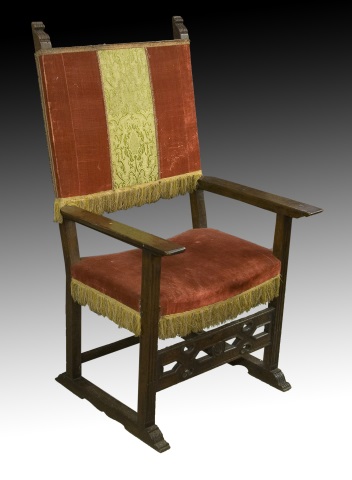
Friar's chair. Walnut wood, textile. Spain, 17th century. Armchair with arms and a high back, of the type known as a "frailero" (friar's chair), upholstered in red and yellow fabric, with fringe on the seat and the lower part of the back. The carved decoration of vegetal motifs and fluting is concentrated on the backrest finials and the front of the piece; the openwork stretcher between the front legs displays simple geometric shapes and curved details surrounding a carved mask. Originally of Italian origin, the frailero armchair became one of the most common pieces of Spanish furniture after its introduction in the 16th century, being characteristic of that century and the 17th, and experiencing a revival in the historicist movement of the 19th century., detectedSourceLanguage: es
· Size: 72x61x130
DECORATIVE ANTIQUES
Ref.: Z0381
-
Cupboard with marbled finish. Carved wood, metal. 20th century. A carved wooden cupboard with three shelves at the bottom and two doors at the top, which provide access to two additional compartments. It has been painted with a marbled finish, reminiscent of veined wood. Both its decoration and lines evoke antique Spanish school pieces.
· Size: 125x35x200 cms.
DECORATIVE ANTIQUES
Ref.: Z0594
-
Miniature moon cabinet. Walnut wood. 19th century. Miniature wardrobe with one door (inside, two shelves and a drawer) and a drawer with two handles, featuring an exterior mirror and decoration based on architectural elements, plants, and moldings with a clear classical influence. The piece shares common elements with 19th-century Spanish Alfonsine wardrobes (columns on the front, mirror on the door, finials at the top, etc.).
· Size: 43x29x94 cms.
DECORATIVE ANTIQUES
Ref.: Z0596
-
Isabeline sofa. Mahogany wood, textile. Spain, 19th century. A sofa or three-piece suite made of carved mahogany, upholstered inside and out in yellow or gold-toned fabric, with plush button tufting on the inside of the backrest. The legs, with their slightly curved shape, and the base feature simple decoration of carved geometric elements, while the high backrests are adorned with more elaborate vegetal crests. This type of furniture, with its strong French influence, was common during the Elizabethan period, a style so named because it reached its peak during the reign of Isabella II (1830-1904).
· Size: 200x65x100 cms.
DECORATIVE ANTIQUES
FURNITURE
Ref.: Z0604
-
Friar's chair. Walnut wood, leather. Spain, 16th century. A high-backed armchair of the type known as a "frailero" (friar's chair), featuring studded leather on the seat and upper back, very low stretchers connecting the front and rear legs, and medium stretchers or side rails (the front one carved with a relief of floral motifs flanking an empty heraldic shield in a roundel) connecting the two front and two rear legs, and simple armrests with fluted fronts reflecting architectural influences. Originally of Italian origin, the frailero armchair became one of the most common pieces of Spanish furniture after its introduction in the 16th century, characteristic of that century and the 17th, and experiencing a revival in the historicist movement of the 19th century. Because it was such a deeply rooted tradition in Spain, this type of chair continued to be produced throughout the centuries. It requires restoration.
· Size: 65,5x53x109 cms.
ANTIQUES
FURNITURE
Ref.: Z0706
-
Rustic chest. Carved wood, wrought iron. 18th century. A rectangular chest with a flat lid and a small drawer at the bottom on the exterior; the fittings, handles, corner pieces, and lock are made of wrought iron; the bottom features curved moldings. Inside, there is a rectangular compartment enclosed by a lid with a ringed fitting on one side. This type of chest was used to store valuable objects, and similar styles can be seen as early as the Spanish Gothic period.
· Size: 126x76x85 cms.
DECORATIVE ANTIQUES
Ref.: Z0958
-
Mirror with gilded wooden crest. 20th century. This rectangular mirror is distinguished by its decoration of carved plant elements and a latticework motif beneath a vegetal form. The curves of the leaves reveal the influence of Rococo styles in the creation of this piece, their movement softened by the straight lines of the frame. These rocaille motifs are also found in the latticework-like finial.
· Size: 60x15x90 cms.
DECORATIVE ANTIQUES
Ref.: Z1259
-
Octagonal side table. Rosewood wood. France, 19th century. Side table with a straight octagonal top, made of rosewood combined with another wood of a different tone to enhance the former. The four legs, turned with lines, are joined with a flat rhomboidal stretcher. The decoration has been reduced to highlight the quality of the wood and the clean lines of the piece, which is why there are no gilt bronze fittings, common in French furniture.
· Size: 75x75x70 cms.
DECORATIVE ANTIQUES
Ref.: Z4843
-
English-style display cabinet. Mahogany veneer, bronze, glass. 20th century. A display cabinet atop a chest of drawers, or a display cabinet with a lower section of drawers, clearly influenced by English Victorian designs. The upper section features double doors, glazing on three sides (with a quarried front section), and a molding trim with a carved central crest, as well as corner pilasters. This trim is repeated in the lower section with architectural elements that visually extend the piece, and the drawers (a total of four) are located at the front, fitted with circular knobs. It has faults.
· Size: 162x40x177 cms
DECORATIVE ANTIQUES
Ref.: Z6134
-
Bronze chandelier with 12 arms. 19th Century Adapted for electric use, the twelve arms are joined above a sphere, which is fixed to the ceiling by a turned arm and another sphere at its midpoint. The earliest examples of this element date from the Middle Ages, adopted for secular use from churches, and its design began to develop from the 15th century onwards. Made of glass, either clear or colored, or of bronze, or a combination of both, these lamps were always intended for important residences, both because of their size and the amount of candles they consumed.
· Size: 70x70x90 cms.
DECORATIVE ANTIQUES
Ref.: Z6360
-
Display case, Louis XV style. Polychrome and gilded wood, textiles, glass. Late 19th century. A glass-fronted display cabinet made of carved, polychrome, and gilded wood, decorated with reliefs of plant and architectural elements, and legs with scrolls. Inside, it features three shelves with Rococo-style brackets and two small shelves at the top. It follows French designs common in the 19th century.
· Size: 85x25x197 cms.
DECORATIVE ANTIQUES
FURNITURE
Ref.: Z6874
-
Mirror with gilded wooden crest. 20th century. This rectangular mirror is distinguished by its decoration of carved plant elements and a latticework motif beneath a vegetal form. The curves of the leaves reveal the influence of Rococo styles in the creation of this piece, their movement softened by the straight lines of the frame. These rocaille motifs are also found in the latticework-like finial.
· Size: 61x10x91 cms
DECORATIVE ANTIQUES
FURNITURE
Ref.: ZE417
-
Desk. Mahogany wood. 19th century. A rectangular tabletop decorated with a band of vegetal motifs along the outer edge, its waistline enhanced with bands carved with egg-and-dart motifs and vegetal designs of classical influence, and legs decorated with an elegant cabriole shape and carved motifs (scrolls, bows, and simple vegetal themes extending along the waistline of the piece) topped with highly simplified claw-like shapes holding balls. This finial on the legs also appears in Chippendale examples and American works and, apparently, was a motif inspired by Far Eastern works, replacing the dragon's paw with the sphere with a lion's paw (thus demonstrating English supremacy) and becoming very popular in England during approximately the first half of the 18th century, before being revived later.
· Size: 94x70x76
DECORATIVE ANTIQUES
Ref.: Z3460
-
Walnut wood chest of drawers with marble top. 19th century. A rectangular chest of drawers on four legs with chamfered corners, divided into two sections by a thin molding: the upper section features a single drawer highlighted with molding, and the lower section has three drawers, all with two handles and a key lock. The lines of the piece are reminiscent of English "chests of drawers," chests of drawers that emerged around the 17th century and influenced some important European manufacturing centers. In the 19th century, it was very common to choose styles and examples from the past to create works more in keeping with the times.
· Size: 56x125x94,5 cms.
DECORATIVE ANTIQUES
Ref.: Z5816
-
Wall mirror. Marble dust. 20th century. Wall mirror with a frame made of polychrome marble dust, featuring a decoration resembling carvings of plants and fruits, with a crest at the top. The piece is inspired by antique European styles.
· Size: 81x10x114 cms
DECORATIVE ANTIQUES
FURNITURE
Ref.: ZE403
-
Nightstand. Wood (mahogany and rosewood veneer), marble, bronze. 19th century. It has faults. Side table with four legs finished with metal fittings, a waist decorated with strips of lighter wood than the rest, highlighted with strips of gilded metal, and a circular top of light-colored stone with a cresting around the edge. It has two drawers with handles and two removable upholstered shelves. Stylistically, it is reminiscent of 19th-century French school models.
· Size: 65,5x65,5x75 cns,
ANTIQUES
FURNITURE
Ref.: ZF1467