Results 1 to 24 of 90
«« « 1234 » »»
-
Double-leaf door in carved walnut and pine wood. Requires restoration. Both leaves feature decoration based on geometric elements framed in moldings. The frame stands out for the movement and prominence of its moldings: the semicircles in the centers of the sides and the widening of the corners are reminiscent of Baroque designs. This type of decorative element was used in important houses and was frequently replaced once new stylistic trends took hold, which is why it is not commonly found in surviving examples., detectedSourceLanguage: es
· Size: 226x15x275 cms. (hojas 165x240 cms)
DECORATIVE ANTIQUES
MISCELLANEUS
Ref.: Z2125
-
Oriental door. Carved wood, bronze nails. 19th century. The double door features a frame enhanced by carved moldings towards the edge (the lower sides are reminiscent of Indian column bases). The upper section is decorated with a cross carved from triangles and fan-shaped motifs on either side. The doors are adorned with carvings of strong European influence and feature decorative and functional bronze fittings or studs., detectedSourceLanguage: es
· Size: 118x33x243 cms Luz 90x194 cms
DECORATIVE ANTIQUES
Ref.: Z0627
-
Columns. Carved stone. 19th-20th centuries. Symmetrical carved stone columns with bases and capitals (formed by various smooth moldings), fluted shafts, and decorated ends with shapes reminiscent of leaves, similar to certain elements of ancient Egyptian architecture. These types of elements were highly valued for prominent houses. 4 units available. , detectedSourceLanguage: es
· Size: 51x51x199 cms, / 46x46x188 cms.
DECORATIVE ANTIQUES
Ref.: AC051
-
Double door with frame, latch, and wrought iron fittings. Made of Soria pine and walnut panels, wrought iron. 18th century. A double door with a simple frame, decorated with carved walnut panels, contrasting in tone with the frame and highlighting the composition of a large rectangle interspersed with two smaller squares placed side by side. The frame is simple, as is typical of this type of piece, and also features a lock and wrought iron fittings. These structural elements are rarely preserved, given their purely utilitarian purpose and their replacement with more modern ones as soon as tastes changed or the old ones deteriorated., detectedSourceLanguage: es
· Size: 148x212 (Hoja 61x202 cms.)
DECORATIVE ANTIQUES
Ref.: Z2655
-
Countertop. Walnut wood. Late 19th-early 20th century. Shop counter board made of walnut wood and worked in a curve at one of its ends., detectedSourceLanguage: es
· Size: 59x3,5x385 cms
DECORATIVE ANTIQUES
MISCELLANEUS
Ref.: Z0996
-
Oak wood clothing press, Holland, 19th century. A clothes press with a lockable cabinet at the bottom, made of oak in Holland. As is typical of these utilitarian items, it is undecorated and was used for smoothing clothes. It is not common to find such objects because they were frequently discarded once better technologies became available. Oak was chosen for its hardness and durability., detectedSourceLanguage: es
· Size: 76x52x171 cms.
DECORATIVE ANTIQUES
Ref.: Z0368
-
Oak wood clothing press, Holland, 19th century. The press stands on four turned legs (three of them secured with a straight bracket), with a drawer underneath. Being a purely utilitarian piece of furniture, it has hardly any decorative elements. The oak wood used in its manufacture was chosen for its hardness and resistance, since these presses were used to smooth clothes as much as possible., detectedSourceLanguage: es
· Size: 72x55x167 cms.
DECORATIVE ANTIQUES
Ref.: Z0369
-
Iron brackets. 19th-20th centuries. A set of three iron brackets, likely used in a prominent residence, decorated with scrolls, lines, and other elements that might link the pieces to Neoclassicism, but which also possess a somewhat more modern feel. The polygonal finials located beneath the two facing scrolls at the top are reminiscent of certain Eastern elements, while the overall composition can be compared to European traditions., detectedSourceLanguage: es
· Size: 42x17x49 cms.
DECORATIVE ANTIQUES
Ref.: Z1015
-
Pulpit grille. Wrought iron. 18th century. A wrought iron grille with thirteen double-pear-shaped bars and discs on their shafts, arranged in a circle with flat bars of the same material (circular and cross-shaped combined at the base for a firmer hold, and arranged in a circle at the top), which would have been created to surround the pulpit of a church, accessible through a door made from the same grille (one of the balusters allows part of the grille to rotate). Although balustraded forms were already used in Baroque ironwork, this composition is more reminiscent of 18th-century Neoclassical models., detectedSourceLanguage: es
· Size: 100x100x110 cms.
DECORATIVE ANTIQUES
Ref.: Z1045
-
Fire truck or motorized sprayer. EC Flader of Jöhstadt, Germany, circa 1920. A motorized sprayer designed to be pulled by horses, manufactured by EC Flader of Jöhstadt (name partially visible on the rectangular label on the front of the unit), with a folding compartment and space for machinery in the rear, powered by two spoked wheels and equipped with a vertical bar for securing it to the ground when in use. This type of machinery was used by firefighters, typically in cities, and this particular example is known to have been used, for instance, in 1925 in Wellsdorf., detectedSourceLanguage: es
· Size: 130x230x145 cms.
DECORATIVE ANTIQUES
MISCELLANEUS
Ref.: Z1009A
-
Fire truck or motorized sprayer. EC Flader of Jöhstadt, Germany, circa 1920. A motorized sprayer designed to be pulled by horses, manufactured by EC Flader of Jöhstadt, with a folding compartment and space for machinery in the rear. It is powered by two spoked wheels and has a vertical bar for securing it to the ground when in use. This type of equipment was typically used by firefighters in cities, and the example shown, if accurate, is known to have been used in 1925 in Wellsdorf., detectedSourceLanguage: es
· Size: 340x142x125 cms.
DECORATIVE ANTIQUES
MISCELLANEUS
Ref.: Z1009C
-
Fire engine or irrigation pump. Renault, 20th century. Trailer or cart with motor and two hose heads, hose and other parts and mechanisms that would have been used for watering, spreading water, etc. The brand can be seen on the plate located at the front of the machine., detectedSourceLanguage: es
· Size: 260x130x135 cms.
DECORATIVE ANTIQUES
MISCELLANEUS
Ref.: Z1009D
-
A flat, octagonal box with a key lock, decorated with exquisite marquetry. On the lid, the vegetal motifs are arranged around a delicate central element; on the sides, a band of symmetrical vegetal elements is placed beneath another band of elegant and simple geometric motifs, so as not to detract from the former. The motifs on the box are reminiscent of Boulle-style marquetry in their delicacy and design., detectedSourceLanguage: es
· Size: 53x53x18 cms.
DECORATIVE ANTIQUES
Ref.: Z0516
-
Anatomical model of the skeletal system. Circa 1950. On a square base and supported upright with a metal rod stands the skeleton, an anatomical model of human bones widely used since the 18th century in Faculties and Schools of Surgery, Medicine, etc., detectedSourceLanguage: es
· Size: 35x35x160 cms.
DECORATIVE ANTIQUES
Ref.: Z2676
-
Fire hose cart. Possibly from the first third of the 20th century. Two-wheeled cart for carrying the hose, normally pulled by the firefighters themselves in case of use, which also has a box at the front to store tools, heads and metal parts for use with the hose, and another auxiliary hose., detectedSourceLanguage: es
· Size: 220x130x102 cms
DECORATIVE ANTIQUES
MISCELLANEUS
Ref.: Z1009B
-
Mahogany wood brazier box, 18th century. The box, circular in profile and decorated with curvilinear skirts at the bottom and nails with vegetal motifs at the top, rises on claw-shaped feet with balls. The central cavity houses the charcoal container, which has two handles adorned with scallop shells. This type of furniture was widely used in homes as a heating system or for purifying the air (by burning olive pits), varying in style and decoration according to the family's status., detectedSourceLanguage: es
· Size: 87x87x20 cms.
DECORATIVE ANTIQUES
Ref.: Z0446
-
Chapel. Walnut wood. 17th century. A chapel for a private oratory, crafted from carved walnut and decorated with classically inspired architectural elements (broken triangular pediment, moldings, etc.) but with a clear Baroque influence, as well as certain touches reminiscent of Italian examples (particularly the columns with their carved undulations). The importance of classicism and the predominance of a simple architectural composition were common features of Spanish Baroque altars, alongside more exuberant ones., detectedSourceLanguage: es
· Size: 80x14x115 cms.
DECORATIVE ANTIQUES
Ref.: Z0607
-
Two bronze candlesticks. 20th century. Two virtually identical bronze candlesticks with triangular bases on legs (these adorned with vegetal motifs ending in claws holding balls) and vase-shaped stems terminating in a disc from which the candle holder extends. In some details, they recall 17th-century Baroque examples, while in others they more closely resemble later examples. This blending of styles was common in 19th-century art. Weight: 12 kg. , detectedSourceLanguage: es
· Size: 21x20x63 cms.
DECORATIVE ANTIQUES
Ref.: Z0413A
-
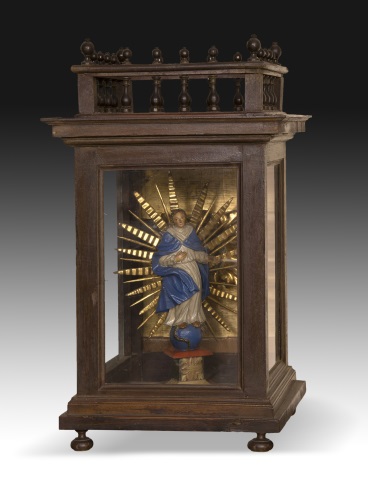
Chapel of the Immaculate Conception. Sculpture, carved wood, glass, metal. Second half of the 18th century. A carved wooden chapel with vase-shaped decoration at the top of the railing and balusters, reminiscent of the Baroque style, features three of its four sides in clear glass and is raised slightly on circular legs. Inside, a gilded background (on the fourth side of the chapel, highlighting a carved and polychrome vegetal composition) and a polychrome sculpture of the Immaculate Conception surrounded by alternating flat, undulating, pointed, and circular rays of light are visible. The sculpture stands on a pedestal and wears a white tunic and a blue mantle; Mary stands on the Orb of Creation, in which a serpent (associated with Sin) appears. The sculpture shows a clear influence of Spanish Baroque models, as well as certain details, such as the pose, that can be linked to Neoclassicism. This blending and the persistence of Baroque influence are common in 18th-century Spanish sculpture., detectedSourceLanguage: es
· Size: 38,5x38x65 cms virgen
DECORATIVE ANTIQUES
Ref.: Z0252
-
Pair of paired pilasters. Mother carved, polychromed and gilded. 17th century. A pair of moldings made of carved, polychrome, and gilded wood, composed of pilasters, curves, etc., paired together and decorated with architectural elements of marked classical influence and clean lines. The lines displayed in their profiles link them to the Baroque period., detectedSourceLanguage: es
· Size: 17x12x74 cms.
DECORATIVE ANTIQUES
Ref.: Z2511
-
Votive lamp. Bronze. 18th century. A bronze lamp for lighting with oil and candles, of the type commonly used in churches, hanging from vaults, arches, etc. Sometimes, and especially when made of silver, they are known as tabernacle lamps because of their usual placement. The form and decorative elements of this piece are reminiscent of Neoclassical models, while retaining details more common in 17th-century Baroque designs., detectedSourceLanguage: es
· Size: 45x45x120 cms.
DECORATIVE ANTIQUES
Ref.: Z0707
-
Set of three heraldic plaques. Bronze. 18th century. Bronze plaques decorated with a castle and a pelican pecking at its breast above the gate, a heraldic element enhanced with symmetrically arranged plant motifs. While the pelican appears fairly frequently in heraldry, it is possible that these pieces are related to the surname Lázaro., detectedSourceLanguage: es
· Size: 23,5x0.2x25 cms
DECORATIVE ANTIQUES
Ref.: Z2265
-
17th century Transformed into a bracket., detectedSourceLanguage: es
· Size: 38,5x26x15 cms.
DECORATIVE ANTIQUES
Ref.: Z0668
-
Double door with castanet frame. Pine wood. Spain, 17th century. Double-leaf door made of pine wood with a decoration of rectangular panels arranged in rows and a castanet-style frame (so named for the decorative elements). Although panels were a common element in the Renaissance, they continued to be used during this period and long afterward., detectedSourceLanguage: es
· Size: Puertas 177x94,5 cms c/Marco 184x107 cms.
DECORATIVE ANTIQUES
Ref.: Z0696