-
“Serviteur muet” side table. 20th century, following 19th century models. Mahogany wood, marquetry, bronze. A circular side table with three legs rising from a single stem, decorated with geometric marquetry on the wood and a pierced railing marking the top and the smaller, circular tabletop that extends from it. Clearly, the piece is inspired by 19th-century French examples, both in its design and in the materials and the delicacy of its execution.
· Size: 80x80x95 cms.
DECORATIVE ANTIQUES
FURNITURE
Ref.: ZF0171
-
Lamp. Bronze, glass. Early 20th century.
A ceiling lamp composed of a central axis from which arms emerge, each ending in a colored glass shade resembling a flower and other decorative elements—a clear neoclassical touch—and topped with a partially openwork form. This type of lamp was common in important houses, more so in the private quarters of the owners than in the halls used for more formal celebrations and receptions.
"
· Size: 110x110x120 cms
DECORATIVE ANTIQUES
FURNITURE
Ref.: ZF0647
-
Mahogany wood desk with seven drawers. The cabinet rests on four legs and features a front divided into three sections: the side sections each have three drawers, and the central section has a recessed door; this area is finished with a band of carved scallop shells, an element also found on the small door. The top surface has been left plain so as not to detract from the mahogany from which it is made or from the front panel.
· Size: 100x44x74 cms.
DECORATION
Ref.: JW032
-
Louis XV style side table with marquetry and bronze decoration. The table stands on four cabriole legs secured by a plate underneath. It features a drawer and decoration consisting of marquetry plaques in light wood with strips forming diamond shapes framed by gilt bronze vegetal motifs and a grotesque mask in the center of each side. The rectangular tabletop has curved edges on all four sides, a fillet highlighting the stone, and four vegetal motifs in the corners. The style known in France as Louis XV (corresponding to Rococo) was widely used as inspiration for furniture design after the 18th century.
· Size: 44x47x72 cms.
DECORATION
Ref.: D073
-
Palanquin with children. Bronze, marble. Bronze figure on a marble base depicting five children with an oversized palanquin or litter, positioned as if they were having an accident. The influence of 19th-century French models (Louis Gossin, etc.) is clear in both the subject matter and the composition. Weight: 19 kg.
· Size: 50x28x32 cms.
DECORATION
Ref.: V3094
-
Special Offer! - Off
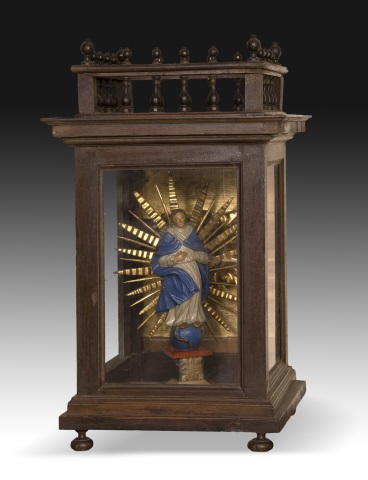
Chapel of the Immaculate Conception. Sculpture, carved wood, glass, metal. Second half of the 18th century. A carved wooden chapel with vase-shaped decoration at the top of the railing and balusters, reminiscent of the Baroque style, features three of its four sides in clear glass and is raised slightly on circular legs. Inside, a gilded background (on the fourth side of the chapel, highlighting a carved and polychrome vegetal composition) and a polychrome sculpture of the Immaculate Conception surrounded by alternating flat, undulating, pointed, and circular rays of light are visible. The sculpture stands on a pedestal and wears a white tunic and a blue mantle; Mary stands on the Orb of Creation, in which a serpent (associated with Sin) appears. The sculpture shows a clear influence of Spanish Baroque models, as well as certain details, such as the pose, that can be linked to Neoclassicism. This blending and the persistence of Baroque influence are common in 18th-century Spanish sculpture., detectedSourceLanguage: es
· Size: 38,5x38x65 cms virgen
DECORATIVE ANTIQUES
Ref.: Z0252
-
Metal fitting with two-key lock. Wrought iron. 20th century. The hardware, decorated with balustraded forms, features a lock adorned with shells, column shafts, and simplified plant motifs arranged symmetrically. Both the material and decoration of the piece are inspired by 17th-century Baroque works, with details (the shells) also found in older Spanish furniture. This type of piece was very common in Historicist movements, drawing inspiration from antique furniture to create works in the 19th and 20th centuries.
· Size: 16x4x40 cms
DECORATIVE ANTIQUES
WROUGHT IRON;LOCKS
Ref.: Z0576
-
Bureau desk It features three long drawers and two shorter ones, all with locks. At the top, two extendable crossbars support the upper surface, which covers a series of shelves with small drawers below, flanking a central niche, in the style of Baroque and later desks. The dynamic design of this area is reminiscent of 18th-century Rococo works.
· Size: 90x50x101 cms.
DECORATION
FURNITURE;CLASSIC
Ref.: Z1785
-
Pair of paired pilasters. Mother carved, polychromed and gilded. 17th century. A pair of moldings made of carved, polychrome, and gilded wood, composed of pilasters, curves, etc., paired together and decorated with architectural elements of marked classical influence and clean lines. The lines displayed in their profiles link them to the Baroque period.
· Size: 17x12x74 cms.
DECORATIVE ANTIQUES
Ref.: Z2511
-
Freestanding fitting room mirror in carved mahogany wood, 19th century. The rectangular mirror frame is decorated with scrolls and carved plant and floral motifs in the classical tradition, and rests on two curved legs with lines reminiscent of the characteristic movement of the Baroque and Rococo periods. This blend of styles was common in 19th-century furniture, as forms from past traditions were often chosen for contemporary creations.
· Size: 88x76x160 cms.
ANTIQUES
Ref.: Z2515
-
Divan sofa. Mahogany wood, upholstered. 19th century. Mahogany divan with upholstered seat, S-shaped or half-lyre-shaped curved arms, and flat cabriole legs ending in scrolls. While the lines are reminiscent of French Empire-style pieces and other pieces from the first half of the 20th century, certain similarities can also be found with 19th-century Spanish Isabeline divans.
· Size: 62x200x90 cms.
DECORATIVE ANTIQUES
Ref.: Z3712
-
Case with field cutlery and knife. 19th century. A cylindrical case with a hinged closure containing various pieces of field cutlery, such as a spoon, a knife, a detachable fork, etc., secured in a rigid lining and stored inside a metal cup. This type of travel item was widely used during the 19th century.
· Size: 8x8x16 cms.
ANTIQUES
MISCELLANEUS;OTHER OBJECTS
Ref.: Z3806
-
Pair of frames. Wood. 20th century. Pair of carved wooden frames decorated on the front with a composition of moldings of different widths, all smooth, combining straight lines with curves.
· Size: 152x7x172 cms.
ANTIQUES
MISCELLANEUS;FRAMES
Ref.: Z3959
-
Table leg of contemporary design. Carved wood. Several units available. Table base inspired by 19th-century French neoclassical models, featuring a capital-shaped finial on a lion's head, which transforms into a pillar with plant-like shapes, ending in a claw of the same animal on a simple quadrangular shape.
· Size: 20x20x84 cms.
DECORATION
Ref.: Z4711
-
Chest. Walnut wood, wrought iron. 17th century. A rectangular chest with a flat lid, crafted from hand-carved walnut and reinforced with metal fittings, features an openwork lock escutcheon decorated with architectural motifs that reflect Baroque influence. This type of furniture was very common in Spain, frequently used to store valuables such as clothing, tableware, and other items.
· Size: 162x58x63 cms.
DECORATIVE ANTIQUES
Ref.: Z4855
-
Special Offer! - Off
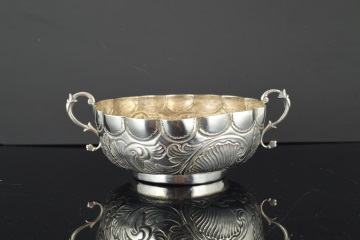
Silver Bernegal. Portugal, 19th century. With contrasting markings on the base. A Bernegal with a wavy rim, decorated with rocaille and vegetal motifs on the exterior, and two S-shaped handles. The hallmarks on the flower adorning the base of the vessel date and place its creation in 19th-century Portugal, a period when it was common to draw inspiration from past styles (Baroque, in this case). Weight: 170 g., detectedSourceLanguage: es
· Size: 18,5x15x7 cms.
ANTIQUES
MISCELLANEUS;SILVER
Ref.: Z4961
-
Angel. Metal with a silver finish. 19th century. A figure of an angel or archangel made of silver-plated metal, standing on a base resembling clouds. This type of sculpture was common in the 19th century, both for churches and personal altars, either alone holding lamps or censers or as part of a larger composition. Weight: 4.7 kg.
· Size: 20x17x29 cms.
ANTIQUES
SCULPTURE
Ref.: ZE294
-
Vase in glazed porcelain. Inspired by neoclassical models from the Manufacture Nationale de Sèvres. Porcelain and bronze. The vase is handcrafted with miniatures depicting plant elements and floral arrangements. Its lines are accentuated by gilded bronze appliqués with motifs inspired by Neoclassical art (and therefore by Antiquity): female grotesques on the handles topped with vegetal scrolls, flowers, openwork vegetal scrolls, etc. The piece is inspired by creations of the Manufacture Nationale de Sèvres. Several units available
· Size: 40x25x77 cms.
DECORATION
Ref.: S2558B
-
Console table with mirror frame, Louis XV style. Carved wood. 20th century. A mirror frame decorated with a series of delicate openwork, vegetal, and architectural elements, in the French Louis XV style, arranged in a geometric composition softened by the curves and undulating forms of the decorative motifs. The console table features similar decoration, but with a greater emphasis on the scrolls and architectural details that adorn it, highlighting both its cabriole legs and the lower molding that joins them in a central shape.
· Size: 168x56x249 cms.
DECORATION
Ref.: Z2720A
-
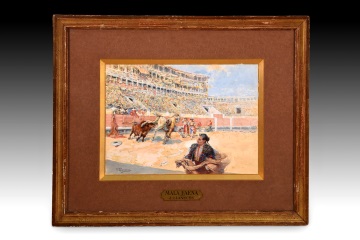
Bad work. Watercolor. Signed towards the lower left corner. LLANECES, JOSÉ DE SAN BARTOLOMÉ (Madrid, Spain, 1863-1919). José de San Bartolomé was a Spanish painter and sculptor who worked from childhood in the studio of the photographer Herbert and began his training at the School of Arts and Crafts in Madrid, expanding it at the San Fernando Royal Academy of Fine Arts, while copying works by the masters at the Prado Museum. In 1886, he moved to Paris, dedicating himself primarily to genre painting in the style of Fortuny, a theme that enjoyed great commercial success. He met Francisco Domingo, who opened the doors of the Buenos Aires art market to him, where he received important commissions for painting and sculpture. He was Secretary of the Society of Artists of Paris, and in 1894 he was named a Knight of the Order of Charles III, in 1901 of the Legion of Honor, and in 1902, a Commander of the Order of Isabella the Catholic. At the beginning of the 20th century, he returned to Spain and devoted himself mainly to portraiture, although he also painted landscapes and scenes of everyday life. He enjoyed the patronage of royalty, as evidenced by the portraits he painted of Queen Maria Cristina and various members of the court. In 1925, the Paris Salon paid him posthumous tribute with an exhibition of his work held in France. Works by Llaneces are held in the Prado Museum, the Pablo Sarasate Museum in Pamplona, and the Spanish Embassy in Paris.
· Size: 52x2x42,5 / int 32x22,5
ANTIQUES
PAINTINGS
Ref.: ZF0997
-
Dressed Virgin. Carved and polychromed wood, etc. Spanish school, 17th century; clothing added later. Shows damage. Polychrome wooden carving of the type of dressed figure or vestment that has a series of garments: skirt, blouse, veil, etc. Religious sculptures of dressed figures were very common during the Spanish Baroque (and later), there may be cases of works in which the unseen part was barely roughed out and others in which it is all carved, with many intermediate points.
· Size: 26x26x57 cms.
ANTIQUES
SCULPTURE
Ref.: ZF1183
-
Special Offer! - Off
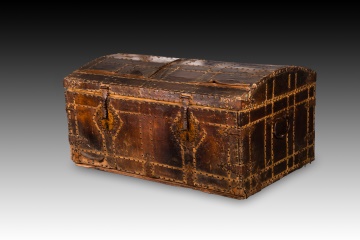
Chest. Wood, leather, iron. Spanish School, circa 1700. A rectangular wooden chest with a curved lid, covered in leather on the exterior, with fittings, handles, tacks, and two front closures. It has a front and top opening. Inside, there is a lower compartment accessible from the front, divided in two by a vertical wooden panel. The lid and part of the chest are lined with fabric. The back is not leathered. The round-headed nails are arranged in geometric patterns. The handles are decorated with discs. The fittings, also ornate, follow designs based on architectural motifs, which are also present on the lock shields on the front. Some of the metal elements still show traces of gilding. These types of trunks were known as "travel trunks" because they were typically used to store belongings on journeys, hence the leather covering and the apparent lack of decoration on the exterior. The two locks provided added security, as both keys had to be combined to open the trunk, and these keys were usually entrusted to two different people. Compare this to the 17th-century travel trunk from the Viceroyalty of Peru in the Museum of the Americas (Madrid), which features animal and plant motifs (embossed leather). Or compare it to the 17th-century chest of the Mayorazgo de la Cerda estate in the National Museum of Decorative Arts (Madrid)., detectedSourceLanguage: es
· Size: 85x129x65 cms.
ANTIQUES
FURNITURE
Ref.: ZF1245
-
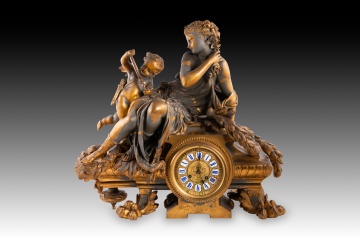
Napoleon III table clock. Calamine, bronze, etc. Samuel Marti et Cie., Philippe Mourey. France, second half of the 19th century. It shows damage. There are marks on the back of the case and a stamp on the movement. It's a table clock with a dial featuring blue numerals on a white background, Roman numerals for the hours, and Arabic numerals every five minutes engraved on the metal. It has a base with animal claws, plant motifs, and discs. Reclining on the base is a female figure dressed in a tunic, accompanied by a winged child with a quiver of arrows on his back; these figures may represent Venus and Cupid. The Paris-type movement features a hallmark alluding to the bronze medal awarded to Samuel Marti et Cie. at the Paris Exposition (France) of either 1855 or 1860, which the watchmaking company retained until 1889 (other experts date this mark between 1867 and 1900). On the reverse, near the base, is engraved the inscription “PH. Mourey 6 8,” referring to Philippe Mourey (active 1840-1910/20), a French bronze worker and watchmaker. Weight: 25 kg.
· Size: 61x20x56 cms.
ANTIQUES
MISCELLANEUS;CLOCKS
Ref.: ZF1482
-
Three children playing with a wild animal. Bronze. French school, 19th century. Bronze sculpture depicting three children accompanied by a panther. The presence of plant elements (grapes, vines) suggests a possible mythological theme from classical antiquity, perhaps Dionysus riding his panther accompanied by two putti. Stylistically, it is reminiscent of models common in the 19th-century French school, such as those created by Claude Michel "Clodion" (December 20, 1738 – Paris, March 29, 1814). Weight: 8287 g.
· Size: 23x20x32 cms.
ANTIQUES
SCULPTURE
Ref.: ZF1511