-
Bed frame. Walnut wood. Spain, 19th century. Bed frame made of carved walnut wood with architectural-style decorations concentrated on the headboard and the vertical corner supports. These carved elements (fluted balusters, knobs, galleries of semicircular arches with paired columns) show a clear classical influence and a marked inspiration from much older Spanish school works.
· Size: ext: 137x207x127 cms / int:128x194x127 cms.
DECORATIVE ANTIQUES
Ref.: Z0458
-
Small chest. Walnut wood, iron. 17th century. Rectangular chest or casket with a flat lid and an iron lock shield on the front (highlighting the key lock), decorated with simplified plant motifs. The lid features smooth moldings around the edge, which would also be present on the lower section, as was common in these pieces during the 17th century.
· Size: 72x41x44 cms.
DECORATIVE ANTIQUES
Ref.: Z0511
-
Special Offer! - Off
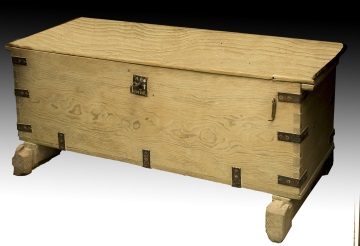
Pine chest, dated 1886. Palencia. Wrought iron fittings , detectedSourceLanguage: es
· Size: 154x54x54 cms.
DECORATIVE ANTIQUES
Ref.: Z0720
-
Ceiling lamp, Tiffany style. Polymer, metal. 20th century. Ceiling lamp with one light point, hanging chain and polymer shade in various colors resembling the usual and appreciated Tiffany compositions in the manner of stained glass.
· Size: 68x68x80 cms. Tramo cadena: 28 cms.
DECORATIVE ANTIQUES
MISCELLANEUS
Ref.: Z0793
-
Classic bracket in marble dust. Beneath a simple molding, a volute with an open center reveals a shell-like shape in a different tone, the lines of which it follows. This two-tone effect is also seen in other architectural details of the corbel, such as the oval shield with volutes in the lower section, and the three drops in the center. While the inspiration from classical elements is clear, these have been used freely, resulting in a highly original work of art.
· Size: 50x37x67 cms.
DECORATIVE ANTIQUES
Ref.: Z0806
-
Armchair. Walnut wood, upholstery. Spanish school, 18th century. A carved walnut armchair or chair with an upholstered seat, featuring a high, openwork back decorated with simplified architectural and vegetal motifs, undulating arms ending in volutes and joined to the back and seat, cabriole-shaped front legs terminating in spherical claws, and straight rear legs secured with a plain stretcher. The seat has a cut-out decoration along its lower edge. Aesthetically, it recalls certain details of English school furniture, but, as is typical of 18th-century Spanish cabinetmaking, it also shows French influence.
· Size: 68x57x107 cms.
DECORATIVE ANTIQUES
FURNITURE
Ref.: Z1466
-
Cylindrical box for “turner’s test”, 17th-18th century. A cylindrical box decorated with various bands and a lid with a carved star. The base bears a series of inscriptions that allude to its purpose: these types of pieces served as demonstrations of mastery by apprentice woodturners, required to pass certain examinations within their guild. Few of these works survive because they were more practical than decorative and were not commissioned by a client, but their significance is undeniable for this very reason.
· Size: 10,5x10,5x19 cms.
ANTIQUES
MISCELLANEUS;OTHER OBJECTS
Ref.: Z2330
-
Boy reading the newspaper. Watercolor. Signed (H. Muñoz). Against a virtually undefined background (floor and wall) to focus attention on the viewer, the figure of a boy with glasses, barefoot and standing, reading a newspaper that he holds with both hands, has been placed.
· Size: 39x4.5x51 cms / int. 18.5x29.5
DECORATIVE ANTIQUES
Ref.: Z3084
-
Mother-of-pearl box with bronze mount. 19th century. A box made of mother-of-pearl plates joined by a bronze structure decorated with simple plant motifs, still retaining traces of gilding in some areas. The piece's form is reminiscent of examples inspired by the French Louis XV style, while the materials used were common in 19th-century decorative arts.
· Size: 7,5x5,5x4 cms.
ANTIQUES
MISCELLANEUS;OTHER OBJECTS
Ref.: Z3817
-
Interior. Oil on panel. GIFFEN CAULDWELL, Leslie (United States of America, 1861-1941). Signed (lower left and upper right areas). Oil on panel depicting an interior with a series of objects (bookshelves, part of the wall, pieces of ceramic or porcelain, etc.) rendered with a style influenced by certain European avant-garde movements, as evidenced by the framing of the scene, the predominance of color over line, the brushstrokes, and other elements. Leslie Giffen Cauldwell was a painter born in New York (USA) who trained at the Académie Julian in Paris (France) under Gustave Boulanger and Carolus-Duran and exhibited his work at the Salons of 1885 and 1888. His work is held in private collections and in institutions such as the Musée d'Orsay in Paris.
· Size: 45x5,5x55 cms / int: 25x35 cms.
DECORATIVE ANTIQUES
Ref.: Z4172
-
Bench. Elm wood. 17th century. Rectangular bench seat decorated with two facing teardrop-shaped holes and two side panels acting as legs (these have been cut out in a curved, Baroque style), which are joined by a central chambranle, also cut at its lower edge.
· Size: 47x26x35 cms.
DECORATIVE ANTIQUES
MISCELLANEUS
Ref.: Z5316
-
“Dompedro” in mahogany wood. 19th-20th century. A polygonal-sectioned piece of furniture used to conceal the chamber pot under a lid and facilitated by a removable footrest. Very similar models were already in use in the 19th century, and this type of furniture was common in homes until the 19th century. Note its resemblance to examples preserved in the Museum of Romanticism in Madrid.
· Size: 45x45x46 cms.
DECORATIVE ANTIQUES
Ref.: Z5613
-
Holy water vessel. Bronze. 16th century. This bronze piece features a circular base and a circular body with an outward-curving mouth at the top. The upper part is decorated with relief masks reminiscent of certain Renaissance pieces depicting Medusa (the rings for the handle emerge from two of these masks). This holy water vessel, also known as a situla, is a type of object that appeared in the West during the Middle Ages within this religious context. This particular example draws inspiration from Renaissance pieces in both its lines and decoration, and thus also evokes works from Ancient Rome (such as the situla in the Landesmuseum in Hanover).
· Size: 19x18x19 cms.
ANTIQUES
MISCELLANEUS;OTHER OBJECTS
Ref.: Z5937
-
Bench. Walnut wood. 18th century. A rectangular bench with a smooth molding around the edge and turned legs shaped like balusters, secured at the bottom by brackets with a cut-out profile. It displays classical influences, present alongside traditional elements of older Spanish furniture (format, construction, etc.).
· Size: 52x34,5x50 cms.
ANTIQUES
FURNITURE
Ref.: ZE331
-
Wall mirror. Molded alabaster. 20th century. Rectangular wall mirror with a polychrome molded alabaster frame decorated with elements strongly inspired by classical art (note the "candelieri" on the edges, reminiscent of Renaissance works, the crest with scrolls and volutes, etc.). Weight: 21 kg.
· Size: 88x5x114 cms
DECORATIVE ANTIQUES
FURNITURE
Ref.: ZE404
-
Chocolate cutter. Wood, metal. 19th century. Chocolate chopper made of carved wood with an iron blade in the shape of a horse, which has a turned wooden handle. Compare with the one from Salamanca preserved in the CIPE Costume Museum in Madrid (inventory CE008848) dating from the 19th century.
· Size: 32x32,5x11 cms.
ANTIQUES
MISCELLANEUS;OTHER OBJECTS
Ref.: ZE442
-
Classic-inspired cup in carved marble. The cup features a wide mouth curved outwards and is set atop a circular base. Its lines connect it to models from all artistic styles inspired by classical antiquity (Renaissance, Neoclassicism, etc.). This type of piece was used both for interior decoration in prominent residences and for exterior decoration in important gardens.
· Size: 50x50x61 cms.
DECORATION
Ref.: M0126A
-
Door knocker. Wrought iron. 16th century. A wrought iron door knocker made of several pieces, the main one being the most prominent. This piece features two bands that begin parallel to each other, then separate to form two opposing volutes joined at this point by a rectangular piece. Several engraved lines further accentuate these elements. The use of volutes in wrought iron was common as early as the Romanesque period, and this element evolved over time. This particular example, due to its shape, belongs to a type of knocker known as a "scissor knocker."
· Size: 15x8,5x2 cms
ANTIQUES
MISCELLANEUS;OTHER OBJECTS
Ref.: Z0007A
-
Armchair and two chairs set. 19th century. Upholstery requires restoration All elements made of mahogany wood with bronze applications., detectedSourceLanguage: es
· Size: Butaca: 58x51x88 cms. Sillas: 48x45x83 cms.
DECORATIVE ANTIQUES
FURNITURE
Ref.: Z0781A
-
Latch. Wrought iron. 18th century. An iron element made up of several pieces tightly joined together, featuring simple decoration with rings and other details, used to close a door or window. These types of pieces were very common in the construction of important residences. 2 units available.
· Size: Longitud 205 cms.
ANTIQUES
MISCELLANEUS;OTHER OBJECTS
Ref.: Z3485B
-
Friar's chair. Leather, wood. Spain, 16th century. It has flaws and requires restoration. A high-backed armchair of the type known as a "frailero" (friar's chair), featuring studded leather on the upper back and seat, low stretchers with a cut-out profile connecting the front and rear legs, and medium stretchers or rails (the front one carved and cut out with geometric patterns) connecting the two front and two rear legs, and simple armrests. Originally of Italian origin, the frailero armchair became one of the most common pieces of Spanish furniture after its introduction in the 16th century, being characteristic of that century and the 17th, and experiencing a revival in the historicist movement of the 19th century. Because it was such a deeply rooted tradition in Spain, this type of chair continued to be produced throughout the centuries.
· Size: 61x54x112 cms.
DECORATIVE ANTIQUES
FURNITURE
Ref.: Z3523A
-
Pair of mirrors with sconces. Metal, glass. 20th century. Pair of wall mirrors with metal frames, decorated with architectural and plant elements of clear classicist influence (note the openwork, the small crest located in the upper part of both and the mask that appears in the lower areas) and which also feature a three-light wall sconce at the front, with arms decorated with plant motifs.
· Size: 43x15x55 cms
DECORATIVE ANTIQUES
MISCELLANEUS
Ref.: ZF0277
-
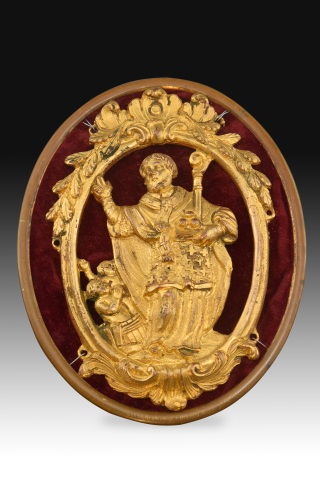
Devotional medal of Saint Nicholas on a stand. Gilt bronze, textile, metal. 18th century. A gilded bronze devotional medal mounted on a wire support with an oval frame adorned with a crest featuring symmetrical vegetal motifs and another finial below, also composed of vegetal elements and volutes. Within this plain frame is the figure of a saint. Standing, holding a staff in one hand and raising the other in a gesture of blessing, is a male figure dressed in liturgical vestments, accompanied by small figures praying, positioned within a barrel or bucket. Saint Nicholas of Myra or Bari was a bishop who died around the middle of the 4th century AD. One of his best-known miracles was the resurrection of three children (depicted in this work) who had been sacrificed by an innkeeper to feed his customers. Although he was bishop of the city of Myra, he is shown here in liturgical vestments but without the customary mitre. The three spheres above the book are believed to allude to the miracle in which the saint helped the father of three girls to gather a dowry for them (as they are three golden spheres).
· Size: 9x11,5x1 cms.
ANTIQUES
SCULPTURE
Ref.: ZF0460
-
Pitcher and glass. Glass. Royal Glass Factory of La Granja de San Ildefonso, Segovia, Spain, 18th century. A pitcher or vase with a lid and a small spout, made of clear, carved, and engraved glass, decorated with plant motifs and architectural elements of classical influence. These were produced at the Royal Glass Factory of La Granja de San Ildefonso, founded in 1727 by Buenaventura Sit, initially as a furnace for flat glass to supply the nearby Royal Palace. Shortly thereafter, they diversified their production, becoming one of the leading glassmaking centers in Spain.
· Size: Jarra 10x10x33 cms. Vaso 13x13x15 cms
ANTIQUES
MISCELLANEUS;OTHER OBJECTS
Ref.: ZF0878