-
Bed frame. Chestnut wood. Spain, 19th century. Bed frame made of carved chestnut wood, with the headboard higher than the footboard, and a carved decoration of geometric motifs centered on the outer parts of these two pieces. The legs, which extend upwards, also feature elaborate turning that, like the aforementioned decoration, is inspired by traditional works of the old Spanish school.
· Size: cabecero: 113x116 cms. piecero:103x100 cms.
DECORATIVE ANTIQUES
Ref.: Z0832
-
Rustic-style sideboard made of pine wood with a warm, natural tone. It features an upper section with two textured glass doors, an open central area with a small shelf and turned columns, and a light marble countertop. The lower section includes a drawer and a two-door cabinet with white ceramic handles. It retains the patina and signs of wear characteristic of its age, which add character to this traditional piece of furniture. It has faults., detectedSourceLanguage: es
DECORATIVE ANTIQUES
Ref.: Z1231
-
Eight-armed chandelier in gilded metal. 20th century. Attached to the ceiling by a chain, the eight arms of the lamp, S-shaped and adorned with vegetal motifs towards the center and at the ends, emerge from a central baluster topped at the bottom by a polygonal piece. While the form and material recall Northern European Renaissance examples, the shapes and decoration show a greater influence from highly simplified classical examples.
· Size: 85x85x100 cms.
DECORATIVE ANTIQUES
Ref.: Z1658
-
Wall clock. Case made of walnut wood, wood, etc. 19th century. Wall clock with a carved walnut wood case decorated with classically influenced architectural elements, combining wood tones. The white dial features Roman numerals for the hours and lines for the minutes; the pendulum has a decoration of thin stems on either side of an arrow and two letters (RA), and a plate on the white case to measure its oscillation.
· Size: 34x80 cms.
DECORATIVE ANTIQUES
Ref.: Z2292
-
“Confidence”. Calamina. France, around 1900, following GRISARD, Désiré (1872-¿). With manufacturing stamp, title and engraved name. A patinated metal figure in various shades depicts a young woman in a tunic, raising one hand to her lips. On the base on which she stands, there is a cartouche with the title of the figure (Confidence), and next to it, engraved, the name of the artist who inspired this work. Désiré or Desire Grisard was a French artist born in 1872, well known for his Modernist or Art Nouveau works, and he created a number of truly striking figures.
· Size: 11x11x39 cms.
DECORATIVE ANTIQUES
SCULPTURE
Ref.: Z2348
-
Centerpiece. Porcelain. Roger's, Portugal, 20th century. With markings on the base. A centerpiece made of glazed porcelain, decorated with a floral arrangement on the front, a base with classical architectural motifs and gilded elements, and a rim at the top with undulations, recesses, and gilded highlights, further enhanced by two elongated shapes or figures on the sides reminiscent of cathedral gargoyles. The base bears the mark of Roger's, a Portuguese firm active in the 20th century, known for pieces reminiscent of 19th-century European porcelain. Weight: 7.1 kg.
· Size: 35x55x47 cms.
DECORATIVE ANTIQUES
MISCELLANEUS
Ref.: Z2763
-
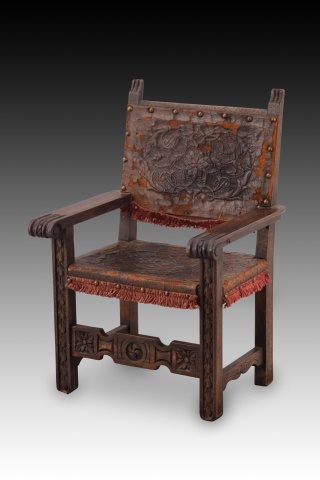
Miniature friar's chair. Wood, leather, metal. Spanish school, 19th century. A high-backed armchair of the type known as a "frailero" (a type of Spanish chair), featuring stretchers on the legs connecting the front and rear, and a central stretcher or beam at the front with carved vegetal and architectural motifs. The legs display vegetal carving that extends onto the arms, forming volutes on the front. The backrest and seat are upholstered in leather (the backrest embossed with vegetal motifs), and adorned with metal studs and fabric fringe. Originally of Italian origin, the "frailero" became one of the most common pieces of Spanish furniture after its introduction in the 16th century, remaining characteristic of that century and the 17th, and experiencing a revival in the historicist movement of the 19th century. Because it was such a deeply rooted tradition in Spain, this type of chair continued to be produced throughout the centuries.
· Size: 22x20x32,5 cms.
DECORATIVE ANTIQUES
FURNITURE
Ref.: Z3123
-
Snuffbox. Ebony, ivory. Possibly Germany, early 19th century. Circular box with a flat lid made of ebony and ivory, decorated on the outside with a carving of geometric elements arranged around a central ivory circle (with an engraving that includes the inscription "Gott ist mein Schultz" –God is my protection– on a belt surrounding three letters –perhaps the owner's initials– and under a unicorn bust). On the back, a similar composition has been carved, but without a central ivory piece.
· Size: 9x9x2 cms.
DECORATIVE ANTIQUES
Ref.: Z3816
-
Landscape. Oil on canvas. Spanish School (J. Boe), 20th century. Signed (lower right area); stamp on the back. Oil on canvas depicting a rural landscape, with mountains in the background and relatively low, whitewashed buildings in the foreground. The composition, subject matter, brushwork, lack of drawing, volumes, etc., show clear influences of 20th-century European avant-garde painting movements.
· Size: 55x2x46 cms
DECORATIVE ANTIQUES
PAINTINGS
Ref.: Z4492
-
Devotional medal, Saint James the Apostle. Gilt bronze. 17th century. A devotional openwork medal depicting Saint James the Apostle in the center, standing on a pedestal and holding a staff and a book, surrounded by a wreath of leaves tied with two bows above and below. Similar examples can be found in the Museum of Pilgrimages in Santiago de Compostela.
· Size: 5x0.5x6 cms.
ANTIQUES
MISCELLANEUS;JEWELRY
Ref.: Z5091
-
Branded. Copper, iron. Marked MS. 17th century. Globular-shaped container with a tall copper neck and an iron handle that has, towards the top, remains of an engraved legend.
· Size: 33x35 cms.
DECORATIVE ANTIQUES
Ref.: Z5366
-
Hyssop. Bronze. 18th century. A bronze swab consisting of the usual circular part, followed by a shaft decorated with moldings, which separate a tubular section from a baluster-shaped one. This combination of lines is common in works of classical inspiration.
· Size: 5x5x27 cms
DECORATIVE ANTIQUES
MISCELLANEUS
Ref.: Z5487
-
Pair of andirons. Wrought iron. 18th century. A pair of wrought iron andirons decorated with fine lines and smooth moldings on the vertical rods and volutes on the flat metal serving as legs beneath them. Although these are utilitarian pieces with a similar form dating back to antiquity, these examples show a marked influence of 18th-century Neoclassicism, to which they belong.
· Size: 76x66 cms,.
DECORATIVE ANTIQUES
Ref.: Z5606
-
“Dompedro” made of mahogany wood. This piece of furniture was very common in some homes until the 20th century, as it was used to conceal the chamber pot. It stands on four turned legs and features a removable footrest and a lid decorated with a stylized geometric pattern very similar to that used in carpets.
· Size: 47x45x45 cms.
DECORATIVE ANTIQUES
Ref.: Z5612
-
Necklace with clear quartz beads. A necklace made from a series of faceted clear quartz discs. Clear quartz is also called rock crystal, and it is a nearly colorless variety of quartz, used since antiquity in decorative arts and often in jewelry as a gemstone.
· Size: 24x3 cms.
DECORATIVE ANTIQUES
Ref.: Z5804
-
Necklace with jasper plates. A black cord necklace has been used to position and join the rectangular jasper plaques that form the necklace, which are wider at one end than the other. Jasper, used for jewelry and other decorative arts since antiquity, is a stone with a variety of colors, valued for its ornamental qualities and as a precious stone.
· Size: 22x5 cms.
DECORATIVE ANTIQUES
Ref.: Z5805
-
Necklace with Mexican agate plaques. A necklace made with cords in different shades, which help to position and highlight the beads that compose it: flat circular discs alternate with dark spherical beads, emphasizing the lines of the former; at the front is a triangular piece, in which white and transparent areas alternate with red, yellow, white, etc. zones. Agate has been a common stone throughout history for the properties attributed to it (Egyptian agate was effective against the bites of certain animals, the stone in general brought longevity in other cultures, etc.) and for its striking appearance (often used in both sculptures and Egyptian mummies for the eyes, carved to create remarkable pieces such as the Chalice of Valencia or the cameos of Ancient Rome, etc.).
· Size: 22x7 cms.
DECORATIVE ANTIQUES
Ref.: Z5806
-
Isabeline style chair. Wood, fabric. Spain, 19th century. A carved and polychrome wooden chair with cabriole legs and a pierced back decorated with a symmetrical composition reminiscent of the Rococo style in some details and Neoclassical elements in others. The Isabelline style developed in Spain during the reign of Isabella II, continuing until the end of the 19th century. The furniture, which prioritized comfort and a degree of ostentation (using relatively inexpensive materials and techniques), interpreted the French Baroque, Rococo, and Neoclassical styles in its own way, with proportions, techniques, and details specific to 19th-century Spain, and a predominance of gilding, polychromy, carvings, and other decorative elements.
· Size: 45x45x87 cms.
DECORATIVE ANTIQUES
Ref.: Z6029
-
Lot of six bolts. Wrought iron. A collection of six wrought iron latches or locks, each different from the others and composed of the usual two pieces. Given their different dates, the decorative motifs vary: cut-out profiles, scrolls, volutes, shell-shaped forms, etc. Weight: 7.35 kg.
· Size: Mayor: 9x6x44 cms
DECORATIVE ANTIQUES
WROUGHT IRON;MISCELLANEUS
Ref.: Z0208B
-
Latch. Wrought iron. 18th century. An iron element made up of several pieces tightly joined together, featuring simple decoration with rings and other details, used to close a door or window. These types of pieces were very common in the construction of important residences. 3 units available. Price per unit
· Size: 290x30 cms.
ANTIQUES
MISCELLANEUS;OTHER OBJECTS
Ref.: Z3485C
-
Spinning wheel. Carved and turned walnut wood. 19th century. Vertical spinning wheel made of carved walnut wood, decorated with fine lines in certain areas and the use of baluster-shaped pieces where deemed necessary. Compare, for example, with the vertical spinning wheel preserved in the El Greco Museum in Toledo, dating from the 19th century.
· Size: 44x41x86 cms.
DECORATIVE ANTIQUES
Ref.: Z5583A
-
Spinning wheel. Carved and turned walnut wood. 19th century. A vertical spinning wheel carved from walnut, decorated with fine lines in certain areas, and the use of baluster-shaped pieces, some decorated with discs and moldings, where all were deemed necessary. Compare, for example, with the vertical spinning wheel preserved in the El Greco Museum in Toledo, dating from the 19th century.
· Size: 43x46x60 cms
DECORATIVE ANTIQUES
Ref.: Z5583B
-
Silver mesh bag, 19th century. A silver mesh handbag, decorated with triangular elements at the bottom, featuring a smooth hinged closure and a chain with alternating long and short links. This type of bag was very common in the 19th century, both as a luxury item and a practical accessory for galas and other special events. Weight: 200 gr
· Size: 16x15 cms.
DECORATIVE ANTIQUES
Ref.: Z6876D
-
Column base. Stone. 17th century. They are missing Column bases made of carved stone, each consisting of a square section with smooth moldings (plinth), a torus or molding, and a smooth cap. Stylistically, they are reminiscent of models derived from classical Roman art, a common feature in both Renaissance and Baroque art. Unit price.
· Size: 56x56x27 cms.
DECORATIVE ANTIQUES
MISCELLANEUS
Ref.: ZF0854