-
Blacksmith's anvil with stand. Wrought iron, wood. Spain, 18th century. Wrought iron anvil used for forging, dating from the 18th century, placed on a later carved wooden support consisting of three legs and a tubular shape, in the upper part of which there is a hollow to place the anvil. Weight: 21 kg.
· Size: 29x14x39 cms. Sin soporte
DECORATIVE ANTIQUES
WROUGHT IRON;MISCELLANEUS
Ref.: Z2423
-
Table lamp base. Glass, metal. 20th century, following Art Nouveau models. Table lamp base made of colored glass reminiscent of Emile Gallé models, featuring a decoration of leaves and flowers clearly inspired by European Art Nouveau around 1900. It has a metal top with two arms to hold a lampshade.
· Size: 28x28x39 cms.diam. pantalla: 30 cms.
DECORATION
Ref.: Z2748
-
Lid of a pyx or chalice. Silver. 16th century. A silver-plated lid for a pyx or ciborium (the inner or lower portion retains its gilt finish). It features a circular base and a slightly flared, conical shape, topped with a disc-shaped piece. The lower part is decorated with a garland of leaves, and leaves along the rest of the piece, interspersed with pointed lines. The decoration clearly shows the influence of Renaissance styles. Weight: 100 grams., detectedSourceLanguage: es
· Size: 10x10x7,5 cms.
ANTIQUES
MISCELLANEUS;SILVER
Ref.: Z2776
-
Mine or ship telephone, model HF, type ST-1. Second half of the 20th century. A telephone for use in mines or on ships, designed to be mounted on a wall or vertical surface. It consists of a metal box to protect the machinery and the handset, which attaches to one side of the box, with the cord or cable emerging from below (next to the line jack). On the other side is the crank, typical of this model. These telephones were made with specific materials and shapes, prioritizing utility and durability, but without neglecting an aesthetic appeal evident in the lines of the box, etc., which is still appreciated today.
· Size: 25x18x30 cms.
DECORATIVE ANTIQUES
Ref.: Z3941
-
Landscape; Forest. Oil on panel. 20th century. Sketch or study of a wooded landscape presented horizontally, highlighting the straight lines created by the trees with a distinctive brushstroke, a predominance of color over drawing, etc. The work exhibits characteristics typical of pieces influenced by certain avant-garde artistic movements that emerged in Europe from the late 19th century onwards. Weight: 2.25 kg.
· Size: 45x6x55 cms. int: 25x35 cms.
DECORATIVE ANTIQUES
PAINTINGS
Ref.: Z4170
-
Coal box. Brass, wood, iron. Northern Europe, 19th century. Rectangular box mounted on four casters or wheels for movement, covered on the outside with metal decorated with a series of genre scenes enhanced by bands of vegetal motifs. These chests were used to store coal near the fireplace, and their use was known in England, Holland, etc. Weight: 5 kg.
· Size: 46x30x28 cms.
DECORATIVE ANTIQUES
MISCELLANEUS
Ref.: Z4318
-
Saint Thomas of Villanova. Painted glass. 18th century. It has faults. A stained-glass window with a simple wooden frame depicts Saint Thomas of Villanova (with his name written at the bottom). A saint of the Order of Saint Augustine, he became Archbishop of Valencia under duress from a superior, as he had always refused. He was canonized in 1658 and is also considered the first saint to have graduated from the University of Alcalá de Henares (Madrid).
· Size: 34x1,5x55 cms. INT 24X37 cms.
DECORATIVE ANTIQUES
Ref.: Z4683
-
Pair of oriental vases. Glazed porcelain. Circa 1950. A pair of lidded vases made of glazed porcelain, decorated with a composition of simple geometric bands and a motif of pink peonies with green stems and leaves in the center of the body and on the lids. These pieces were highly valued in the West for their originality, colors, and designs.
· Size: 23x23x53 cms.
DECORATIVE ANTIQUES
Ref.: Z4876
-
Pair of wall sconces. Bronze. 20th century. Pair of wall sconces with two light points each decorated with vegetal scrolls, interlacing patterns, leaves and pinecones and topped by two children's figures playing wind instruments with the lower part of their bodies formed by leaves, following in all this a strong classicist influence.
· Size: 28x15x50 cms
DECORATIVE ANTIQUES
FURNITURE
Ref.: ZE426
-
Still life with flowers. Oil on canvas. ALBAICÍN, María (María García García; Madrid, 1943). Signed (lower right area). The daughter of bullfighter Rafael Albaicín, María García García was a student of Regla Ortega. The niece of Josefa García Escudero, she was better known as María Albaicín and became a renowned flamenco dancer.
· Size: 64x3x53,5 cms. int: 49x39 cms.
DECORATIVE ANTIQUES
PAINTINGS
Ref.: ZE430
-
Low table. Solid wood, wrought iron Low table with a rustic finish made of carved wood, featuring four drawers (three on each longer side) with metal rings and turned legs. The lines of the piece and its finish are reminiscent of old provincial examples.
· Size: 90x60x40 cms.
DECORATION
Ref.: AJ573B
-
Tuft. Metal. 19th century. A set of three metal pieces that, when joined, would form a crest. The scrolls, plant motifs, palms, lines, etc., link these pieces to 19th-century works with a clear Neoclassical influence, being similar to French works or those from schools with a strong French influence.
· Size: central 23x30 lateral: 40x23 cms
DECORATIVE ANTIQUES
Ref.: Z0165G
-
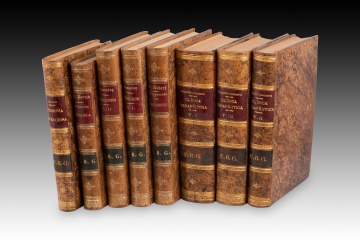
Lot of eight medical books. Spain, 1889-1890. Lot of books, with handwritten inscription, consisting of: -Three volumes, Lessons in therapeutic clinic by Dr. Dujardin-Beaumetz…”. Second Spanish edition, fourth printing. Madrid, D. Carlos Bailly-Bailliere Publishing House, 1890. -Medical Clinic. Clinical lessons given at the Faculty of Medicine of Valencia during the course of 1888 to 1889 by D. Francisco Moliner…”. Valencia, Pascual Aguilar Bookstore, 1889. -Two volumes, Manual of Internal Pathology by G. Dieulafoy…”. Library of the Journal of Practical Medicine and Surgery. Second corrected and enlarged edition. Madrid, Administration of the Journal of Practical Medicine and Surgery, 1889. -Elements of venereal pathology by D. José Pareja Garrido (…). Granada, Imp. de la Viuda e Hijos de Paulino V. Sabatel, 1889. -Diseases of the digestive system by Doctors D. Bartolomé Robert (…) and D. Emerenciano Roig y Bofill (…). Library of the journal of medicine and practical surgeries. Madrid, Administration of the Journal of Medicine and Practical Surgery, 1889.
· Size: 15x28x22 cms
DECORATIVE ANTIQUES
MISCELLANEUS
Ref.: Z0801A
-
Artichoke baluster. Wrought iron. Spain, 16th century. Wrought iron baluster with a straight, tubular section, featuring a series of discs and moldings as decoration. The central area includes a larger disc, moldings, and a balustraded shape with raised vegetal decoration (this detail gives rise to the common name for these elements, "artichoke balusters"). Weight: 10 kg.
· Size: 12x12x114 cms.
DECORATIVE ANTIQUES
WROUGHT IRON;MISCELLANEUS
Ref.: Z1102A
-
Bed headboard. Molded wood. A molded wooden headboard decorated with oval finials on the sides and smooth moldings following the lines of the headboard, which features a central shape with a curved top, flanked by two other pieces, creating a symmetrical composition with several more moldings. It follows typical lines of the 20th-century Spanish school., detectedSourceLanguage: es
· Size: 140x5x130 cms
DECORATION
FURNITURE;CLASSIC
Ref.: Z1968C
-
Oriental figure. Hard stones. 20th century. Stylized figure made of hard, dark-toned stone, with some lighter-colored veins, which may represent one of the Eight Immortals of the Taoist pantheon, specifically He Xiangu (who is usually shown holding a lotus flower, sometimes also accompanied by a sheng, or by a mythological bird called fenghuang).
· Size: 4,5x3x16 cms.
ANTIQUES
MISCELLANEUS;OTHER OBJECTS
Ref.: Z6142B
-
Satsuma vase with base. Porcelain. Japan, Meiji Era (1868-1912). Satsuma-style vase with a base in the shape of a Fu lion or Buddha (a mythical Buddhist animal that protects against evil spirits, negative energies, and malicious people), finished in a reddish tone with gold details. Satsuma porcelain originated in Japan in the 6th century AD and is still produced today, becoming known in Europe after the International Exhibition in Paris in 1867.
· Size: 21x10x26 cms.
ANTIQUES
MISCELLANEUS;CERAMIC
Ref.: ZA6255
-
Candlestick with triangular base. Bronze. Spain, 18th century. A bronze candlestick with a triangular base raised on three legs and embellished with moldings, a balustraded shaft with discs of varying diameters, and a similarly decorated upper section, precisely in the area used for the candle. This type of item was common in the 18th century, both in important private homes and in monasteries, convents, churches, etc., and this particular piece represents a very common style in Spain at that time.
· Size: 18x18x45 cms.
DECORATIVE ANTIQUES
MISCELLANEUS
Ref.: ZF0438
-
Winding machine of J. Fábrega Carrera's nephews. Barcelona, Spain, 20th century. Manually operated winding machine with bell signal for five threads. The company had a factory in Manresa and what was then called an office in Barcelona, and in addition to machinery, it produced ropes, straps, etc.
· Size: 70x46x52 cms,
DECORATIVE ANTIQUES
MISCELLANEUS
Ref.: ZF0739
-
Courtesan. Carved tiger's eye. China, 20th century. A female figure carved from tiger's eye (quartz, limonite, and riebeckite, with a cat's-eye or chatoyancy effect) depicts a young lady with a draped fabric over her shoulders and a flowering branch in one hand, posed gracefully, suggesting a dancing courtesan. It may represent Guanyin, the Chinese name for Avalokiteshvara, a deity venerated in Buddhism.
· Size: 7x3x21 cms
DECORATIVE ANTIQUES
SCULPTURE
Ref.: ZF0911
-
Bed headboard. Rosewood. 19th century. Headboard for a bed made of carved rosewood, decorated with two fluted columns with entasis at the bottom (located on either side), topped by two vegetal motifs on pedestals. The central area curves gently upwards. Stylistically, the influence of Neoclassical models is clear. It requires restoration
· Size: 166x9x128 cms
DECORATIVE ANTIQUES
FURNITURE
Ref.: ZF0956
-
Pair of ashtrays. Blue glass. Murano, Italy, 20th century. A pair of glass ashtrays combining two shades of blue and decorated on the exterior with a series of thick protrusions or spikes towards the bottom. Due to their shape and the quality of the material, they have been associated with the city of Murano, renowned for both its glass and the design of its pieces.
· Size: 21x21x9 cms.
DECORATIVE ANTIQUES
MISCELLANEUS
Ref.: ZF1161
-
Landscape. Oil on canvas. 19th century. A horizontal landscape with a waterway in the background, islands, and a series of trees and rock formations in the foreground, which, along with the light, help to highlight a figure with an animal that appears toward the center of the composition. Stylistically, it is a typical work in certain European painting movements of the 19th century.
· Size: 55,5x6,5x41 cms. Int 38,5x27,5 cms
DECORATIVE ANTIQUES
PAINTINGS
Ref.: ZF1348
-
Last Supper. Silver-plated metal, wood. Spanish school, circa mid-20th century. Wall painting with a silver-plated metal relief depicting the Last Supper (title at the bottom), with Christ at the center of the table and the composition, the Apostles around him in various poses, and an architectural frame in the metal, reminiscent of classicist models common in European art since the Renaissance. Weight: 3.5 kg.
· Size: 79x3x56 cms
DECORATIVE ANTIQUES
PAINTINGS
Ref.: ZF1357