-
Sold
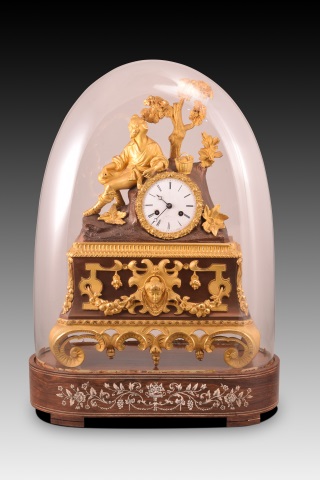
Table clock with lantern. Bronze, wood, glass. 19th century. Table clock with a base enhanced by a series of gilt bronzes in a distinct Renaissance and Classicist style. It features a rocky top (on which the white dial with Roman numerals is located), on which a young man leans, looking up at a vine with bunches of grapes. The clock is protected by a glass lantern with a wooden base decorated with light-colored marquetry, depicting floral and vegetal themes.
· Size: 40x20x27 cms. reloj 33x13x45 cms.
ANTIQUES
MISCELLANEUS;CLOCKS
Ref.: ZF0941
-
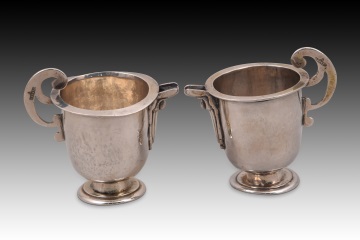
Pair of spouted jugs. Silver. BENITO GOMEZ, Antonio (1775-1835). Segovia, Spain, 1801-1835. With contrast marks. Pair of small jugs with a circular base with mouldings, a low conical foot and a tubular body ending in a hemisphere at the bottom and with a flat moulding at the top; the handle, in double C, has a simple volute or branch that rests towards the mouth of the piece; the spout shows simple decoration. Typologically, the present pair is linked to a type of spouted jug that, with variations, was common in Spanish domestic silverware from the first half of the 17th century until the beginning of the 18th century, and was also found after this date. As usual, the civil model was quickly assimilated by religious silverware, especially for use in liturgical cruets. Antonio Benito Gómez (1775-1835) was a silversmith who worked in Segovia from at least 1801 until his death, and also a silversmith who worked between 1824 and 1828 and between 1831 and 1835. Son of the silversmith Juan de la Cruz Benito, several of his works have been preserved: a baptismal shell and a small rostrillo for the church of Vera Cruz in Zamarramala, a hyssop found in the church of Nuestra Señora de los Dolores in La Granja de San Ildefonso (Segovia), etc. Stylistically, most of his known work is clearly Rococo in style, although some Neoclassical pieces stand out.
· Size: 8,5x5,5x8 cms.
ANTIQUES
MISCELLANEUS;SILVER
Ref.: ZF0984
-
Art Nouveau ceiling lamp. Metal, glass. Circa 1900. Gold metal ceiling lamp with several points of light hidden by white translucent glass shades decorated with geometric elements. The stems, leaves and shapes it presents frame it within Modernism or Art Nouveau, a style highly appreciated in Europe around 1900.
· Size: 61x61x67 cms.
ANTIQUES
FURNITURE
Ref.: ZF1291
-
Mustard and spice jars. Silver, "regent plate", glass. 20th century. Incomplete. With contrast marks. A collection of sixteen pieces (tubular salt shaker, three spice racks, mustard jars) bearing hallmarks. Some are English (from Birmingham, by AL Davenport Ltd, established around 1927, GJ Myatt & Co. Ltd., Arthur Willmore Pennington –established 1901–, S. Blanckensee & Son Ltd.; Goldsmiths' & Silversmiths' Company –established in London in 1880–; etc.), while others combine glass (both clear and transparent) with metal elements. Stylistically, they are inspired by traditional designs. Weight: 900 grams
· Size: 7x5,5x6,5 cms
ANTIQUES
MISCELLANEUS;SILVER
Ref.: ZF1374
-
Honorary Uniform, Order of Malta. Spain, possibly around the beginning of the 20th century. Blue jacket or coat and trousers, the first of which bears the label of the Félix del Hierro tailor shop, which was located on Barquillo Street in Madrid (Spain) and had another location on Almirante Street in the same city. It is known to have been in operation until at least 1946. The Sovereign Military Hospitaller Order of Saint John of Jerusalem, of Rhodes and of Malta (SMOM), known simply as the Order of Malta or Knights Hospitaller, was recognised by Pope Paschal II in 1113. After having provisional headquarters in Messina, Catania and Ferrara, the Order was finally established in Rome in 1834. During the 20th century, the Order refocused on its mission of hospital care.
· Size: 50x5x90 cms.
ANTIQUES
MISCELLANEUS;OTHER OBJECTS
Ref.: ZF1448
-
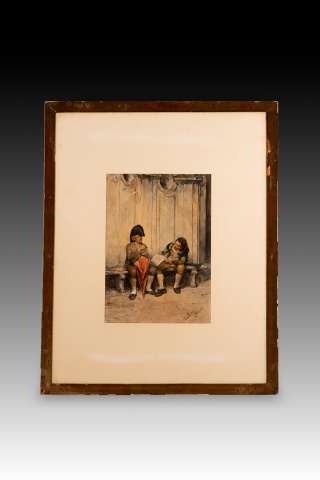
Two men on a bench. Watercolor. JIMÉNEZ ARANDA, Luis. Rome, Italy, 1879. Signed, dated and located (lower right area). Luis Jiménez Aranda (Seville, 1845-Pontoise, France, 1928) was the brother of the painters José and Manuel Jiménez Aranda. He began his training with José, expanding it at the Academy of Fine Arts of Santa Isabel de Hungría in Seville and, even more, going to Rome in 1867 thanks to a four-year stipend provided by a private patron in exchange for a painting a year (here he would train with Marià Fortuny). When this aid ended in 1874, he continued in the city sharing housing with José Villegas Cordero and Francisco Peralta del Campo (all three studying with Eduardo Rosales). In 1876 he settled in Pontoise, near Paris, becoming a naturalized French citizen from 1877 onwards. He participated in several editions of the Paris Salon, in the Universal Expositions of this city in 1889 and of Chicago in 1893 (achieving recognition in both), and in National Exhibitions of Fine Arts of Spain (First Medal in 1892). Well-known for his genre paintings, he specialized in historical subjects, producing numerous important works. His work is held in several private collections and institutions such as the Meadows Museum (Dallas, Texas, USA), the Prado Museum in Madrid, the Museum of Fine Arts in Seville, etc.
· Size: 55x3x68 cms. int. 25x34,5 cms.
ANTIQUES
PAINTINGS
Ref.: ZF1459
-
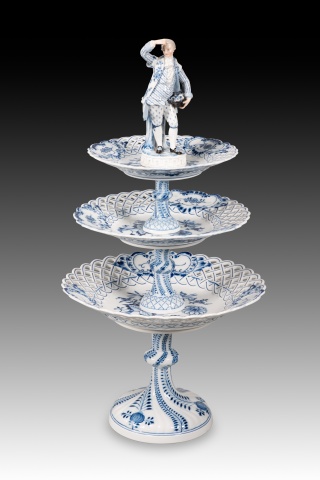
Centerpiece. Glazed porcelain. Meissen, Germany, possibly second half of the 19th century. With marks and numbers on bases. Enameled porcelain centerpiece topped with a male figure dressed in 18th-century European fashion. It features three saucers with openwork edges (the smaller one at the top) arranged on a centerpiece decorated with simple geometric elements and spiraling plant motifs. Incised marks and numbers can be seen on the bases of the saucers and the centerpiece. The blue and white decoration with these particular plant elements is a type known as "blue onion," very characteristic of Meissen porcelain, and inspired by works from China that also frequently used these colors as early as the 17th century. Although onions were not depicted, the stylized elements (peaches, melons, bamboo, etc.) reminded Europeans of this vegetable, hence the name. At the base of the centerpiece, you can see the Meissen mark used between 1815 and 1924. The base of the "larger plate" features engraved numbers and another in blue ink; the next plate shows the mark of the two crossed swords and more engraved numbers; at the base of the smaller plate, the number 17 can be seen in blue ink.
· Size: 28x28x57 cms
ANTIQUES
MISCELLANEUS;CERAMIC
Ref.: ZF1465
-
Pair of urban views. “Venice”. Marianne Lucy Le Poer Trench (England, 1888-1940). Signed in the lower right corner. Pair of paintings depicting urban views of the Italian city of Venice. Marianne Lucy Le Poer was a landscape painter and teacher who studied at the Slade and exhibited regularly from 1920 at the Royal Society of British Artists, the Royal College of Art, the Royal Scottish Academy, the Royal Academy, etc., becoming an Associate Professor of the Royal Society of British Artists in 1926.
· Size: int. 30x35 cms.
ANTIQUES
PAINTINGS
Ref.: Z3730
-
Special Offer! - Off
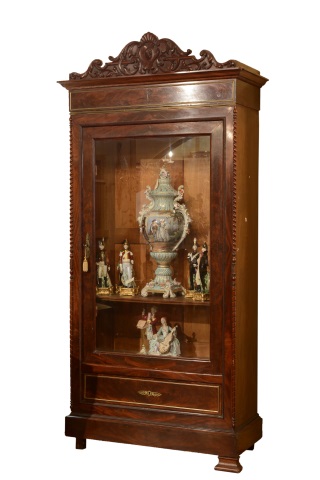
Display case. Mahogany wood. 19th century. A tall display cabinet made of carved mahogany with gilt metal details, featuring a lockable glass door and enhanced with legs and a carved crown adorned with classically inspired vegetal and architectural motifs. Both the decorative motifs and the proportions and lines of the piece clearly demonstrate the influence of French designs.
· Size: 113x48x243 cms.
ANTIQUES
FURNITURE
Ref.: Z5530
-
Chrismera. Silver in its colour. 16th century. Non-original cover. Silver chrismera in its colour with a circular base decorated with an engraved composition of plant elements and a flat circular body with two “S” shaped handles with plant motifs and a small neck at the top covered with a lid topped with a ring (which is not the original piece). The body has engraved, on one side, a cross on a pedestal with a shroud hanging from it, all within an engraved frame; on the other side, with a frame similar to the one mentioned above, appear the letters “ihs” (Christogram of ancient origin, already used in Paleochristianity, which gave rise to varied etymologies and was adopted as a seal by Saint Ignatius of Loyola, founder of the Society of Jesus). Weight: 157 grams.
· Size: 6,5x 10x15 cms.
ANTIQUES
MISCELLANEUS;SILVER
Ref.: Z5977
-
Pastoral box. Carved horn. 1811. With engraved date. Carved horn box with an oval base and a polygonal lid decorated on the outside with a series of carvings. The lid has animals, scrolls and simple geometric elements arranged flanking and facing a crowned heraldic shield; the base has a geometric composition leaving a rectangle in the centre (where the date 1811 has been engraved, which would be the date of creation of the piece); the edges of the base have fine smooth mouldings. The aforementioned shield, very simplified, has five elements in the centre and a border of towers or castles under a closed crown.
· Size: 8,5x5x3 cms.
ANTIQUES
MISCELLANEUS;OTHER OBJECTS
Ref.: ZF0658
-
Safe box. Iron. 19th century. Rectangular safe made of iron, with a rectangular base, two handles on the sides and classical-influenced moulding decorations on the fronts and top. It opens from the top with a door with two hinges, which also has a knob and a lock with a cover to cover it. It is reminiscent of Victorian examples, some of the models made by Cannon, etc. Weight: 43 kg.
· Size: 48x30x33 cms.
ANTIQUES
FURNITURE
Ref.: ZF1265
-
Ceiling lamp or chandelier. Bronze, glass. 20th century. Ceiling chandelier made of gilded bronze and metal that features plant elements of classicist influence, following 19th century models common especially in the French school (influence also present in the shape of the lamp), and transparent glass beads of various shapes and sizes (leaves, tears, flowers, etc.) and colors, a chromatic combination that was not the most common in these old examples.
· Size: 64x64x92 cms.
ANTIQUES
FURNITURE
Ref.: ZF1447
-
Chest of drawers. Lemongrass wood. 19th century. A chest of drawers made of lemongrass wood with a straight, rectangular top and five drawers at the front (two narrow and three long), decorated with simple flat mouldings and spherical legs. This decorative simplicity, which highlights the quality and grain of the lemongrass wood finish, is reminiscent of English examples.
· Size: 103x49x106 cms.
ANTIQUES
FURNITURE
Ref.: Z0312
-
Chest. Walnut wood, iron. Burgos, 17th century. Rectangular chest with a flat lid made of carved walnut wood, with corners and a latch at the front to lock it with a key, and a carved decoration on the bottom with simple geometric elements, and simple lines on the outer edge of the lid. This type of furniture was very common in Spain, frequently used to store objects of a certain value such as clothes, dishes, etc.
· Size: 169x52x73 cms.
ANTIQUES
FURNITURE
Ref.: Z4841
-
Special Offer! - Off
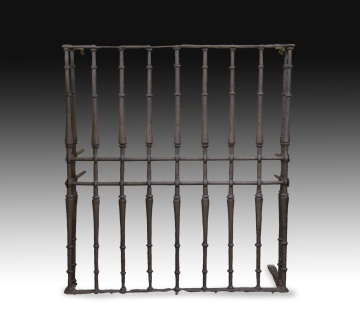
Grille with two gates. Wrought iron. Spain, 17th century. A wrought iron window grille featuring two smooth, circular cross-section rails in the center, inserted between the vertical bars. These rails are decorated with small discs and balustrade-like shapes (adding a subtle sense of movement) between the two rails, with the two pieces facing each other to create harmony. The decorative details mentioned refer to Baroque works of this material from the 17th century: compare, for example, with the balconies of the Casa de Panadería in the Plaza Mayor of Madrid, or with Spanish pieces preserved in the Victoria and Albert Museum in London, a confessional grille in the Metropolitan Museum of New York dated 1629 (inv. 57.137.51) and another in the same museum made by the master Francisco González (inv. 56-234.12Ad).
· Size: 120x38x133 cms.
ANTIQUES
MISCELLANEUS;OTHER OBJECTS
Ref.: Z5602
-
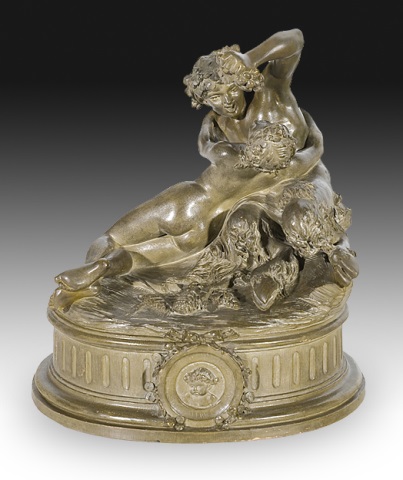
“Satyr”. Patinated terracotta. Following models by CLODION, Claude Michel (France, 1738-1814). Late 19th century-early 20th century. A patinated terracotta sculpture consisting of an oval base decorated with simple architectural elements of classical influence and a tondo with a bust enhanced by a garland and two figures. These, lying on the upper part, are a satyr (with his usual goat-like legs) raising a bunch of grapes, and a young nymph, who embraces him while trying to reach these fruits. Compare this sculpture (not so much the base) with the one entitled “Nymph and Satyr” from the Calouste Gulbenkian Museum in Lisbon (Portugal), related to the sculptor Claude Michel, highlighting the similarities and differences. Pieces similar to the present work, also known as “Satyr Feeding a Nymph Grapes”, are kept in several private collections. Claude Michel “Clodion” (1730-1814) was a French sculptor who trained with Lambert Sigisbert Adam and Jean-Baptiste Pigalle. He was recognised with numerous awards (the Prix de Rome in 1762, etc.) and had an important workshop in Paris from 1771. Although he also produced large-scale works, he is above all known for his small-format sculptural works, made in bronze (or other materials such as corrugated iron or terracotta, for example), and which had a very important influence both during the sculptor's lifetime and long after his death on a large number of works inspired by his creations.
· Size: 38x31x40 cms.
ANTIQUES
SCULPTURE
Ref.: Z5882
-
Special Offer! - Off
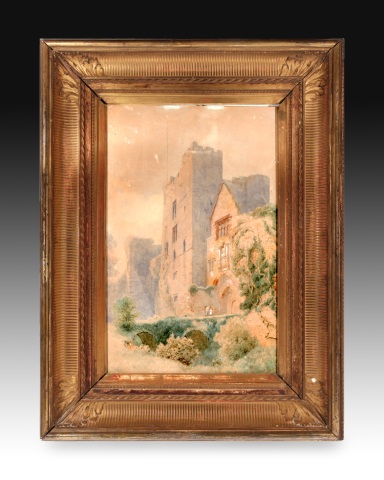
CASWELL, William Frederick (United Kingdom, act. 1870 – 1914). "Landscape". Watercolor on paper. Signed with initials in the lower right corner. . In this work, Caswell offers us an evocative landscape with romantic roots, typical of English landscape painting of the time, worked with a light and translucent chromatism that gives a special luminosity to the scene, enhancing at the same time its mysterious atmosphere. William F. Caswell, a British painter active between 1870 and 1914, worked in landscape and portraiture using oil and watercolor, and also produced series of prints such as "Le Barnabooth et autres bêtes modernes." He was a member of the Royal Birmingham Society of Artists, where he exhibited his works regularly.
· Size: 78x103 int 49x71 cms
ANTIQUES
PAINTINGS
Ref.: Z6194
-
Box in enamelled porcelain and engraved glass. 19th century. Oval box with a base made of etched glass and a hinged lid, the latter made by combining enamel and metal. The lower part presents a bucolic landscape, with a series of human figures and buildings in it, combining trees with lakes and solid ground. The scene on the upper part responds to the same typology: a couple in an idealized rural landscape.
· Size: 7,5x6x4,5 cms.
ANTIQUES
MISCELLANEUS;OTHER OBJECTS
Ref.: Z6447
-
Toiletry bag. 19th century. Tortoiseshell, metal, glass. Rectangular case with a hinged lid made of tortoiseshell decorated with fine inlaid plant and floral elements on its sides, containing a toiletry bag set composed of various feminine toiletries and personal items (a small perfume bottle, scissors, a thimble, etc.), with a space designed for each of these utensils.
· Size: 6x3x8 cms.
ANTIQUES
MISCELLANEUS;OTHER OBJECTS
Ref.: Z6854
-
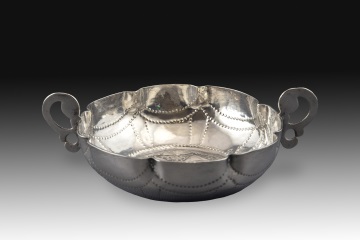
Catavinos or quaking glass. Silver. 18th century. Without contrast marks. Vessel known as catavinos or tembladera with two flat, closed “S” shaped handles and a line of “bites” (gallon-shaped shapes) highlighted by bands of dots that move to the inside of the piece. The bottom has a star shape (leaving smooth and with a shiny finish some stripes forming a Maltese Cross, and combining in the rest areas in the same finish with others in diamond-shaped lustre with dots). The bernegales and tembladeras with mortise-shaped pieces were frequent pieces in Spanish silverwork in the 17th century, usually being relegated to centres of somewhat less importance in the 18th century. Compare this with pieces such as the silver bernegal from the last third of the 17th century in the Lázaro Galdiano Museum (perhaps from the Portuguese school; inventory 3916), or the one dated between 1640 and 1665 from the same museum (inventory 3910), or the one by José Jiménez de Illescas (inventory 3915, dated 1715-1725) in the same institution. Weight: 83 gr.
· Size: 14,5x11x3 cms.
ANTIQUES
MISCELLANEUS;SILVER
Ref.: ZE192
-
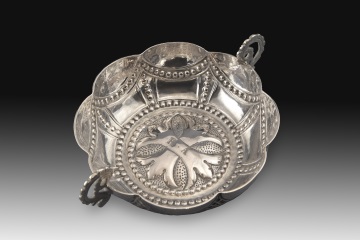
Catavinos or quaking glass. Silver. 18th century. Without hallmarks. With ownership initials. Vessel known as a catavinos or tembladera with two curved flat handles decorated with simplified plant elements, and a line of morsels (gallon-shaped shapes) on the edge enhanced by bands of sunken dots that remain in relief on the inside of the piece, where they extend and frame the decoration on the bottom. In this area there is a florentine Greek cross in a smooth shiny finish with the letters “RA” engraved (initials of the property), highlighted on a dotted background. The bernegales and tembladeras with mortise-shaped pieces were frequent pieces in Spanish silverwork in the 17th century, usually being relegated to centres of somewhat less importance in the 18th century. Compare this with pieces such as the silver bernegal from the last third of the 17th century in the Lázaro Galdiano Museum (perhaps from the Portuguese school; inventory 3916), or the one dated between 1640 and 1665 from the same museum (inventory 3910), or the one by José Jiménez de Illescas (inventory 3915, dated 1715-1725) in the same institution. Weight: 94 gr.
· Size: 13,5x10,5x4,5 cms
ANTIQUES
MISCELLANEUS;SILVER
Ref.: ZE193
-
Catavinos or quaking glass. Silver. 17th century. Without contrast marks. Vessel known as a catavinos or tembladera with two flat, closed “S”-shaped handles (with simplified plant decoration) and a line of “bites” (gallon-shaped shapes) highlighted with bands of dots. On the bottom, inside, there is an eight-petaled flower engraved with a cross inside. The bernegales and tembladeras with mortise-shaped pieces were frequent pieces in Spanish silverwork in the 17th century, usually being relegated to centres of somewhat less importance in the 18th century. Compare this with pieces such as the silver bernegal from the last third of the 17th century in the Lázaro Galdiano Museum (perhaps from the Portuguese school; inventory 3916), or the one dated between 1640 and 1665 from the same museum (inventory 3910), or the one by José Jiménez de Illescas (inventory 3915, dated 1715-1725) in the same institution. Weight: 96 gr.
· Size: 15x10,5x4,5 cms.
ANTIQUES
MISCELLANEUS;SILVER
Ref.: ZE195
-
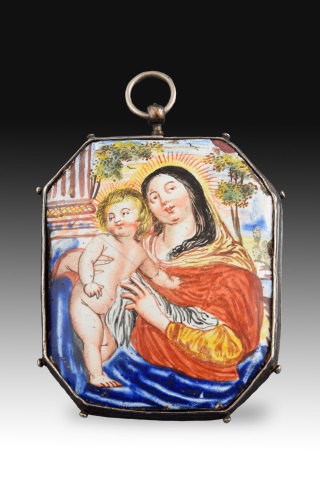
Reliquary pendant. Silver, enamel, textile. 17th century. A large polygonal pendant with a silver frame in its colour decorated with small pearls of the same material located in the corners of the edge, which has a ring at the top so that it can be hung or carried. One of its fronts has a textile background under a sheet of transparent glass, probably designed to contain relics. The other has a brightly coloured enamel showing the Virgin Mary in three-quarters, with the naked Child Jesus in her arms and both figures cut out against a landscape background with classicist architectural elements (a column with a fluted shaft on a pedestal, with mouldings) and details of a natural landscape (thus linking the moment with the Rest on the Flight into Egypt; compare, also, with works such as the Virgin and Child by Anton van Dyck from the Cerralbo Museum in Madrid or the oil painting from The Walters Art Museum, or the engraving by Paulus Pontius following Van Dyck's models - where the elements coincide in arrangement with those of the medallion -, for example). This type of jewellery has always had great value, both for the materials used and for its religious content. Despite this (or perhaps because of this same appreciation) there are not many examples of quality and in good condition, and it is possible to find them only in important private collections and in outstanding museums such as the Fundación Valencia de Don Juan in Madrid, the Museo Nacional de Artes Decorativas in the same city, etc., or old religious centres such as the Convent of the Descalzas Reales in Madrid.
· Size: 6,5x0.5x8 cms.
ANTIQUES
MISCELLANEUS;JEWELRY
Ref.: ZF0399