-
Axe. Wrought iron. 20th century. Tall wrought iron torch holder with a tripod base formed by scrolls and a triangular piece from which the axis emerges (with a balustrade profile with discs). This ends in a plate from which an openwork piece starts that would hold the candle. The scrolls, the lines of the axis, simplified plant details, etc. show a clear influence of ancient works, especially from the Baroque of the 17th century. This inspiration is frequent within the framework of Historicisms.
· Size: 38x38x133 cms
ANTIQUES
MISCELLANEUS;OTHER OBJECTS
Ref.: ZF0310
-
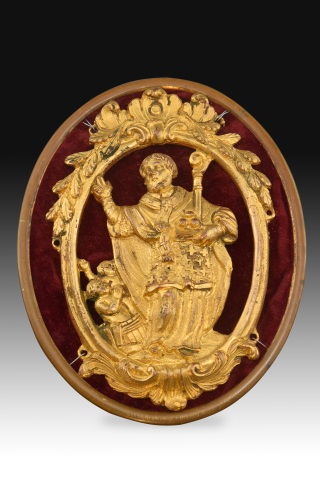
Devotional medal of Saint Nicholas on a support. Gilt bronze, textile, metal. 18th century. Devotional medal in gilded bronze placed on a support with wires that presents an oval frame enhanced with a crest with vegetal elements in a symmetrical composition and another top below also with vegetal elements and scrolls, and the figure of a saint inside this smooth frame. Standing, holding a staff in one hand and raising the other in a gesture of blessing, is a male figure dressed in liturgical attire, accompanied by some small figures praying, placed in a barrel or bucket. Saint Nicholas of Myra or Bari was a bishop who died around the middle of the 4th century AD. One of his most famous miracles was that of resurrecting three children (shown in this work) sacrificed by an innkeeper to feed his clients. Although he was bishop of the city of Myra, he is shown here wearing liturgical vestments but without the usual headdress (mitre). The three spheres that appear on the book would allude to the miracle in which the saint helps the father of three girls to gather a dowry for them (as they are three golden spheres).
· Size: 9x11,5x1 cms.
ANTIQUES
SCULPTURE
Ref.: ZF0460
-
Jug and glass. Glass. Royal Glass Factory of La Granja de San Ildefonso, Segovia, Spain, 18th century. Jug or vase with lid and glass with a small spout made of clear, carved and engraved glass, decorated with plant elements and architectural motifs of classical influence. They were made in the Royal Glass Factory of La Granja de San Ildefonso, founded in 1727 by Buenaventura Sit and, initially, as a furnace for flat glass to supply the nearby Royal Palace. Shortly after, they would diversify their production, becoming one of the main centres in Spain.
· Size: Jarra 10x10x33 cms. Vaso 13x13x15 cms
ANTIQUES
MISCELLANEUS;OTHER OBJECTS
Ref.: ZF0878
-
Sold
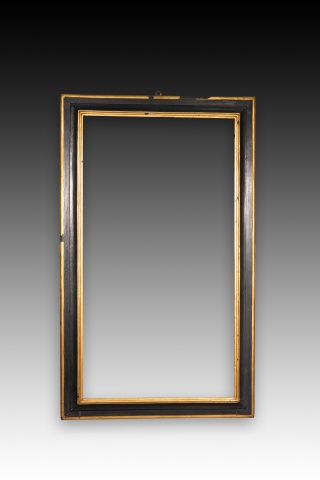
Frame. Carved, polychrome, and gilded wood. 18th century. It has faults. Rectangular frame made of carved wood with a black area flanked by two gilded areas on the outside and inside of the piece, with a flat area in both colors and a different one, again in both finishes. Stylistically, it recalls examples common in numerous European schools since the Renaissance.
· Size: 85x6x140 cms. Int 68x123,5 cms
ANTIQUES
MISCELLANEUS;FRAMES
Ref.: ZF1338
-
Niche. Carved and polychrome wood. Possibly Spanish school, 18th century. A table niche made of carved, polychrome, and gilded wood. It features a front door with a key lock and gilt wood elements in this area, as well as a finial at the top and two side doors with a view into the interior. Plant elements appear in the corners of these openings. Stylistically, slight Rococo influences can be seen alongside a strong Baroque tradition.
· Size: 55,5x38x74 cms, int: 42x30x65 cms.
ANTIQUES
FURNITURE
Ref.: ZF1363
-
Horse. Patinated metal. 19th century. Figure of a walking horse with a bronze base and a patinated iron animal. It shows a strong influence from the animal figures common in the 19th-century French school, such as the care taken in the composition, the search for naturalism, etc. It is particularly reminiscent of models by Pierre-Jules Mène (Paris, 1810-1879), a French sculptor specializing in domestic animals, whose work is held in important private collections and institutions such as the Louvre Museum. Weight: 11 kg.
· Size: 4013x30 cms.
ANTIQUES
SCULPTURE
Ref.: ZF1461
-
Espagnolette. Wrought iron. 18th century. An iron element made up of several pieces firmly joined together, with simple decoration based on rings and other details, used to close a door or window. This type of piece was very common in the construction of important residences. Available 1 unit
· Size: 30x13x250 cms.
ANTIQUES
MISCELLANEUS;OTHER OBJECTS
Ref.: Z3485E
-
Pair of andirons. Blued and gilded bronze, iron. 19th century. Fireplace andirons decorated with vine leaves and bunches of grapes on the side pieces and in the centre of the horizontal part, working the metal to also remind us of the plant. These three elements or areas are visually united by an openwork piece, decorated in a simpler way with motifs inspired by Neoclassicism.
· Size: 36x45x45 cms.
ANTIQUES
MISCELLANEUS;OTHER OBJECTS
Ref.: ZF0126
-
Candlestick. Bronze. 17th-18th centuries. Candlestick made of bronze with a circular base and an axis combining discs, balustrade shapes, smooth areas, concave and convex mouldings of different widths, etc., creating a very lively profile common in this type of pieces since the Baroque in various European schools and reminiscent in some details of the so-called spool candlesticks. Weight: 520 gr.
· Size: 21x21x55 cms.
ANTIQUES
MISCELLANEUS;OTHER OBJECTS
Ref.: ZF0491
-
Frame. Carved and gilded wood. 18th century. Rectangular frame with a semicircular top in the centre, crowned by a composition with leaves and elements of the Passion of Christ (Crown of Thorns, Nails, etc.) decorated with a series of bands, alternating plain ones with two different strings of pearls. Although the 18th century is known for Rococo, it is not the only artistic style of the period: the decoration and shapes of the frame show a closer relationship with ancient Roman art, a common influence in Neoclassicism.
· Size: 44x8x81 cms
ANTIQUES
MISCELLANEUS;FRAMES
Ref.: ZF0527
-
Sword. Metal, leather. Royal Factory of Toledo, towards the end of the 19th-20th century Small sword with a garnish bearing the emblem of the Infantry and the simplified coat of arms of Spain on the other side, cap with the monogram of King Alfonso XIII and wire-wrapped hilt, featuring a Toledo blade (inscription “Fca de Toledo”) and a scabbard combining leather and metal, slightly curved. Compare with the small sword for Infantry Officers, model 1901.
· Size: 12x2x97 cms.
ANTIQUES
MISCELLANEUS;OTHER OBJECTS
Ref.: ZF0575
-
Oval case. Silver. 19th century. With contrast marks. Oval box with flat lid made of silver, partially gilded, decorated on the outside with framed figurative scenes and landscapes and geometric motifs arranged in bands and architectural and plant motifs. The Rococo influence can be seen, for example, in the frames chosen for the landscapes on the body of the piece and in the figurative scene on the lid. Weight: 96 grams. Hallmarks are on the inside.
· Size: 6x4,3x2,2 cms.
ANTIQUES
MISCELLANEUS;SILVER
Ref.: ZF0690
-
Pair of stirrups. Carved wood, iron. Chile, 18th century. Pair of stirrups made up of a block of carved wood, in the shape of a half moon at the front, and decorated on the outside with geometric and vegetal elements, and an iron surround. Since metal was reserved for other uses during the 18th century, wood began to be used more frequently to make stirrups in Chile. The shape of the present pair, which follows a common typology of the time, seems to have been derived from Asturian pieces, preferred over metal stirrups to protect from water, branches, etc., and the artisanal development carried out mainly by the Jesuits in the area was what led to this type of carving and decoration, which survives to this day.
· Size: 16x20x17 cms.
ANTIQUES
MISCELLANEUS;OTHER OBJECTS
Ref.: ZF0933
-
Sold
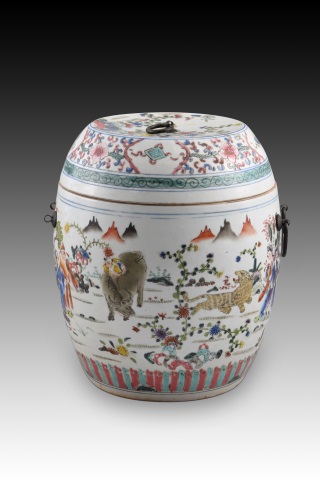
Oriental barrel-shaped vessel. Porcelain, metal. China, 20th century. With marks on the base (apocryphal, Xangxi). A barrel-shaped vessel with a flat lid, made of white-ground porcelain and decorated with a polychrome figurative composition based on plant motifs and scrolls on the lid, and upper-class figures set in a garden with pavilions, a large censer, a tiger and other animals, etc., on the body, on a frieze of repeated elements and under a double blue line at the top (this last detail also separates the stripes on the lid). Morphologically, it is reminiscent of the Chinese porcelain seats often used in gardens, but note that it has a lid with a metal washer and handles of the same material, elements that are not found on the known seating pieces. Next to these courtiers in the pavilion is a male figure on a water buffalo (a frequent motif in Chinese art, associated with either wise men or peasants or shepherds). The marks on the base, located within a double circular line, resemble those used on Chinese porcelain made during the Kangxi Empire (1662-1722), but are considered apocryphal.
· Size: 25x25x30 cms.
ANTIQUES
MISCELLANEUS;CERAMIC
Ref.: ZF1082
-
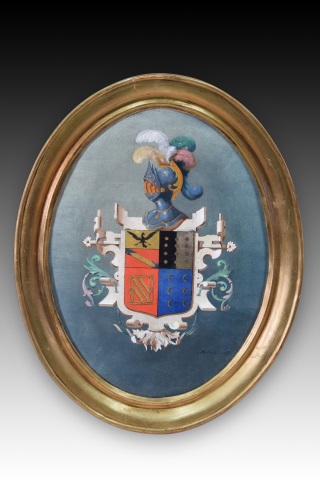
Heraldic shield. Oil on canvas. TORRES, A. Spanish School, 1856. Signed and dated. This work shows a heraldic shield on a blue background with different shades, on an oval framed support. The central (and only) element of the composition consists of a crest with a helmet with gold bars and four feathers, and a quartered shield. Towards the lower right area, there is a signature (A. Torres) and a date (1856). First quarter, cut, with a bird (possibly a sable eagle) with wings displayed and spread over gold, and, below, in green, a gold band crossed between the mouths of two azure serpents (recalling the well-known “band of Castile”), on gules. In the second quarter, twelve eight-pointed gold stars in three columns, on a divided field in sable and silver. In the third, on gules, gold chains around three crossed gold bands. In the fourth, six gold crescents on azure. Around both elements, and joining them, there is a symmetrical composition of architectural elements, plants and scrolls, with a clear classicist influence and with some reminiscence of works from the Spanish Renaissance.
· Size: 46x4,5x58 cms. int: 36x47 cms.
ANTIQUES
PAINTINGS
Ref.: ZF1118
-
Spice rack in glazed ceramic. Talavera de la Reina, 18th century. A three-cup spice rack in the shape of an equilateral triangle, made of ceramic and decorated with high-temperature enamels typical of Talavera polychromy: manganese black for the edges and antimony oranges and yellows, copper green and cobalt blue. It is a classic-style piece, with clean lines that delimit the different parts of the structure, well-organised decoration and synthetic motifs that refer to the Greco-Latin ornamental repertoire, such as the palmette and the acanthus leaf.
· Size: 16x14x4,5 cms.
ANTIQUES
MISCELLANEUS;CERAMIC
Ref.: ZF1255
-
Hunters, pair of panels. Porcelain. Possibly Germany, 19th century. Pair of wall plaques with metal pieces to hang on the top and a polychrome figurative decoration on the front, in relief. One shows a horseman dressed in furs, accompanied by a fox (probably), and the other shows a woman, also on horseback, hunting a feline (possibly a tiger). Their style is reminiscent of porcelain pieces made in Meissen in the 19th century.
· Size: 31x31x6 cms
ANTIQUES
MISCELLANEUS;CERAMIC
Ref.: ZF1387
-
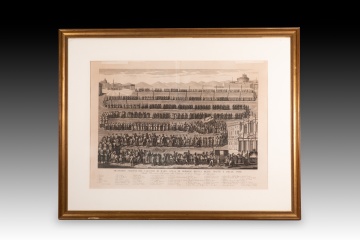
“Sollene transportation of the corpse of Maria Luisa di Borbone (…)”. Framed engraving. Rome, Italy, [Sl : sn, 1819]. Framed engraving titled below the image as “TRASPORTO SOLENNE DEL CADAVERE DI MARIA LUISA DI BORBONE REGINA DELLE SPAGNE E DELLE INDIE / Dalla Basilica Liberiana alla Vaticana il di 10 Jannajo del MDCCCXIX” which also presents the names of those responsible for it. “Gio. Petrini incise” appears on the right (Giovanni Petrini was an Italian engraver who worked in Rome and Paris, prospering between 1810 and 1812) and “Filip. Ferrari inventó, i disegnó” can be seen towards the left (Filippo Ferrari is dated between 1819 and 1897). It represents the funeral procession held on the occasion of the transfer of the body of the deceased Maria Luisa of Parma, wife of Charles IV, in Rome, from the Basilica of Santa Maria Maggiore to the Basilica of St. Peter, also detailing the Roman confraternities, religious orders and high officials who attended (legend under the image).
· Size: 101x2,5x80 cms. int: 53,5x74,5 cms.
ANTIQUES
MISCELLANEUS;GRAPHIC WORK
Ref.: ZF1471
-
Sold
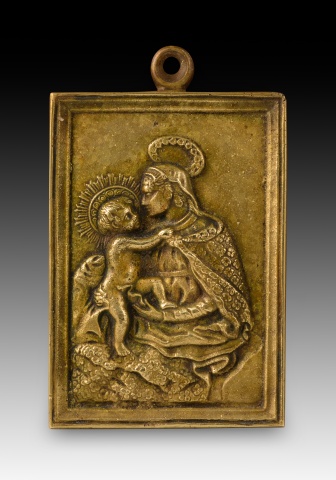
Devotional plaque, Virgin and Child. Bronze. Spanish school, 17th century. Rectangular devotional plaque, made of bronze, featuring a ring at the top, a molded frame, and a figurative relief on the front. It depicts the Virgin Mary with the Christ Child in her arms, reminiscent of one held in the British Museum in London (inventory 1915,1216,216), attributed to the circle of Sansorino (perhaps a typo; they mean Sansovino) and considered a 16th-century Venetian work. Weight: 166 grams.
· Size: 7 x 0,5 x 11,2 cm.
ANTIQUES
MISCELLANEUS;OTHER OBJECTS
Ref.: ZF1416D
-
Advertising poster, Magin Rubio Factory. Paper or cardboard. Spain, possibly around 1900. The Magin Rubio Chocolate and Mantecados Factory was located in a modernist mansion built by Eduardo Sánchez Eznarriaga at the beginning of the 20th century to house both production and the home of the company's founder, Magín Rubio González. It currently houses the Astorga Chocolate Museum.
· Size: 22,5x0,1x34,5 cms
ANTIQUES
MISCELLANEUS;GRAPHIC WORK
Ref.: ZF135437
-
Monk's armchair. Leather, walnut wood. Spain, 16th century. It has faults. Armchair with arms and high backrest of the type known as “friar's chair”, which has leather with studs on the upper part of the backrest (lack of the seat), low, low-profile trimmed jambs joining the front and back legs and middle jambs or side rails (the front one carved and re-cut to create geometric motifs) joining the two front and two back legs, and simple armrests with raised scrollwork finishes. The friar's chair, originally of Italian origin, became one of the most common pieces of Spanish furniture since its introduction in the 16th century, being characteristic of both the 17th and 18th centuries and being recovered again in the historicist movement of the 19th century. Being such a deep-rooted tradition in Spain, this type of model was never stopped being created.
· Size: 68x53x102 cms.
ANTIQUES
FURNITURE
Ref.: Z0750
-
Mortar and pestle. Bronze. 17th century. Mortar with a circular base, cylindrical body and mouth slightly flared outwards, decorated with a series of smooth horizontal mouldings arranged both at the bottom and at the top and with some simple vertical elements (which still maintain slight balustrade shapes) derived from the ribs that these specimens used to have in the medieval Spanish school.
· Size: 13x13x8,5 cms
ANTIQUES
MISCELLANEUS;MORTARS
Ref.: ZF0966
-
Poseidon or Neptune with a hippocampus. Enameled porcelain. Europe, 19th century. A glazed porcelain figurine with a circular base, decorated with openwork elements and Rococo-inspired motifs enhanced with touches of gold, depicting a bearded, half-naked male figure, standing, in a purple and white cloak, accompanied by a half-horse, half-fish monster. The character is the classical god Poseidon or Neptune, and the creature is known as a hippocampus. This type of work was common in several prominent porcelain factories throughout the 19th century, especially Meissen, but also Chelsea (whose brand name is an anchor) or Samson, for example.
· Size: 6x7x15 cms.
ANTIQUES
MISCELLANEUS;CERAMIC
Ref.: ZF0995
-
Baluster vase. Porcelain. Taisho period, Japan, 1912-1926. With marks on the base. Baluster vase (due to its shape) made of brown glazed Hirado porcelain with iron oxide varnish and two sceptre-shaped handles on top. Hirado is a type of porcelain made mainly in Mikawachi, Sasebo and Nagasaki, in the former feudal territory of Hirado, owner of the kilns and responsible for production. The Taisho period was that under the government of the emperor of the same name, and lasted from July 30, 1912 to December 25, 1926.
· Size: 15x15x27 cms.
ANTIQUES
MISCELLANEUS;CERAMIC
Ref.: ZF1109