-
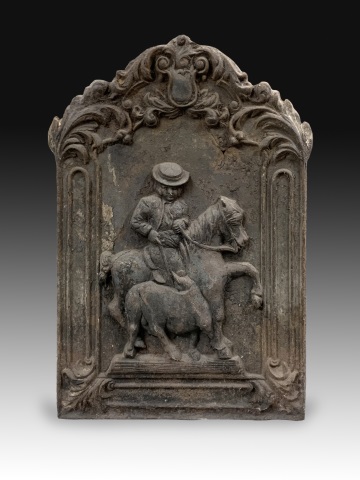
Fireplace plate with chimney pot. Cast iron. Spain, early 20th century. A rectangular cast iron fireplace surround decorated with reliefs on the front. The upper section features a composition of leaves flanking a plain shield, extending along the sides and lower section with a series of lines and more leaves of classical influence at the corners. The front depicts a figurative bullfighting scene, with a picador (or lancer) spearing a bull, which charges the horse he is riding. This type of piece was already used in the Gothic period, and outstanding examples survive, such as the one bearing the Imperial coat of arms of Charles V (dated 16th century; Lázaro Galdiano Museum, Madrid). While heraldry is considered by some experts to be the most unusual decoration on these objects, pieces with mythological or pastoral scenes, architectural elements, religious motifs, and other motifs have also come down to us. This particular piece, in addition to its interesting decoration and historical value in the study of bullfighting, is noteworthy for the quality and depth of its reliefs.
· Size: 53x74x2,5 cms.
DECORATIVE ANTIQUES
Ref.: Z3402
-
Centerpiece. Glazed ceramic. Possibly Lunéville (France), 19th century. With markings on the base. A centerpiece with a circular base and oval body, decorated inside with small bouquets of flowers and outside with an elaborate composition of architectural and plant elements enhanced with touches of color and gold, its movement and curves reminiscent of 18th-century Rococo works. The “Luneville Faience” factory has been one of the leading French ceramic manufacturers since its founding in Lunéville (Lorraine, France) in 1730.
· Size: 36x36x18 cms
DECORATIVE ANTIQUES
Ref.: Z5039
-
Medal. Silver gilt. Spain, 18th century. A devotional medal made of silver gilt depicting the Virgin Mary on a pedestal, surrounded by a radiant, trilobed halo. Towards the bottom, winged angel heads are visible, and the reverse of the medal is decorated in the area of the image. Compare with medals of Our Lady of the Tabernacle of Toledo, Our Lady of the Angels of Getafe, etc. Weight: 40 grams.
· Size: 4,5x0.5x7 cms.
DECORATIVE ANTIQUES
Ref.: Z5233
-
Collection of engravings. “Goya’s Bullfighting”. Special edition directed by Antonio de Horna. 1815-1983. Madrid, Culture and Art Collection, De Horna Publishers. 39 plates. Antonio de Horna directed this compilation of the series of engravings from Francisco de Goya's (1746-1828) *La Tauromaquia*, composed of 39 engravings and first published in 1816, along with eleven other prints considered "unpublished" because they did not appear in that first edition. It seems he intended to illustrate passages from Nicolás Fernández de Moratín's 1777 work, *Carta histórica sobre el origen y progreso de las corridas de toros en España* (Historical Letter on the Origin and Progress of Bullfighting in Spain), to which he added personal recollections and some famous bullfighting incidents from the painter's time.
· Size: 49,2 x 34,5 x 5 cm.
DECORATIVE ANTIQUES
Ref.: Z4179B
-
Wall telephone from Kjøbenhavns Telefon Aktieselskab (KTAS). Scandinavia, late 19th century - early 20th century. Wall-mounted telephone from the company Kjøbenhavns Telefon (later known as Kjøbenhavns Telefon Aktieselskab or KTAS) with rear features, including a cover for the dial wheel and space for a telephone directory or similar item beneath the device. An earlier company was founded in Copenhagen in 1881 (Kjøbenhavns By-og Hustelegraf, which began in 1879); the Danish branch of the American International Bell Telephone Co. was established in 1880 and is considered the precursor to KTAS, registered in 1884 (two years after beginning operations in 1882; this company acquired the other two mentioned).
· Size: 31x24x76 cms.
DECORATIVE ANTIQUES
MISCELLANEUS
Ref.: ZF0115
-
"
· Size: 100x40x75 cms.
DECORATIVE ANTIQUES
Ref.: Z0281
-
Incense burner. Bronze. 19th century. A bronze censer with a circular base and a cup-shaped lid featuring elaborate lines and simple openwork elements, inspired by antique pieces. It includes metal chains that connect it to the standard ring-shaped holder. Certain lines and decorative motifs are reminiscent of some Spanish works from the 17th and 18th centuries.
· Size: 10x10x16 cms.
DECORATIVE ANTIQUES
Ref.: Z0351
-
Fifteen balusters. Bronze and wood. 18th century. Grouped in sets of seven, the bronze balusters are set between two straight painted wooden crossbars, thus highlighting the curved lines, discs, and other forms of the aforementioned elements. These types of pieces were very common in Neoclassicism (as well as in other periods) for decorating railings, staircases, and so on.
· Size: 200x5x54 cms.
DECORATIVE ANTIQUES
Ref.: Z0404
-
Box with metal marquetry. Wood, metal. Possibly French school, 19th century. It shows damage. It requires restoration. A rectangular casket with a flat lid features a dark wood interior decorated with two metal lines on the lid, and a black exterior with carved decorations (one molding towards the base and another at the top) and metal marquetry inlays. The marquetry is concentrated around the lock opening and the top of the lid (a composition of polychrome vegetal and architectural elements, centered and connected by lines). Both the style of decoration and the colors used are reminiscent of Napoleon III pieces from the French school.
· Size: 38x27x14 cms.
DECORATIVE ANTIQUES
MISCELLANEUS
Ref.: Z0503
-
Pair of cupboard doors with latches. Walnut wood, iron. 18th century. A pair of carved walnut wood doors decorated with panels flanked by flat areas, featuring a wrought iron latch and lock with key (whose shield displays curved lines clearly reminiscent of the Baroque style) and parts of the hinges that would have joined it to the cupboard for which they were created. Both the wood and the decoration (on the doors and the latch) show influences of Baroque models, as was common in certain Spanish centers of the 18th century.
· Size: 50x103 / ud
DECORATIVE ANTIQUES
Ref.: Z0532
-
Eight-armed chandelier in gilded metal. 20th century. Attached to the ceiling by a chain, the eight arms of the lamp, S-shaped and adorned with vegetal motifs towards the center and at the ends, emerge from a central baluster topped at the bottom by a polygonal piece. While the form and material recall Northern European Renaissance examples, the shapes and decoration show a greater influence from highly simplified classical examples.
· Size: 85x85x100 cms.
DECORATIVE ANTIQUES
Ref.: Z1658
-
Wall clock. Case made of walnut wood, wood, etc. 19th century. Wall clock with a carved walnut wood case decorated with classically influenced architectural elements, combining wood tones. The white dial features Roman numerals for the hours and lines for the minutes; the pendulum has a decoration of thin stems on either side of an arrow and two letters (RA), and a plate on the white case to measure its oscillation.
· Size: 34x80 cms.
DECORATIVE ANTIQUES
Ref.: Z2292
-
Centerpiece. Porcelain. Roger's, Portugal, 20th century. With markings on the base. A centerpiece made of glazed porcelain, decorated with a floral arrangement on the front, a base with classical architectural motifs and gilded elements, and a rim at the top with undulations, recesses, and gilded highlights, further enhanced by two elongated shapes or figures on the sides reminiscent of cathedral gargoyles. The base bears the mark of Roger's, a Portuguese firm active in the 20th century, known for pieces reminiscent of 19th-century European porcelain. Weight: 7.1 kg.
· Size: 35x55x47 cms.
DECORATIVE ANTIQUES
MISCELLANEUS
Ref.: Z2763
-
Snuffbox. Ebony, ivory. Possibly Germany, early 19th century. Circular box with a flat lid made of ebony and ivory, decorated on the outside with a carving of geometric elements arranged around a central ivory circle (with an engraving that includes the inscription "Gott ist mein Schultz" –God is my protection– on a belt surrounding three letters –perhaps the owner's initials– and under a unicorn bust). On the back, a similar composition has been carved, but without a central ivory piece.
· Size: 9x9x2 cms.
DECORATIVE ANTIQUES
Ref.: Z3816
-
Branded. Copper, iron. Marked MS. 17th century. Globular-shaped container with a tall copper neck and an iron handle that has, towards the top, remains of an engraved legend.
· Size: 33x35 cms.
DECORATIVE ANTIQUES
Ref.: Z5366
-
Hyssop. Bronze. 18th century. A bronze swab consisting of the usual circular part, followed by a shaft decorated with moldings, which separate a tubular section from a baluster-shaped one. This combination of lines is common in works of classical inspiration.
· Size: 5x5x27 cms
DECORATIVE ANTIQUES
MISCELLANEUS
Ref.: Z5487
-
Pair of andirons. Wrought iron. 18th century. A pair of wrought iron andirons decorated with fine lines and smooth moldings on the vertical rods and volutes on the flat metal serving as legs beneath them. Although these are utilitarian pieces with a similar form dating back to antiquity, these examples show a marked influence of 18th-century Neoclassicism, to which they belong.
· Size: 76x66 cms,.
DECORATIVE ANTIQUES
Ref.: Z5606
-
Necklace with clear quartz beads. A necklace made from a series of faceted clear quartz discs. Clear quartz is also called rock crystal, and it is a nearly colorless variety of quartz, used since antiquity in decorative arts and often in jewelry as a gemstone.
· Size: 24x3 cms.
DECORATIVE ANTIQUES
Ref.: Z5804
-
Necklace with jasper plates. A black cord necklace has been used to position and join the rectangular jasper plaques that form the necklace, which are wider at one end than the other. Jasper, used for jewelry and other decorative arts since antiquity, is a stone with a variety of colors, valued for its ornamental qualities and as a precious stone.
· Size: 22x5 cms.
DECORATIVE ANTIQUES
Ref.: Z5805
-
Necklace with Mexican agate plaques. A necklace made with cords in different shades, which help to position and highlight the beads that compose it: flat circular discs alternate with dark spherical beads, emphasizing the lines of the former; at the front is a triangular piece, in which white and transparent areas alternate with red, yellow, white, etc. zones. Agate has been a common stone throughout history for the properties attributed to it (Egyptian agate was effective against the bites of certain animals, the stone in general brought longevity in other cultures, etc.) and for its striking appearance (often used in both sculptures and Egyptian mummies for the eyes, carved to create remarkable pieces such as the Chalice of Valencia or the cameos of Ancient Rome, etc.).
· Size: 22x7 cms.
DECORATIVE ANTIQUES
Ref.: Z5806
-
Spinning wheel. Carved and turned walnut wood. 19th century. Vertical spinning wheel made of carved walnut wood, decorated with fine lines in certain areas and the use of baluster-shaped pieces where deemed necessary. Compare, for example, with the vertical spinning wheel preserved in the El Greco Museum in Toledo, dating from the 19th century.
· Size: 44x41x86 cms.
DECORATIVE ANTIQUES
Ref.: Z5583A
-
Spinning wheel. Carved and turned walnut wood. 19th century. A vertical spinning wheel carved from walnut, decorated with fine lines in certain areas, and the use of baluster-shaped pieces, some decorated with discs and moldings, where all were deemed necessary. Compare, for example, with the vertical spinning wheel preserved in the El Greco Museum in Toledo, dating from the 19th century.
· Size: 43x46x60 cms
DECORATIVE ANTIQUES
Ref.: Z5583B
-
Silver mesh bag, 19th century. A silver mesh handbag, decorated with triangular elements at the bottom, featuring a smooth hinged closure and a chain with alternating long and short links. This type of bag was very common in the 19th century, both as a luxury item and a practical accessory for galas and other special events. Weight: 200 gr
· Size: 16x15 cms.
DECORATIVE ANTIQUES
Ref.: Z6876D
-
Column base. Stone. 17th century. They are missing Column bases made of carved stone, each consisting of a square section with smooth moldings (plinth), a torus or molding, and a smooth cap. Stylistically, they are reminiscent of models derived from classical Roman art, a common feature in both Renaissance and Baroque art. Unit price.
· Size: 56x56x27 cms.
DECORATIVE ANTIQUES
MISCELLANEUS
Ref.: ZF0854